One of the things that all people do during the holidays, besides real shopping, is window shopping. Storefront window displays therefore have a stronger significance during the holiday season. Keeping that in mind, eBay has developed a way to make this experience move from passive to interactive and engaging.
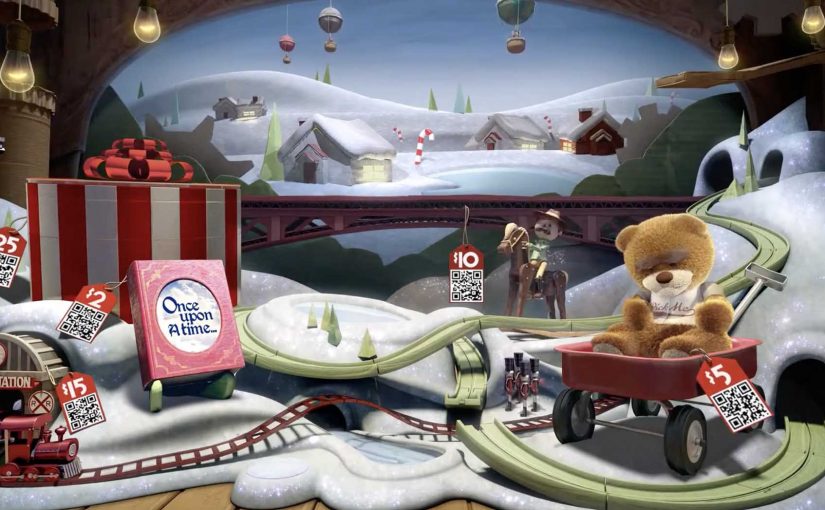
Give-A-Toy Store is a 3D Christmas window installation with QR code tagged toys, built to evoke the passer-by’s giving side. Scanning the QR codes inside the eBay app allows passers-by to donate that toy on the spot, with the window lighting up and rewarding them for the donation.
The window installation is currently available at Toys for Tots in New York (at 35th and Broadway) and San Francisco (at 117 Post St).
Additionally customers can also customize their own toys on eBay’s Facebook page. For each toy created, eBay will donate $1 (up to $50,000).
From window shopping to “giving on the sidewalk”
This is a simple flip. The window is no longer just display media. It becomes a donation interface. You look, you scan, you give. Then you get instant feedback in the physical world.
How the mechanism does the heavy lifting
The mechanic is intentionally friction-light. Toys are visually presented as scannable choices. The QR tag is the call-to-action. The eBay app is the checkout. The window lighting up is the reward loop, confirming that something happened and making the act feel social even if you are alone.
In high-traffic retail corridors, a good interactive storefront turns waiting and wandering into measurable intent, without asking people to step inside.
Why it lands in a holiday crowd
It works because it respects the window-shopping mindset. People are already browsing. They are already comparing. This just adds a small, clear next step that feels aligned with the season. The visual “thank you” in the window also matters. It makes the donation feel immediate and real, not abstract and back-end.
Extractable takeaway: If you can make the environment visibly react to a mobile action, you create trust and momentum. The moment becomes self-explanatory, and bystanders learn the behavior just by watching.
What the brand is really building
The real question is whether a holiday storefront can turn passing attention into a mobile action that feels immediate enough to complete on the sidewalk.
This is not only about donations. It is a product demo for mobile commerce in disguise. It shows that scanning can be a legitimate buying action, that the phone can complete a transaction in seconds, and that the brand can connect physical retail ritual with digital conversion.
What this teaches about interactive storefronts
- Make the first action obvious. If scanning is the behavior, the codes must look like the product tag.
- Design a physical confirmation. Light, motion, or animation reduces doubt and makes the act feel rewarding.
- Keep the choice set tight. Fewer, clearer options beat a cluttered scene when people are walking past.
- Match the moment. Holiday giving is a natural fit for “instant donate” mechanics.
- Make it watchable. When others can see the window respond, you get free teaching and free social proof.
A few fast answers before you act
What is the core idea behind Give-A-Toy Store?
Turn a holiday window into a scannable donation experience, so giving happens in the same moment as browsing.
Why does the window lighting up matter?
It provides immediate confirmation and reward. That reduces hesitation, makes the interaction feel real, and invites others nearby to notice and copy the behavior.
What makes this different from a normal QR campaign poster?
The display is the product experience. The scene feels like a store window first, and the QR code is integrated as a natural “price tag” action rather than a separate ad instruction.
What is the biggest execution risk?
Friction. If scanning is unreliable, the app flow is slow, or the codes are hard to spot at walking distance, people will not complete the action.
How would you adapt this if you do not have an app?
Keep the structure. Use a fast mobile entry point, and pair it with a visible physical confirmation so people know their action worked.