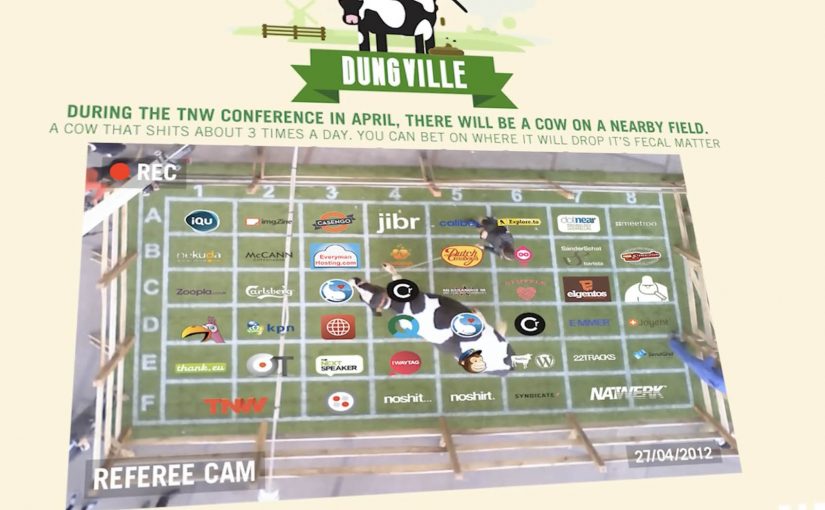
Natwerk was asked to create something playful for the online-minded visitors of The Next Web Conference 2012. So they built an analogue prediction game featuring a real cow, then layered it with an online extension.
Klara, a grid, and a one-day “village”
The installation was framed as a tiny pop-up “village” at the conference venue. One real farmer. One real cow named Klara. A field laid out as a grid. Visitors could place bets on where she would drop her dung.
Mechanism: a physical event drives a digital game
As shown in the case film, Klara was expected to do her business several times a day, and the audience wagered on where it would happen. The web layer turns that unpredictability into a simple loop. Pick squares. Wait. Validate. Win or lose.
That mechanism works because one visible but unresolved physical outcome gives everyone the same reason to watch, talk, and check back.
In event marketing, the strongest activations turn a shared physical moment into a lightweight digital ritual people can join and talk about instantly.
Why it lands
The idea is memorable because it is absurdly literal. A real-world randomizer. A clear grid. A clear outcome. It also fits the conference crowd. People who live online love mechanics that are easy to explain, easy to screenshot, and easy to debate in real time.
Extractable takeaway: If you can attach your digital interaction to an offline moment that nobody can fully predict, you get tension for free, and tension is what keeps people checking back.
What this kind of activation is good for
The real question is whether the game gives people a simple reason to keep returning to the shared moment.
This is not about deep persuasion. It is about creating a shared story at the venue and giving the event a “small legend” people repeat after they leave. It works best when your goal is attention, conversation, and community participation rather than detailed product education.
Steal the event-game pattern
- Use a single, visible game board. A grid makes rules self-explanatory and outcomes easy to verify.
- Keep the loop simple. Pick. Wait. Result. Repeat. Complexity kills participation at events.
- Make the offline moment the engine. When the physical world provides the variability, the digital layer can stay minimal.
- Design for group talk. The best event games create debate and banter, not solo play.
- Be deliberate about tone. Toilet-humour mechanics are polarising. If you use them, commit fully and keep it light rather than crude.
A few fast answers before you act
What is Dungville in one sentence?
It is a conference activation where a real cow on a gridded field powers a web game, letting visitors predict where she will drop dung.
Why does a real-world “random” trigger work so well?
Because it creates genuine uncertainty. People keep watching and checking because nobody can fully control the outcome.
What makes this an “online extension” rather than just a stunt?
The web layer turns the physical moment into a repeatable interaction loop, giving people a way to participate, compare picks, and track results.
What is the biggest execution risk?
Drop-off due to waiting. If results take too long, interest fades. The format needs clear timing and frequent enough outcomes to sustain attention.
What should you measure for a similar event game?
Participation rate, repeat participation, time-on-experience, social mentions during the event window, and whether attendees recall the activation as part of the event story.