
McDonald’s: Dollar Drink Days Ice Sculpture

McDonald’s: Dollar Drink Days Ice Sculpture

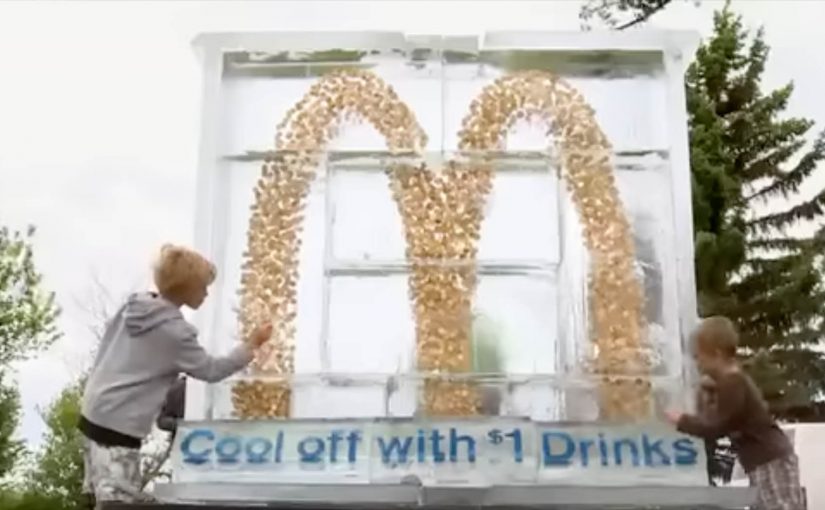
McDonald’s Canada and Cossette Vancouver brought to life one of the first interactive ice sculptures this summer on behalf of McDonald’s Restaurants in Alberta. The objective was to drive consumer interest in the company’s Dollar Drink Days campaign. Here, “interactive” means people can physically engage with the installation and change it in real time.

Hosted in the town of Sylvan Lake, the stunt saw 8,000 pounds of ice moulded into a seven-foot tall installation containing over 4,000 sparkling loonies, shaped into McDonald’s famous Golden Arches. The ice melted on a summer Saturday, and consumers chipped away at the sculpture to collect their bounty.

To attract high levels of interaction, the sculpture was strategically placed near the Sylvan Lake Pier, an area frequented by young adults and families. The day also featured a DJ, street promotional teams, hula hooping, limbo contests and giveaways.

In quick-service promotions, especially in seasonal, high-footfall leisure locations, the hard part is converting “cheap” into “must-see”.

The real question is how you turn a simple price offer into a moment people choose to chase.

Price promotions are forgettable until you give people a physical action that earns a visible payoff.

Why this activation pulls people in

The reward is visible and the deadline is unavoidable. Because the coins sit inside melting ice, the mechanism turns curiosity into action and keeps people moving from watching to participating.

Extractable takeaway: If you want a price promo to travel, make the payoff visible, put it behind one simple action, and bake in a deadline people can feel.

  • A clear, physical payoff. The value is visible and tangible, and the “win” is earned through participation.
  • Built-in urgency. Melting ice creates a natural time limit, which pushes people to act now rather than “later”.
  • Placement does the heavy lifting. Putting it at a high-traffic summer spot turns curiosity into crowds.

Reusing the melting-deadline mechanic

This is a strong example of turning a price promotion into a real-world spectacle. Instead of telling people “Dollar Drink Days is on”, the brand created a moment people wanted to be part of, and then made participation the mechanism for reward.

  • Make the payoff obvious. Put the value where people can see it before they commit.
  • Use a deadline that enforces itself. A physical countdown beats a marketing one, because it changes what people do right now.
  • Let the location supply the audience. Choose a place that already has the right crowd, then make the moment easy to join.

A few fast answers before you act

What was the Dollar Drink Days ice sculpture?

It was a seven-foot interactive ice installation in Sylvan Lake, Alberta, shaped like the Golden Arches and packed with thousands of loonies for visitors to collect as it melted.

How did people interact with it?

As the sculpture melted during the day, people physically chipped away at the ice to reach the coins inside.

Why stage it near Sylvan Lake Pier?

The location is naturally busy with young adults and families in summer, which increases footfall and keeps participation high.

What is the core pattern worth reusing?

Give people one simple action that unlocks a tangible reward. Add a natural deadline, and stage it where the right crowd already gathers.

Mountain Dew: Paintball Street Art in London

Mountain Dew: Paintball Street Art in London

Paintballing meets street art in Mountain Dew Energy’s UK campaign. The idea is built around a simple collision: take the raw physicality of paintballing and merge it with graffiti culture.

The campaign is centred on a Facebook app designed to find and showcase the brand’s official street artists. Rather than appointing talent from the top down, Mountain Dew Energy lets fans decide who represents the brand on the street.

The campaign video shows the Graffiti Kings creating large-scale street art using paintballs inside London’s graffiti hub, the Leake Street Tunnel. The featured artists, Knoxville and Grohl, are not random selections. They were chosen by fans following a teaser phase that invited participation before a single wall was painted.

When the medium becomes the spectacle

The mechanism is the twist on technique. Graffiti is usually associated with spray cans and markers. Paintballs introduce unpredictability, force, and performance. The act of creation becomes as interesting as the final artwork, giving the campaign strong visual momentum.

In youth and culture-led marketing, credibility rises when the brand builds a participatory system and lets the community validate the outcome.

In UK culture-led brand marketing, credibility compounds when the community is allowed to validate who gets the wall.

The real question is whether you will let fans choose the makers before you ask them to share the outcome.

Why fan selection changes the power dynamic

Letting fans choose the artists shifts authorship. The brand steps back from curating taste and instead creates a framework where the community validates talent. That makes the outcome feel earned rather than manufactured, which matters in street culture.

Extractable takeaway: If you need cultural credibility, move selection upstream and let the community choose the creators before you invest in production.

This also gives the campaign a built-in narrative arc. The teaser phase creates anticipation. The vote creates ownership. The execution becomes a payoff that fans feel partially responsible for.

The intent behind the paintballs

The business intent is not just awareness. It is cultural alignment. Mountain Dew Energy positions itself close to street culture, creativity, and youth expression. By avoiding polished studio aesthetics, the brand signals that it understands the messier, louder edges of its audience. Brands should not borrow street-culture signals unless they also borrow the audience’s decision rights.

Moves to copy from paintball graffiti

  • Hybridise formats. Combining two cultures can create immediate distinction.
  • Make creation performative. If the process is entertaining, it becomes shareable.
  • Let fans decide. Participation before execution increases emotional investment.
  • Choose the right setting. Leake Street Tunnel adds credibility that no set could replicate.
  • Design the buildup. Teasers and voting give the campaign a rhythm, not just a reveal.

A few fast answers before you act

What makes this campaign different from typical street art sponsorships?

The use of paintballs turns graffiti into a live performance, not just a finished visual, and makes the act of creation central to the story.

Why involve fans in choosing the artists?

It transfers credibility. When the community selects the talent, the brand avoids looking like it is imposing taste from above.

Does the Facebook app actually matter?

Yes. It is the coordination layer, meaning the simple system that collects votes and points fans to the official artists, and gives the campaign a reason to unfold over time.

What audience behaviour is this trying to encourage?

Engagement, sharing, and identification with the brand as part of a creative subculture rather than just a beverage choice.

What is the key takeaway for brand-led cultural campaigns?

Create a platform, not just a placement. When people can influence the outcome, they are more likely to care about the result.

Jeep: Compass Remote Postcards

Jeep: Compass Remote Postcards

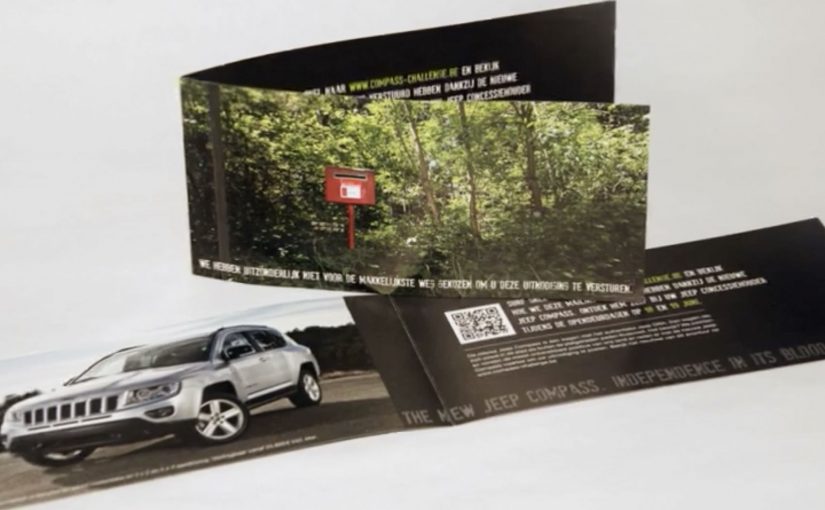
One of the oldest and most effective ways to sell a product is with a good demonstration. Leo Burnett Brussels takes that approach and gives it a fresh spin for the Jeep Compass by turning the demo into a journey people can follow.

Cameras are strapped onto a few Jeep Compasses, and the team sets out to find the most remote post locations they can. Direct mailers are then shipped from these far-flung places, pointing recipients to a site where they can follow the trip and see the Compass in action.

Remote postcards as proof, not promise

The mechanic is simple. Put the product in the environment that proves the claim, document it, then send a physical artifact from the place itself. The postcard becomes evidence that the vehicle actually got there, not just a line in a brochure.

In automotive marketing, demonstrations land best when the proof is embedded in the distribution, so the message and the evidence arrive together.

The real question is how to turn an off-road capability claim into proof people can hold, trust, and retell. This is stronger than a spec-led demo because the proof is built into the medium itself.

Why this lands

This works because it collapses storytelling and verification into one object. A postcard from a remote location is inherently credible. Add footage from the route, and the demonstration feels earned rather than staged, even for people who only skim the campaign.

Extractable takeaway: If your product benefit is “go anywhere” or “handle more,” make the medium carry the proof. Send something that could only exist if the product performed as claimed.

What the campaign is really optimizing for

Beyond awareness, this is built to move the vehicle into active consideration. It gives prospects a concrete reason to re-evaluate the vehicle, and it creates a narrative that sales teams and enthusiasts can retell without needing technical jargon or spec sheets.

How to adapt this demonstration pattern

  • Turn proof into an artifact. Physical mail can signal effort and credibility.
  • Design a followable journey. A route with checkpoints is easier to remember and share than a one-off stunt.
  • Keep the CTA tight. One action. Follow the trip. See the product perform.
  • Make the environment do the persuading. Terrain and remoteness communicate capability faster than copy.

A few fast answers before you act

What is the core idea of the Jeep Compass remote postcards?

Use real remote locations as the demonstration, then mail postcards from those locations and direct recipients to follow the journey and watch the vehicle perform.

Why use direct mail instead of only video?

A postcard from a remote post office feels like proof. It is a physical signal that the journey happened.

What makes this a product demonstration, not just content?

The route and the mailer are consequences of the capability claim. The campaign structure is built around showing the vehicle doing the work.

What kind of products benefit most from this pattern?

Products with a capability claim that is easy to show in the real world. Durability, reach, range, off-road, endurance, or access.

What’s the biggest risk if you copy this approach?

If the “proof” feels manufactured or the journey is hard to follow, the credibility advantage disappears. The checkpoints and documentation need to be clear.