
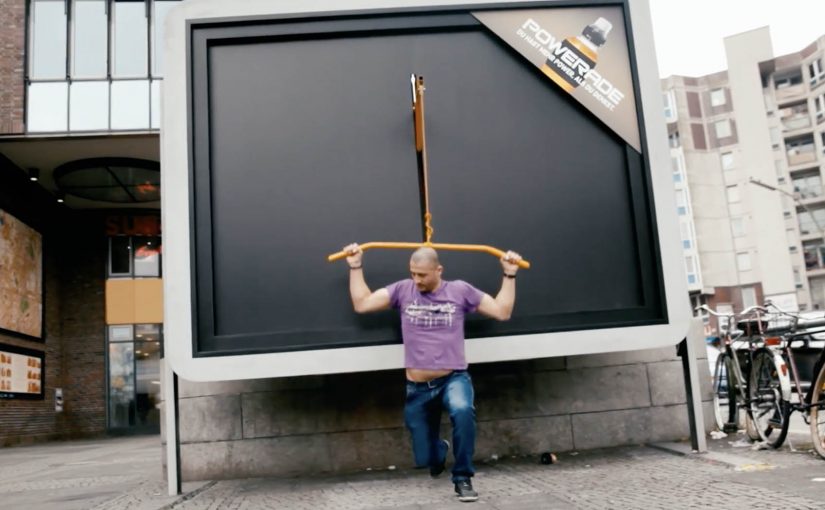
Powerade: Workout Billboards in Berlin

A billboard does not just tell you to train. It invites you to climb it, lift it, or punch it, right there on the street, then hands you a Powerade when you are done.

Powerade, with the help of Ogilvy & Mather, set up several workout billboards in Berlin that, apart from advertising the product, also doubled up as workout equipment to emphasize the brand’s attitude, “You have more power than you think”. Here, “workout billboards” means the billboard structure is built to be used as simple exercise equipment.

People practicing their rock climbing, weight lifting, and boxing skills on the unique billboards were also rewarded with some free Powerade to help replenish their electrolytes.

Why this works as outdoor advertising

The mechanism is a clean value exchange. The brand offers an activity that creates immediate proof of effort. The participant gets a short challenge and a visible outcome. The product then shows up as the natural next step, not as an interruption. Because effort comes first, the product feels like a reward rather than an ad.

Extractable takeaway: When outdoor media gives people a small, safe task to complete, the brand message lands as earned proof, not as a claim.

In sports and performance brands competing for attention in dense urban spaces, turning an ad surface into a usable experience is a direct way to earn participation instead of only impressions.

What Powerade is really buying

This is not mainly about reach. It is about association. The ad makes the brand feel like a training partner, not a poster. It also turns physical engagement into a public spectacle, which draws more people in and makes the moment more memorable than a standard billboard.

The real question is whether your activation gives people something they can do in public, not just something they can look at.

Steal-worthy moves for participatory OOH

  • Make the product a logical reward. The drink lands because effort comes first.
  • Design for participation, not just viewing. If people can do something, they will stop and watch others do it too.
  • Keep the idea explainable in one line. “Billboard that is also a workout” travels fast.
  • Let the environment do the distribution. Public performance creates its own audience.

A few fast answers before you act

What is a “workout billboard” in this campaign?

A billboard installation that doubles as real workout equipment, so people can climb, lift, or punch as part of the brand experience.

Why does turning a billboard into equipment change behavior?

It shifts the role from passive viewing to active participation, which increases time spent, memorability, and the likelihood people talk about it.

What is the main value exchange for the audience?

A quick public challenge plus a tangible reward. Free Powerade after effort makes the product feel earned and relevant.

What is the biggest execution risk?

If it looks unsafe, complicated, or embarrassing, people will not try it. The interaction has to feel obvious and low-risk at first glance.

What is the simplest way to apply this idea without building hardware?

Create a participatory moment that produces visible effort and a clear reward, even if the “equipment” is replaced by a simpler challenge format.
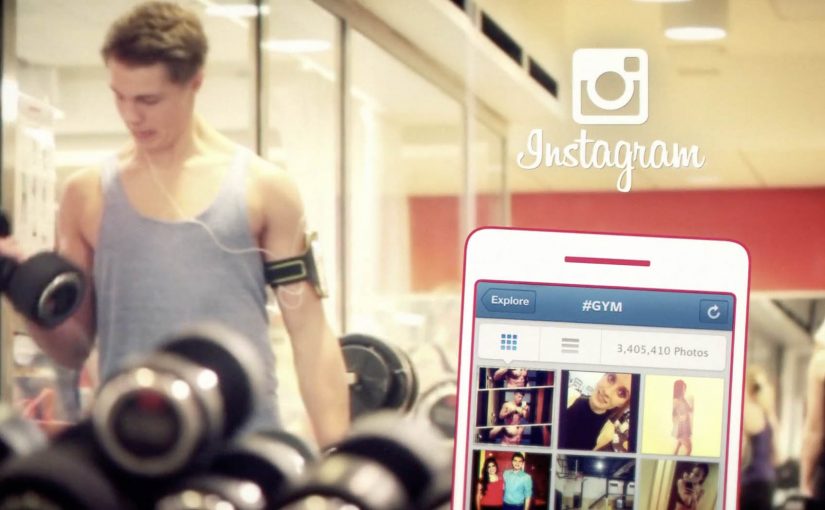
Friskis&Svettis Stockholm: #friskissthlm

January in Sweden is when gyms and health clubs go loud, chasing everyone who made the classic New Year’s resolution to start exercising. Stockholm-based health club Friskis&Svettis is no exception.

Because Friskis&Svettis is a non-profit association owned by its members, they and their agency Volt build a campaign where members inspire the wider community. A hashtag, #friskissthlm, invites people to work out, photograph the moment, and tag their pictures, so the members themselves become the creative running “around Stockholm”.

How the member-driven mechanic scales

The mechanism is participation as media: member actions create the content and also help distribute it. Instead of producing a single hero ad, the brand defines one simple behavior: train, post, tag. The hashtag becomes the aggregation layer, a single place where the posts collect and stay discoverable, and every new image becomes both proof and invitation. The campaign’s distribution is powered by the same thing gyms want more of in January: visible momentum.

In member-owned fitness communities, letting real members supply the proof tends to land harder than brand-led messaging, because the social permission comes from peers rather than from advertising.

The real question is not how to make a louder January gym ad, but how to make visible member momentum easier to join. The stronger move here is to make member behavior the campaign, not to outshout every other club in January.

Why it lands

It turns the most fragile moment in fitness, starting, into something public and shareable without making it complicated. The posts do two jobs at once. They show variety (different workouts, different people, different branches) and they reduce intimidation, because the “campaign face” is not a model, it is your neighbor.

Extractable takeaway: If you want community growth, choose one repeatable participation unit and one clear tag, then let volume and variety do the persuasion. Your members become the credibility layer.

What to borrow for your own January push

  • Make the ask behavioral. “Work out, post, tag” is easier to follow than “join our movement”.
  • Let variety do the selling. Many small proofs beat one polished claim, especially in fitness.
  • Turn members into the creative. It is cheaper, more credible, and naturally localized.
  • Design for aggregation. One hashtag, one place to browse, one loop that keeps filling itself.

A few fast answers before you act

What is #friskissthlm in one sentence?

A member-powered Instagram hashtag campaign where workouts posted and tagged by members become the campaign content for Friskis&Svettis Stockholm.

Why is this stronger than a typical January gym ad?

Because the proof is peer-generated. People trust “someone like me did this” more than they trust a brand saying “you should”.

What is the key design decision?

Keeping the participation unit tiny and repeatable, so the barrier to contributing stays low while the content volume stays high.

What is the main risk with hashtag-led campaigns?

If the tag is not actively adopted, the feed looks empty and the idea collapses. You need early seeding from members and staff so momentum is visible from day one.

How would you adapt this outside fitness?

Keep the pattern, not the category. Pick one repeatable action people are already willing to do, give it one clear tag or container, and make the resulting proof easy for others to browse and copy.