
Welcome back. Hope everyone had a great holiday season. Now for a great start to 2013.
Taking off from my last post, here are a series of holiday action videos created by ad agencies around the world in their lead up to Christmas 2012. By “holiday action videos,” I mean greetings built around a simple interaction or trigger with a visible payoff.
Holiday greetings that behave like products
The mechanism across this set is consistent. Use the “holiday card” moment as permission to ship something people can experience, not just watch. A hacked player, a tweet-triggered donation, a synchronized “orchestra,” a physical gag product.
In global agency culture, the holiday card is a low-risk moment to test interactive mechanics and craft that can later show up in bigger client work.
Why this format keeps working
These pieces earn attention because they trade greeting-card sentiment for an observable action. The real question is whether your greeting demonstrates a capability people can experience, not just a sentiment they can scroll past. You should treat the holiday card as a tiny product launch, not a branded message. The viewer is not only receiving wishes. They are triggering something, learning something, or being surprised by a mechanism that is simple enough to retell.
Extractable takeaway: If you want something to travel during peak-season noise, design a one-step interaction with a visible payoff, and make the payoff describable in a single sentence. That is retellability, meaning a friend can summarize it in one sentence.
Maurice Lévy’s Digital Wishes by Publicis Groupe
Maurice Lévy, the chairman and chief executive of Publicis Groupe, traditionally records a holiday greeting-card video. This year, through a special deal with YouTube, Publicis modified the function buttons of the video player and embed tricks into what seems like another long, boring address by an ad industry veteran.
TwinterWonderland by 360i
To celebrate the arrival of the holiday season and provide assistance to those affected by Hurricane Sandy, 360i wanted to do something big. For every #TwinterWonderland tweet they received, 360i donated $5 to an aid organization helping with the post-Sandy cleanup effort.
25th Anniversary Holiday CompuCard by TBWA\TORONTO
To celebrate their 25th anniversary, TBWA\TORONTO brought in their digital expert from 1988, who then, through an e-card, tried to capture the spirit of their past along with their digital future.
Buzzed Buzzer by Havas Worldwide Chicago
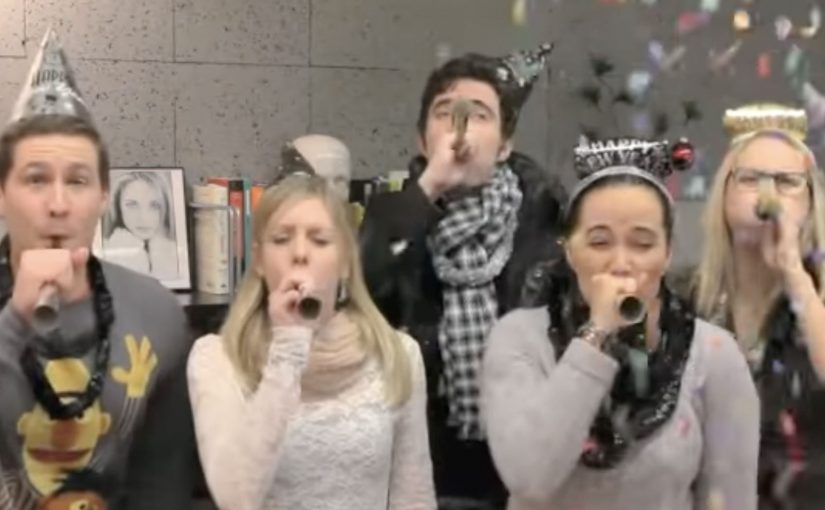
The first New Years Eve noise maker that only works when you’re drunk.
Christmas carol played on food by FullSIX Spain
To wish happy new year to customers and friends, FullSIX transformed typical Spanish Christmas food into a carol-playing piano.
Click here to watch video on the AdsSpot website.
The Snow Machine by Weapon7
Passers-by were invited to Tweet #snow to @thesnowmachine Twitter account. For every tweet received, the machine gave ten seconds of snow flurry. The event ran all day, was seen by thousands of people and generated over one thousand tweets.
Stealable patterns for next year’s greeting
- Give the audience one trigger. One hashtag, one button, one simple mechanic.
- Make the payoff visible. Something changes immediately, on-screen or in the real world.
- Design for retellability. If the idea cannot be summarized in one sentence, it will not spread.
- Let craft do the selling. Use the holiday excuse to demonstrate capability, not just sentiment.
A few fast answers before you act
What makes “holiday action videos” different from normal holiday ads?
They are built around a visible action or interaction. The greeting is the excuse. The mechanism is what people experience, talk about, and share.
Why do agencies use holiday cards as a playground for experimentation?
The stakes are lower and the audience is receptive, so it is easier to try unusual formats, technical tricks, and interactive mechanics that would be harder to justify elsewhere.
What is the common mechanism across the strongest examples?
One clear trigger and one clear payoff. A hacked player that surprises you, a tweet that causes a donation, a simple “instrument” that performs when activated.
How do you keep it from feeling like a gimmick?
Anchor the interaction in a human reward. Delight, generosity, togetherness, or a simple shared joke. Then keep friction low so the idea survives first contact.
How do you test retellability before you publish?
Ask someone outside the project to explain the idea back to you after a 10-second description. If they cannot say the trigger and payoff in one sentence, simplify the mechanic.