
Heineken Carol Karaoke

What if you were singing holiday carols to a few friends at a karaoke bar, when suddenly your performance became a concert broadcast before thousands on the Jumbotron at a professional basketball game, in Times Square and on the screens of nearly every New York City taxicab. Would you keep singing?

That is the setup behind Heineken’s Carol Karaoke. It starts as a small, friendly singalong, then flips into a “will you or won’t you” decision in seconds. Keep going and you are suddenly performing for strangers at scale. Stop and you walk away from the moment.

How the stunt works

The mechanism is deliberately clean. Invite people to sing. Reveal the twist. Put a choice in front of them with no time to overthink. The broadcast layer is what raises the stakes, but the real content is the decision itself. Because the choice arrives before people can script themselves, the reaction reads as real, which is why the clip holds attention. The real question is whether you keep singing once the room suddenly becomes the city.

It is also built for the social era without relying on a hashtag to do the work. The reaction is the story. The story becomes the share unit. Here, the “share unit” is the few seconds where the singer realizes the stakes and chooses.

In big-city holiday campaigns, the fastest route to earned attention is a simple public challenge that people can imagine themselves facing.

Why it lands

Karaoke is already a controlled embarrassment. The campaign simply stretches that discomfort from “friends in a booth” to “a city watching”. That tension creates instant empathy and instant curiosity, because nearly everyone knows what it feels like to sing badly, and nearly everyone has imagined what it would feel like to be exposed. Heineken positions itself as the catalyst for crossing that line, not the judge of the performance.

Extractable takeaway: If you want a stunt to travel, engineer one visible, time-pressured choice that viewers can feel, then make the brand the enabler of that choice, not the evaluator.

Business intent

This is branded entertainment built around social courage. It connects Heineken with celebration behavior, and it manufactures a holiday moment that people will retell, because the premise is easy to repeat and the outcome is emotionally satisfying.

Steal these levers from Carol Karaoke

  • Use a decision, not a slogan. Put real choice in the frame and you get real reaction.
  • Make the twist explainable in one sentence. If the idea cannot be retold instantly, it will not travel.
  • Raise stakes with environment, not complexity. Big screens and public broadcast do more than extra rules.
  • Cast ordinary people. Relatability is what turns “a stunt” into “I can picture myself there”.

A few fast answers before you act

What is Heineken Carol Karaoke?

It is a surprise karaoke activation where people singing holiday carols are suddenly offered a choice. Keep singing and be broadcast publicly to a much larger audience, or stop and walk away.

Why does the “will you or won’t you” structure work?

Because the content is the decision under pressure. That creates tension, authenticity, and a clear emotional arc that viewers follow in seconds.

What role do out-of-home screens play in the idea?

They turn a private performance into a public moment instantly. The scale shift becomes the stakes, and those stakes are immediately legible to anyone who has ever felt stage fright.

What makes this kind of stunt shareable?

The setup is retellable in one line, and the payoff is emotional and human. People share it to relive the moment of courage, not to explain a complicated mechanic.

How can a brand adapt this idea without a Jumbotron?

You can swap the “big screen” for any sudden jump in visibility that feels real. For example, a live in-venue feed, a public projection, a partner-owned network of screens, or an unexpected “broadcast” to a larger nearby audience.
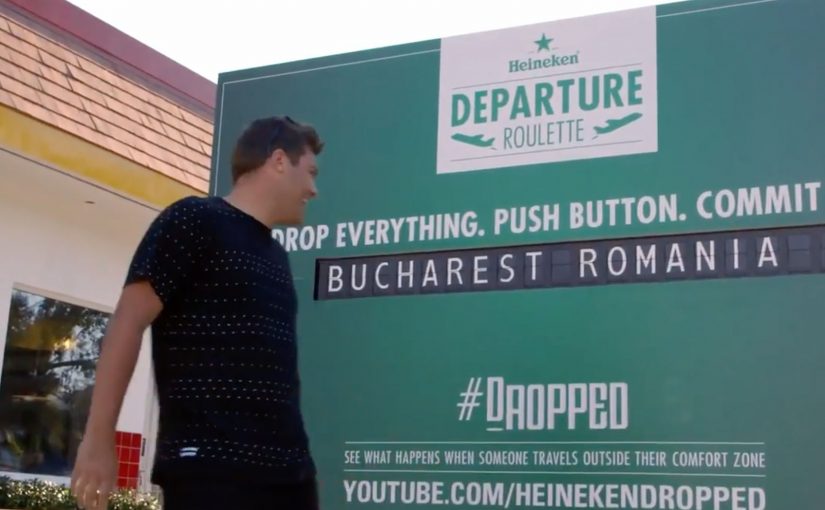
Heineken Departure Roulette En Route

Heineken spots the tweets. Then they make them real. People watch the original Departure Roulette stunt and post the inevitable line on Twitter: “I’d press the button.” Heineken takes that public intent seriously. They track down a few of the people who tweet about wanting to play. Then they offer them the chance to play Departure Roulette on the spot. Real time, real commitment, no rehearsal.

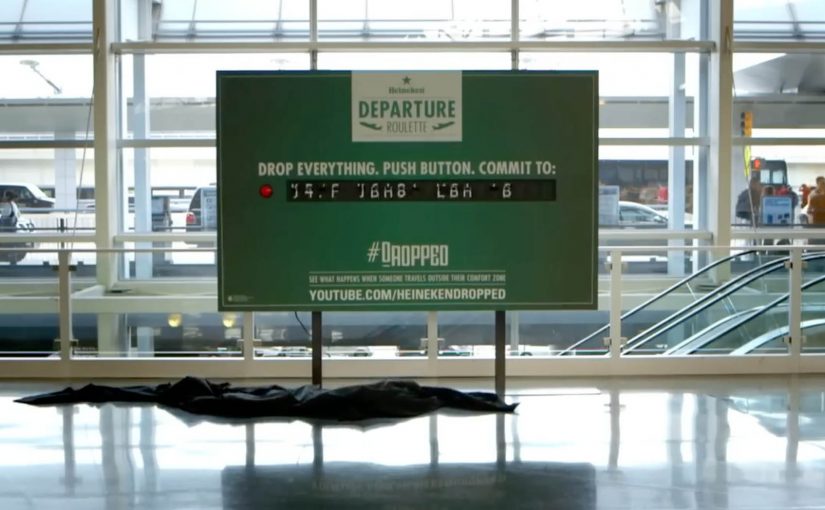
If you want the backstory first, the original Departure Roulette activation sets the frame: a physical roulette board at JFK Terminal 8. One red button. Press it and you accept a new destination immediately. Read about the original here.

What “En Route” gets right: it turns social intent into action

The smartest part of this follow-up is not the surprise. It is the mechanism. Heineken treats social conversation as a live signal of willingness, not just commentary. Here, “social intent” means an explicit public statement like “I’d press the button,” not passive engagement. By acting on that signal fast enough to feel connected, the brand turns curiosity into a credible story of commitment.

Extractable takeaway: When people declare intent in public, treat it as an opt-in trigger. Respond fast with a real commitment moment, and make the decision itself the content.

The real question is whether you can turn “I’d do that” intent into a real commitment fast enough to feel causal, while keeping consent and safety airtight.

If you cannot deliver the commitment reliably in real time, you should not run this pattern.

It rewards declared intent in public

A tweet is a lightweight commitment. Heineken upgrades it into a real decision. The gap between “I would” and “I did” becomes the content.

It closes the loop from earned media to owned experience

The original stunt earns attention. The follow-up re-enters the stream where that attention lives. Social becomes a trigger for a real-world activation, not just a distribution channel.

It stays consistent with the campaign’s core promise

Departure Roulette is about spontaneity and courage. The follow-up keeps the same proposition, just delivered to a different moment and audience.

In global consumer brands running real-time social and experience programs, the advantage comes from turning explicit public intent into a safe, opt-in moment of commitment.

What to measure beyond views

  • Intent volume. How many people explicitly say they would do it.
  • Conversion rate. Percentage of selected participants who actually commit when approached.
  • Time-to-response. How quickly you move from trigger to activation.
  • Amplification quality. Replies and quote-posts that debate “would you do it,” not just “nice video.”
  • Brand linkage. Whether the audience repeats the core idea (spontaneity, adventure), not just the prank.

Risks and guardrails that matter

  • Consent and privacy. Do not approach people in a way that feels extractive. Keep it clearly opt-in.
  • Safety and duty of care. High-stakes travel stunts need hard boundaries, support, and contingencies.
  • Credibility. The offer must be unquestionably real, or the story collapses into suspicion.
  • Operational readiness. The logistics are the product. If ops fail, the story turns.

How to reuse this pattern without copying the stunt

  1. Define the “press the button” moment. Pick one unmistakable action that proves intent.
  2. Listen for explicit triggers, not vague sentiment. Look for “I would,” “I want,” or “If you did this I’d…” rather than likes alone.
  3. Respond fast enough that it feels connected. If the follow-up arrives too late, it reads like a promotion, not a story.
  4. Make the commitment real, but safe. Build constraints on timing, eligibility, logistics, and consent.
  5. Capture the decision, not just the reward. The moment of choice is the asset. The prize is the justification.

A few fast answers before you act

What is Departure Roulette En Route in one line?

It is a social-powered follow-up where Heineken turns “I’d press the button” tweets into a real-world chance to do exactly that.

Why does it spread?

Because it stages a high-stakes, relatable decision in public: keep your plan, or choose the unknown.

What is the reusable strategy?

Treat public intent as a trigger for action. Then deliver a real experience that proves the brand promise.

What is the minimum viable version for a brand without travel budgets?

Reward declared intent with an immediate upgrade: surprise access, exclusive drop, instant appointment, or fast-track service.

Where does this go wrong fastest?

When it feels like surveillance, or when the logistics do not deliver on the promise.

Heineken Departure Roulette

Board at JFK Terminal 8. A single red button. A real decision. To embody Heineken’s adventurous spirit, Wieden + Kennedy in New York sets up a Departure Roulette board at JFK’s Terminal 8 and dares travelers to play. If they press the button, they drop their existing plans and go somewhere totally new and exotic.

The commitment is real. The travelers who take the dare receive $2,000 to cover expenses and get booked into a hotel for two nights at the new destination. This is the recently released video of how it unfolds at JFK.

The stunt links to a broader idea. The game draws inspiration from Dropped, a Heineken campaign launched from W+K Amsterdam in which four men get sent to remote destinations, and the adventure of getting back gets filmed.

In global FMCG brand marketing, high-traffic moments like airports make public, irreversible choices unusually effective at turning a value into proof.

Why this stunt works

The power is not the prize. It is the forced, public decision moment that turns “adventurous” from a claim into an observable act.

Extractable takeaway: If your brand stands for a value, design one visible, irreversible choice that makes people either live it or walk away.

It makes spontaneity measurable

Most people can say they are spontaneous. Departure Roulette forces a binary choice in public. Press or walk away. The brand promise becomes an observable action. Because the choice is binary and public, it creates proof people can retell without needing extra context.

It raises stakes without needing complex rules

The mechanic is simple. Here, the mechanic is the single red-button press that swaps your itinerary on the spot. The tension is high. You do not need a long explanation to understand what is at risk: your plan.

It turns a brand value into a story people retell

The red button is a prop with meaning. It compresses the entire narrative into one symbol that is easy to remember, share, and debate.

The real question is whether your brand promise can survive a real, irreversible choice in front of people.

This pattern is worth copying only when the commitment and the logistics are truly real in the moment.

What to measure beyond views

  • Participation rate. How many approached travelers agree to play.
  • Completion rate. How many press the button after hearing the rules.
  • Story lift. How often people retell the mechanic correctly.
  • Brand linkage. Whether the audience connects the act to “adventurous spirit,” not just “free trip.”

Steal the red-button blueprint

  • One irreversible trigger: Reduce the experience to a single action that cannot be half-done.
  • Visible trade-off: Make what they give up as clear as what they gain.
  • Decision-first filming: Capture the seconds before and after commitment, not just the outcome.
  • Operations as creative: Treat booking, payout, and handoff as part of the story, because failure kills believability.

A few fast answers before you act

What is Departure Roulette?

A physical airport activation where travelers can press a red button and immediately swap their planned trip for a surprise destination.

Where did the activation take place?

At JFK Airport, Terminal 8, where the Departure Roulette board invited travelers to press the red button and swap trips.

What is the core mechanic?

One irreversible choice that turns a brand value into an action people can witness.

How does it connect to Heineken’s Dropped campaign?

It borrows the premise from Dropped, where participants are sent to remote destinations and the journey back becomes the story that gets filmed.

What makes it repeatable for other brands?

The format is not travel. It is a high-stakes choice with a simple trigger, a clear trade-off, and a real reward.

What is the biggest failure mode?

When the commitment is not credible, or the operations cannot deliver the promise.