
The Day Shazam Forgot

Alzheimer’s Research UK partners with Shazam and does something deliberately uncomfortable. It gives the app the symptoms of Alzheimer’s. You use Shazam as you normally would, but the experience starts to break in ways that mirror memory loss. It is a hard-hitting way to feel, in a small moment, what daily struggle can look like.

The insight behind the campaign is about who needs to be reached. Most people associate Alzheimer’s with late life, but the disease can affect people as young as 40. The post cites over 40,000 people under 65 living with dementia in the UK.

The point is education through friction

This does not try to persuade with claims or statistics alone. It turns education into a lived interaction. Shazam is familiar and fast. Making it unreliable becomes the message.

The real question is how to make a misunderstood condition felt in a way that stays with people after the interaction ends.

This is a strong use of product behaviour because the disruption teaches rather than distracts. The intent here is public education, not app utility.

Why the Shazam choice is strategic

Shazam already sits in a high-frequency behaviour loop. By behaviour loop, this means a repeated habit people perform in real-life moments with very little effort or planning. That makes it a powerful carrier for a message about everyday disruption, because it arrives inside everyday life rather than as a separate awareness film.

Extractable takeaway: If you want people to understand a condition that is easy to distance or abstract away, place the message inside a familiar action so the disruption explains the reality better than a claim alone.

In consumer-facing digital experiences, familiar habits are often the best place to make a hard message land because the contrast is felt immediately.

What to take from this if you build digital experiences

  • Simulate a small part of the experience, not just the outcome, when the condition itself is hard to explain.
  • Put the message inside a familiar behaviour, so the contrast is instantly felt.
  • Use disruption sparingly and intentionally, so the discomfort has a purpose and does not turn into irritation.

A few fast answers before you act

What is “The Day Shazam Forgot”?

A Shazam partnership campaign that simulates Alzheimer’s symptoms to give users a direct, hard-hitting insight into memory loss.

Who is the campaign trying to educate?

A younger audience that may assume Alzheimer’s only affects people in late life.

What key fact reframes the audience assumption?

The disease can affect people as young as 40. The post cites over 40,000 people under 65 living with dementia in the UK.

What is the core creative technique?

Turning a familiar app experience into a controlled failure state, so the message is felt rather than only read.

Why use Shazam instead of a separate awareness film?

Because Shazam already lives inside everyday moments, the disruption arrives where memory lapses would feel personally relevant rather than abstract.
Snickers: Hungry Purchase Resale

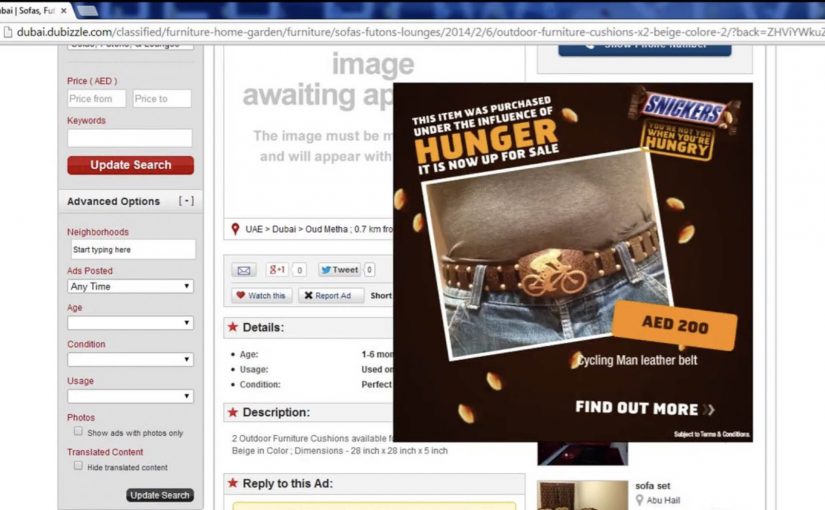
The global Snickers platform “You’re not you when you’re hungry” has generated plenty of buzz. To extend it in Dubai, and make the downside of hunger feel more real, Impact BBDO created “Hungry Purchase Resale”.

The insight is simple. During big sales, people often buy things they later regret. Snickers pins these shopping bloopers on hunger and, in partnership with Dubizzle.com, lets shoppers upload the items they want to sell straight into Snickers branded banners that appear on the site’s homepage. Clicking the banner takes people directly to the classified listing so the item can be sold on.

Turning regret into a media unit

The clever bit is that the ad is not just an ad. It becomes a functional resale slot that people actually want, because it helps undo a mistake. This is the stronger move, because utility gives the audience a reason to use the format, not just notice it.

In high-velocity retail environments, the best digital ideas piggyback on existing intent surfaces, meaning the places where people are already ready to browse, compare, or buy, then give people a reason to interact that is bigger than “engage with our brand”.

The real question is how to turn a brand platform into a useful action inside the exact behavior it is commenting on.

Why it lands

The better approach here is to make the platform behave like a service, not a message. The audience is already on a classifieds site to browse, compare, and transact. By turning remorse into a shareable listing, the campaign earns attention inside the exact behavior it is commenting on.

Extractable takeaway: If your brand truth is behavioral, do not just illustrate it. Build a mechanic that lets people enact it in a familiar environment, and make the brand the enabler of a useful outcome.

What the results are described to show

Campaign reporting describes over 200 submissions in a week. It also describes the interactive banners achieving a click-through rate almost five times the industry standard, with 80% of posted items sold the same day.

What commerce teams should steal from this

  • Make the ad do a job. Utility beats persuasion when attention is scarce.
  • Put the idea where intent already exists. Classifieds, marketplaces, and search are “ready-to-act” contexts.
  • Let users supply the proof. Real submissions and real listings create credibility you cannot script.
  • Keep the action one-step. Upload, appear, click, sell. No extra hoops.

A few fast answers before you act

What is “Hungry Purchase Resale”?

It is a Snickers activation in Dubai where shoppers can upload regretted purchases into Snickers branded homepage banners on a classifieds site, linking directly to the resale listing.

What is the core insight behind it?

People often make irrational purchases during sales and later regret them. The campaign frames hunger as the trigger for those mistakes.

Why partner with a classifieds site?

Because it is where resale intent already lives. The campaign becomes actionable in-context instead of being a standalone brand message.

What makes the idea feel credible?

It routes real items from real people into a real marketplace flow, so the audience can see behavior, not just hear a claim.

How can another brand replicate the pattern?

Choose a partner platform that already hosts the behavior you are talking about, then build a simple mechanic that turns your brand message into a useful action.