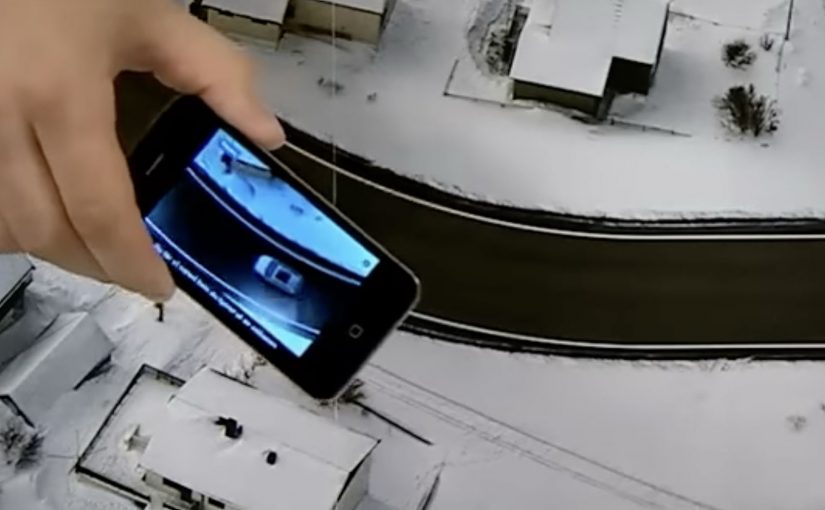
You open a magazine and see a long, empty road. Then you hover an iPhone over the printed page and a Volkswagen appears to “drive” along that road on your screen. It is a test drive that happens inside a print ad, with summer and winter road versions depending on the magazine insert.
Volkswagen Norway builds this as a hybrid print and mobile experience. Readers are prompted to download an app, developed by Mobiento, that turns the printed road into a track. The phone becomes the controller and the page becomes the environment. The payoff is simple viewer control. You move the phone. The car moves with you.
An augmented reality print ad is a piece of print that a camera can recognize as a trigger. Once recognized, an app overlays a digital layer onto the page, anchored to the printed design so the interaction feels connected to the physical medium.
In European automotive marketing, the hardest part is making driver-assist feel concrete without getting people behind the wheel.
The experience is designed to demo three features in a way print usually cannot. Lane assist, adaptive lights, and cruise control. It is not a real test drive, but it is a clear and surprisingly tactile explanation of systems that are otherwise hard to “feel” from a magazine spread.
Why this works as an explanation engine
By “explanation engine” I mean a format that lets someone experience a feature benefit in seconds, not just read about it. Driver-assist features are abstract until you see them respond to a road situation, and this setup works because the printed road plus the phone’s motion becomes a simple input loop the viewer can control. This kind of demo is worth doing when the feature’s value is easier to show than to describe.
Extractable takeaway: When the benefit is behavioural, make the user’s motion the control and the physical asset the scenario.
What the campaign is really doing for the brand
This is a positioning move as much as a product demo. It says Volkswagen brings technology into everyday life and it does it with familiar media, not only with future-facing formats. Print becomes the doorway into a mobile experience, and that contrast makes both feel more interesting.
The real question is whether your media choice can carry the product story without needing a live demo.
What to steal for your own print-to-mobile idea
- Make the printed asset the interface. The road is not decoration. It is the input surface.
- Choose features that benefit from simulation. Assist systems and “smart” behaviours are ideal for quick demos.
- Keep the interaction one-step. Download, point, move. Anything more kills curiosity.
- Provide two contexts. Summer and winter versions make the concept feel robust and replayable.
A few fast answers before you act
What is “test drive in a print ad” in simple terms?
It is a magazine ad that works with an iPhone app. When you hover the phone over the printed road, the app overlays a car on screen and lets you simulate driving along the page.
What features does the VW print-ad test drive demonstrate?
The experience is built around lane assist, adaptive lights, and cruise control, using the printed road as the scenario that triggers the system behaviours.
Why is this better than a normal print ad for tech features?
Because it shows behaviour, not descriptions. The viewer sees the system respond in a road context, which is more memorable than reading about it.
Is it accurate to call it the world’s first?
Volkswagen Norway bills it that way, and the work is widely described as an early example of augmented reality applied to print as a functional “test road”.
What is the main risk with print-to-app activations?
Friction. If install or recognition is slow, people stop. The first payoff has to arrive quickly so the novelty turns into understanding.