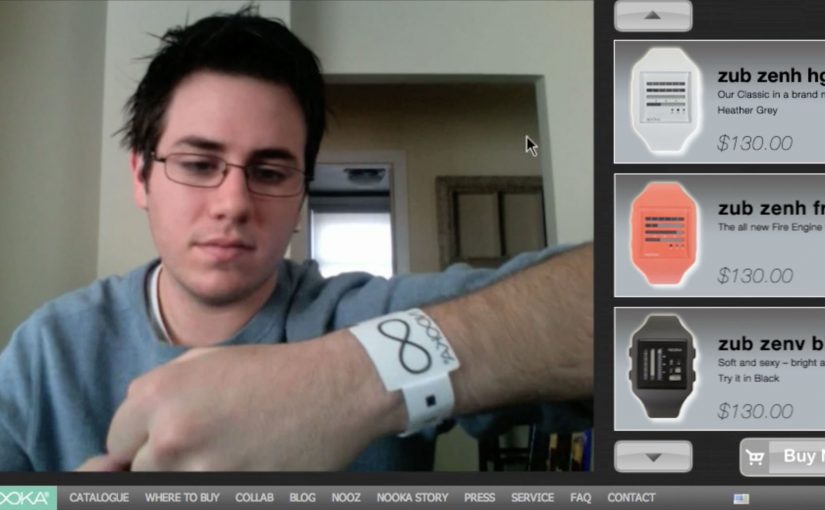
NOOKA watches created a video-led way to let you try out their watches virtually. All you need is a simple strip of NOOKA watch-representing paper to make it work, and once you see it in action, the idea becomes obvious.
A paper strip that turns your webcam into a fitting room
The mechanism is a coded wrist strip and a webcam. You place the strip on your wrist, hold your arm up to the camera, and the watch appears aligned to your wrist as you move. It is a fast, low-friction way to demonstrate “how it looks on me” without needing a physical product in hand.
Because the strip gives the webcam a stable reference, the overlay can track your wrist as it moves, which is what makes the preview feel believable.
In online retail, the fastest way to reduce hesitation is to replace abstract product specs with a visual proof the shopper can control.
The real question is whether you can turn “how will this look on me?” into a live proof the shopper can control before they decide.
Why this feels more convincing than a static product shot
Most product pages show the same images to everyone. This flips the experience from passive viewing to live preview. For look-and-fit products, a live preview like this is a stronger trust-builder than piling on more static shots. Even if the rendering is simple, the feeling of personalization comes from movement and alignment, not photorealism.
Extractable takeaway: If your product is bought on look and fit, design a try-on moment that uses a behavior people already understand (webcam + holding up your wrist), then make the payoff immediate so the demo does the selling.
Stealable moves for NOOKA’s print-to-digital bridge
By a “print to digital” bridge, I mean a physical cue that unlocks or anchors a digital preview in a way the viewer can control.
- Use a physical key. A simple strip, card, or marker makes the digital experience feel tangible and intentional.
- Keep the interaction one-step. The user should be able to try it within seconds, not after setup friction.
- Build for sharing. The best proof is something people can show a friend in the moment.
- Let the demo carry the story. If it needs heavy explanation, simplify the mechanic.
A few fast answers before you act
What is the NOOKA Augmented Reality Accessorizer?
It is an augmented reality try-on concept where a coded paper wrist strip and a webcam let a shopper preview a NOOKA watch aligned to their wrist in real time.
Why does a paper strip matter in an AR try-on?
It provides a consistent reference point for positioning and scale, and it makes the experience feel like a “real” object-assisted try-on rather than a random filter.
What makes this useful for e-commerce?
It reduces uncertainty about appearance and proportion. The shopper can see the watch on a wrist-sized reference and judge the look before buying.
What is one practical lesson to apply without AR?
Use a simple physical reference or on-screen guide that anchors scale and positioning, then let the shopper control the view quickly so the proof feels personal.
What is the main limitation of this type of approach?
It can show appearance and rough scale, but it cannot fully replicate comfort, weight, or how a strap feels. It works best as a confidence booster, not a perfect substitute for trying it on.