
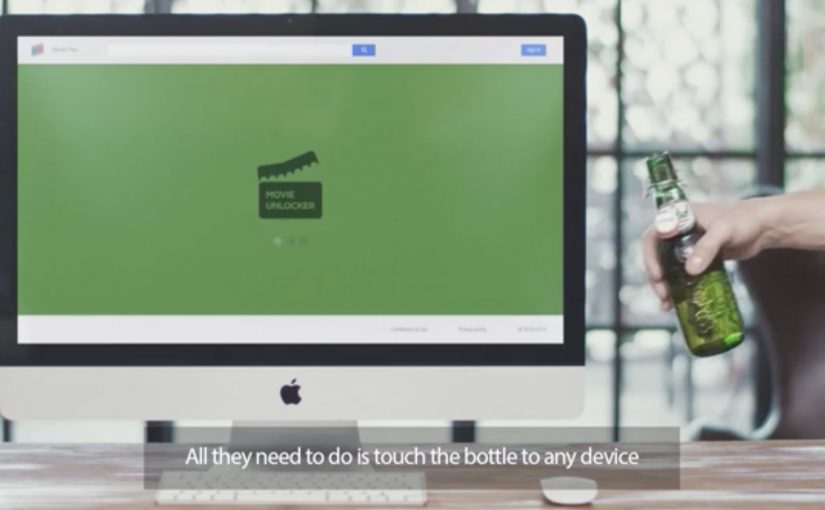
Grolsch: The Movie Unlocker

Grolsch: The Movie Unlocker

Paying for movies with a credit card is framed as yesterday’s behaviour. Grolsch positions a new alternative as “Movie Unlocker” technology, letting consumers use the beer bottle itself as the key to watch movies online.

The bottles are described as being fitted with custom Bluetooth beacons that transmit a unique code when brought close to a laptop or smartphone with Bluetooth Low Energy, or BLE, enabled. That code verifies the user and unlocks access to the chosen movie.

How the bottle becomes the checkout

The mechanism is a proximity-based redemption flow. Open the beer. Bring the bottle near your phone or laptop. The beacon transmits an identifier. The partner website receives it, validates it, and then grants access.

Functionally, it’s the same “code under the cap” idea, but moved from manual entry to a one-touch interaction triggered by distance and Bluetooth.

In consumer promotions, frictionless redemption mechanics often outperform bigger media spend because they turn the product into the access token.

Why “bottle-as-ticket” works

This lands because the value exchange is immediate and physical. The bottle is proof-of-purchase, and the unlock moment happens in the same context as consumption. At-home. On-device. With minimal steps. That makes the reward feel like a feature of the product, not a separate campaign hoop.

Extractable takeaway: If you want high participation in a reward mechanic, eliminate typing and logins where possible. Use a physical trigger that makes redemption feel like a natural extension of the product ritual.

What the brand is really optimizing

The real question is how to make purchase verification feel like part of the product experience rather than a separate redemption step.

Beyond “cool tech,” this is about repeat preference. It attaches a digital entertainment benefit to a beer purchase, creating a reason to choose Grolsch again the next time someone is deciding in-store.

What to steal from bottle-as-ticket

  • Turn proof-of-purchase into a trigger. Let the product initiate the unlock, not a coupon field.
  • Design for the living room moment. Redemption should work where consumption happens.
  • Keep the exchange legible. “Beer near device equals movie” is easy to explain.
  • Make authentication invisible. Users should feel the magic, not the plumbing.

A few fast answers before you act

What is Grolsch Movie Unlocker?

It’s a promotion mechanic where a beer bottle transmits a unique Bluetooth Low Energy code to help unlock a movie online.

What does BLE do here?

BLE enables low-power proximity communication so a nearby bottle can pass an identifier to a phone or laptop without pairing like a normal accessory.

Is this replacing payment or replacing a promo code?

It functions like replacing the promo code step with a proximity trigger. The “payment” is effectively the purchase of the beer tied to the unlock.

Why is this better than typing a code?

It reduces friction. Fewer steps usually means higher completion and less drop-off in promotional redemptions.

What’s the biggest practical risk?

Reliability and onboarding. If Bluetooth is off, compatibility is unclear, or the unlock flow is confusing, the perceived magic disappears fast.

Prigat: User Generated Orange Juice

Prigat: User Generated Orange Juice

Prigat, a leading company in the Israeli fruit juice market, launched one of the more inventive Facebook mechanics of its era. It invited people to squeeze real orange juice by doing something absurdly simple. Smile at your webcam.

The idea was packaged as “User Generated Orange Juice (UGOJ).” A Facebook application that translated user participation into a physical outcome you could actually watch.

The mechanism: your smile triggers a real machine

A custom Facebook app developed by Publicis E-Dologic used webcam-based smile detection to trigger a real, oversized juicer. When the app detected a smile, it activated the juicer and squeezed fresh oranges. Users could watch the machine live 24/7, so the cause-and-effect was visible rather than implied.

Campaign coverage also described a personalization touch where the participant’s name appeared on the machine during use, and that the resulting juice was directed to a charity choice.

In social platform marketing, physical proof loops outperform abstract engagement prompts because they give people a reason to believe and a reason to share.

Why this lands

This works because it turns a universal emotion into a measurable input. Smiling is effortless, socially contagious, and camera-friendly. The live feed makes the outcome undeniable, and that “I did this” ownership nudges people to recruit friends so their smiles compound into more visible results.

Extractable takeaway: If you want participation at scale, connect a low-friction action to a real-world output that people can witness in the moment, then make sharing feel like extending the impact, not like promoting the brand.

What Prigat is really doing

The campaign turns Facebook from a place for liking into a place for doing. The real question is how to turn a passive social audience into a participant who can see, trust, and share the brand experience. This is stronger than a standard Facebook giveaway because the proof is built into the interaction itself. It converts attention into a visible production line, then uses the live stream as credibility and the smile photos as distribution. Prigat gets warmth by associating the brand with positive emotion and generosity, while the machine supplies a visible proof point that keeps the story believable.

What to steal from the Prigat participation loop

  • Design a simple input. The easier the action, the more likely people repeat it and recruit others.
  • Show the output live. A real-time feed reduces skepticism and increases share-worthiness.
  • Make participation legible. If the user can see their effect immediately, they trust the loop.
  • Attach a social good endpoint. A charity destination converts novelty into meaning.

A few fast answers before you act

What is “User Generated Orange Juice” (UGOJ)?

It’s a Facebook app activation where users smile at a webcam and trigger a real juicer that squeezes fresh oranges, visible via a live stream.

How does the smile activation work?

The app uses webcam-based smile detection to decide when to trigger the juicer. The user’s action becomes the on-switch.

Why include a 24/7 live view of the juicer?

It provides proof. People can watch the result of participation, which increases trust and makes the story easier to share.

What kind of results were reported?

Reported results include around 30,000 new likes, over 20,000 photos uploaded, and roughly 40,000 oranges squeezed.

What’s the key risk if you copy this concept?

Trust and privacy perception. You need clear, simple communication that the webcam is used only to detect the smile for the interaction, and that the experience is safe and transparent.

NOOKA: Augmented Reality Accessorizer

NOOKA: Augmented Reality Accessorizer

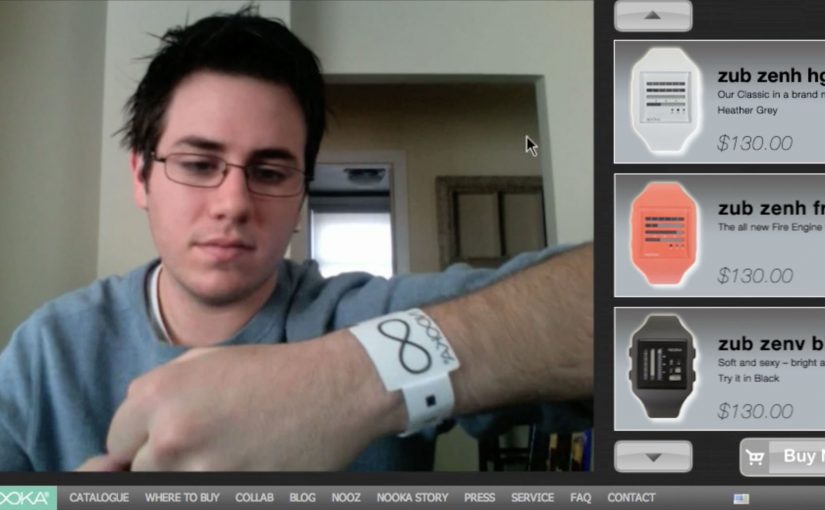
NOOKA watches created a video-led way to let you try out their watches virtually. All you need is a simple strip of NOOKA watch-representing paper to make it work, and once you see it in action, the idea becomes obvious.

A paper strip that turns your webcam into a fitting room

The mechanism is a coded wrist strip and a webcam. You place the strip on your wrist, hold your arm up to the camera, and the watch appears aligned to your wrist as you move. It is a fast, low-friction way to demonstrate “how it looks on me” without needing a physical product in hand.

Because the strip gives the webcam a stable reference, the overlay can track your wrist as it moves, which is what makes the preview feel believable.

In online retail, the fastest way to reduce hesitation is to replace abstract product specs with a visual proof the shopper can control.

The real question is whether you can turn “how will this look on me?” into a live proof the shopper can control before they decide.

Why this feels more convincing than a static product shot

Most product pages show the same images to everyone. This flips the experience from passive viewing to live preview. For look-and-fit products, a live preview like this is a stronger trust-builder than piling on more static shots. Even if the rendering is simple, the feeling of personalization comes from movement and alignment, not photorealism.

Extractable takeaway: If your product is bought on look and fit, design a try-on moment that uses a behavior people already understand (webcam + holding up your wrist), then make the payoff immediate so the demo does the selling.

Stealable moves for NOOKA’s print-to-digital bridge

By a “print to digital” bridge, I mean a physical cue that unlocks or anchors a digital preview in a way the viewer can control.

  • Use a physical key. A simple strip, card, or marker makes the digital experience feel tangible and intentional.
  • Keep the interaction one-step. The user should be able to try it within seconds, not after setup friction.
  • Build for sharing. The best proof is something people can show a friend in the moment.
  • Let the demo carry the story. If it needs heavy explanation, simplify the mechanic.

A few fast answers before you act

What is the NOOKA Augmented Reality Accessorizer?

It is an augmented reality try-on concept where a coded paper wrist strip and a webcam let a shopper preview a NOOKA watch aligned to their wrist in real time.

Why does a paper strip matter in an AR try-on?

It provides a consistent reference point for positioning and scale, and it makes the experience feel like a “real” object-assisted try-on rather than a random filter.

What makes this useful for e-commerce?

It reduces uncertainty about appearance and proportion. The shopper can see the watch on a wrist-sized reference and judge the look before buying.

What is one practical lesson to apply without AR?

Use a simple physical reference or on-screen guide that anchors scale and positioning, then let the shopper control the view quickly so the proof feels personal.

What is the main limitation of this type of approach?

It can show appearance and rough scale, but it cannot fully replicate comfort, weight, or how a strap feels. It works best as a confidence booster, not a perfect substitute for trying it on.