
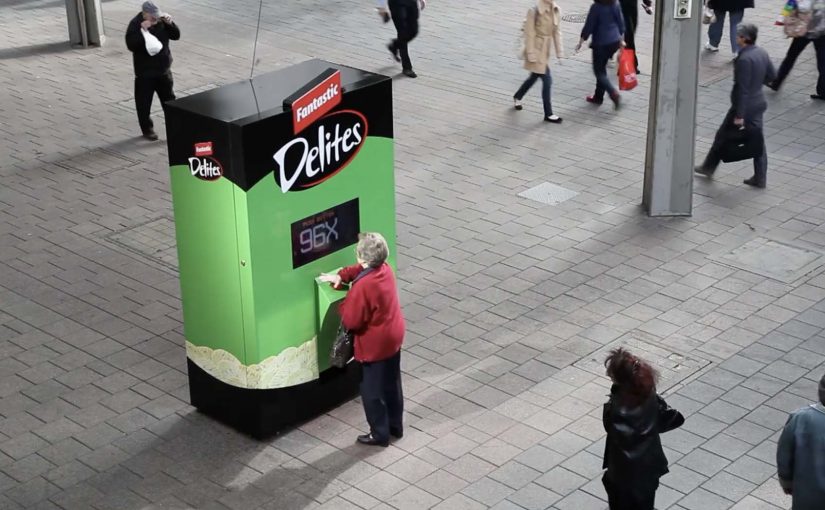
Fantastic Delites: Delite-O-Matic

In this latest example, ad agency Clemenger BBDO Adelaide set out to see how far people will go for a free pack of Fantastic Delites.

So a machine dubbed the “Delite-O-Matic” was created that gave people a free pack of Fantastic Delites by means of pushing a button hundreds of times or performing challenges. It was then put out on the streets to prove that because Fantastic Delites taste so good, people would go to incredible lengths to get them.

Sampling that people choose to earn

Interactive vending machines are a great way to get consumer participation and engagement on the ground. There are tons of examples out there, of which some have been covered here.

The mechanic that makes it watchable

The mechanism is effort-based reward. The machine sets an instruction, the participant complies, and the prize is dispensed only after the effort is visible. The escalating “work” becomes the entertainment, and the entertainment becomes the message.

In FMCG sampling and retail activations, interactive vending machines are a repeatable way to exchange effort for product trial.

That structure works because visible effort gives the crowd a simple story to follow before the product appears.

Why it lands

This works because it turns sampling into a story people can instantly judge. The point is not only “free snack”. The real question is what kind of visible effort makes a simple product feel worth watching and worth wanting. Each extra button press or challenge makes the product feel more desirable, and the crowd becomes a built-in audience.

Extractable takeaway: When you make the cost of entry visible, you turn a giveaway into a social moment. That moment carries the brand further than a silent handout ever could.

What to steal from Delite-O-Matic

  • Make the exchange legible: people should understand the rule in one glance, and the effort should be obvious on camera.
  • Escalate, then release: tension comes from “will they do it”. Satisfaction comes from the dispense moment.
  • Keep the prize simple: the product is the hero. The machine is the stage.
  • Design for bystanders: the best sampling stunts recruit a crowd even before the first pack comes out.
  • Let participation become proof: the more people comply, the stronger the implicit claim becomes.

A few fast answers before you act

What is the Delite-O-Matic?

It is an interactive vending machine activation that dispenses a free pack of Fantastic Delites after people complete button-mashing or challenge-style tasks.

Why use effort instead of a simple giveaway?

Effort creates a story. It increases attention, pulls in bystanders, and makes the reward moment feel earned, which boosts recall and sharing.

What’s the key behavioral trick?

Visible commitment. When people publicly invest effort, the product feels more “worth it”, and the scene becomes entertainment for everyone around.

Where does this work outside snacks?

Anywhere trial is the goal and the product is easy to dispense or unlock. Beauty samples, quick-service food, entertainment promos, and event activations.

What’s the main risk?

If the tasks feel humiliating or unfair, the tone can flip. The sweet spot is playful challenge with a clear, quick payoff.

NAB: The Honesty Experiments

Australian bank NAB positions Australians as an honest lot, and argues they deserve honest credit cards to match. To bring that promise to life, they conducted a series of “honesty experiments” and published the results on YouTube.

Incorrect Change

Lost Wallet

Leaky Pockets

From a product claim to a public proof loop

The mechanism is a classic credibility builder. A “public proof loop” means turning a claim into a repeatable test, then publishing the outcome so the audience can judge it. Run simple real-world tests where people can choose honesty, film the outcome, then let the audience do the judging rather than the brand doing the telling.

In retail banking categories, trust is built faster through observable behaviour than through promises and price claims.

The real question is whether a trust claim can be converted into something people can judge for themselves.

For trust-starved categories, this is a stronger play than another round of product-feature messaging.

Why it lands

These films work because they invite a low-friction emotional conclusion. People want to believe the best of others, and the experiments are structured to deliver that relief, then attach it to the brand stance. The content is also inherently shareable because it is about character, not about banking mechanics.

Extractable takeaway: If you want to own “trust,” do not describe it. Show a behaviour that audiences can recognise as trust in action, then connect it back to the product promise in one simple line.

Then NAB escalates to “thank you” in real time

To say thanks in the biggest possible way, NAB followed the experiments with a real-time stunt that thanked honest passers-by immediately after they returned lost objects.

What the second phase adds that video alone cannot

  • Immediate reciprocity. Honesty is met with an instant reward, not abstract praise.
  • A bigger emotional beat. Surprise gratitude creates a stronger memory than “you did the right thing.”
  • Proof at street level. The brand shows up in the moment of integrity, not after the fact.

What to replicate from NAB’s honesty experiments

  • Pick one human truth. “Most people are honest” is clearer than a bundle of values.
  • Design the choice point. The story lives in a single decision. Keep it simple and legible.
  • Let people self-identify. The viewer should be able to imagine themselves in the situation.
  • Add a second act. If phase one proves the belief, phase two can reward it and deepen the brand role.
  • Protect credibility. Be transparent about rules and ensure the reward does not feel staged or selective.

A few fast answers before you act

What are the “honesty experiments” in one sentence?

A set of filmed, real-world tests where strangers can choose to act honestly, used to support NAB’s “honest credit cards” positioning.

Why do social experiments work for trust-based brands?

They replace claims with observable behaviour. Viewers decide what the outcome means, which feels more credible than advertising language.

What does the real-time thank-you stunt add?

It turns the brand from narrator into participant, rewarding honesty immediately and creating a stronger emotional memory.

What is the biggest risk with this format?

Credibility erosion. If viewers suspect manipulation, selective editing, or unclear rules, the trust message can backfire.

What should you measure beyond views?

Brand trust lift, message association with the product, sentiment, share rate, and whether the work changes consideration versus competitors in the same period.

The Creative Ransom: Domain Hijack Job Hunt

In May 2010 an aspiring creative from the USA used Google to play upon the vanity of some top American creatives and land himself interviews and eventually a job.

Then in July 2011 a Dutch creative team created “The Twitter Hustle” to land a job with a big agency in the Netherlands.

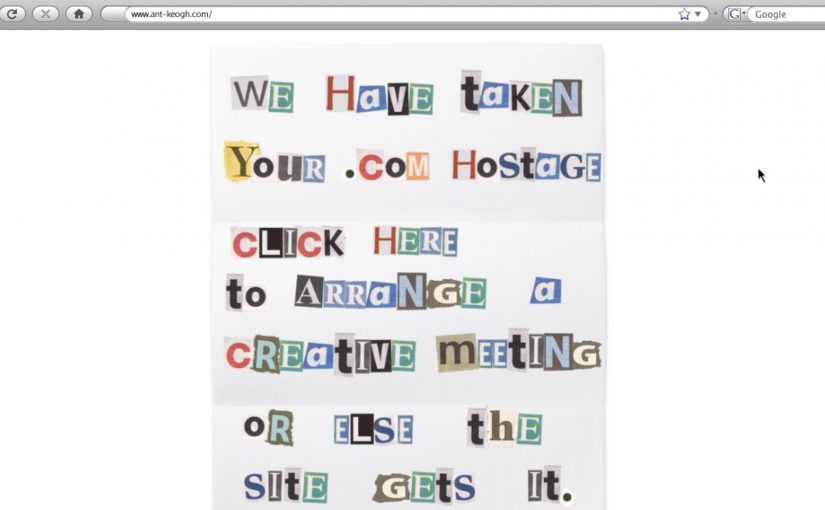
Now an Aussie creative team consisting of Andrew Grinter and Lee Spencer-Michaelsen take the job hunt to the next level. Their approach is to stand out from the crowd by buying domain names matching top creative directors in Melbourne, then sending ransom notes that point each target to their “hostage” URL.

The daring move gets them interviews. They are reported to have worn ski masks to those interviews, and still managed to get hired. The duo are also reportedly working for DTDigital, a division of Ogilvy Melbourne.

Ransom as a résumé

The mechanism is engineered interruption. First, choose a tiny list of people who can actually say “yes”. Next, buy the unclaimed name domains that would naturally belong to them. Then send a physical ransom note that forces a single action. Type the URL. When they land, the “ransom page” is really a portfolio pitch, personalised through the director’s own name.

In creative industry hiring markets where inbox outreach gets ignored, targeted disruption works when it is unmistakably personal and immediately resolves into craft.

Why it gets meetings

This is high-wire theatre with a simple psychological hook. You cannot half-notice your own name on a domain. The note creates curiosity and a tiny sense of urgency, and the landing page converts that spike of attention into proof of creative thinking.

Extractable takeaway: If you need decision-maker attention, design a one-to-one interruption that is impossible to confuse with spam, then make the first click deliver immediate evidence of your value.

The line between bold and dumb

There is a reason this one divides opinion. “Ransom” framing and identity-adjacent tactics can feel aggressive, even if the domains were available to buy. The stunt works as a story because it is extreme. That also makes it easy to copy badly.

The real question is whether the stunt creates enough admiration for the thinking before the intimidation becomes the headline.

What to steal without copying the threat

  • Steal the targeting. Make a short list of the only people who matter, and design for them.
  • Steal the personalisation. Use a bespoke hook that cannot be forwarded without losing its power.
  • Steal the proof-on-click. The first interaction should instantly demonstrate craft, not promise it.
  • Drop the menace. Keep the theatre, remove the coercion. Surprise beats intimidation.

A few fast answers before you act

What is “The Creative Ransom”?

A self-promotion job hunt where a Melbourne creative duo buys domain names matching senior creative directors, then uses ransom-style notes and landing pages to force a portfolio view and secure interviews.

What is the core mechanism?

Highly targeted interruption plus extreme personalisation. The target’s own name becomes the channel, and the landing page becomes the pitch.

Why does it work as a piece of communication?

It compresses a full narrative into one action. Open note. Type URL. See personalised page. The story is instantly retellable.

What should I copy from this, safely?

Copy the focus on a tiny list, the one-to-one hook, and the immediate proof of ability. Avoid coercive framing and anything that could be read as a threat.

What is a modern equivalent?

A personalised experience that appears exactly where a decision-maker already looks, then delivers unmistakable proof in seconds. Think bespoke microsites, tailored prototypes, or targeted creative drops, without the intimidation layer.