
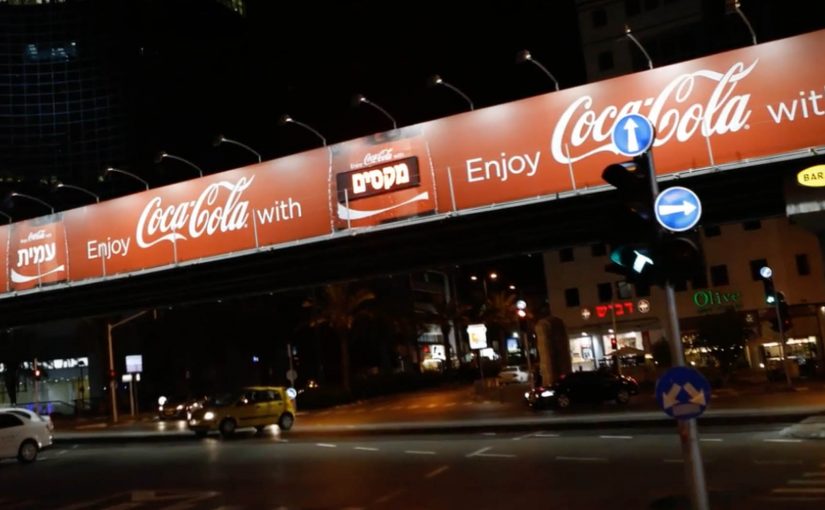
Coca-Cola: Personal Road

Coca-Cola has an ongoing global campaign that allows consumers to personalise bottles and cans…
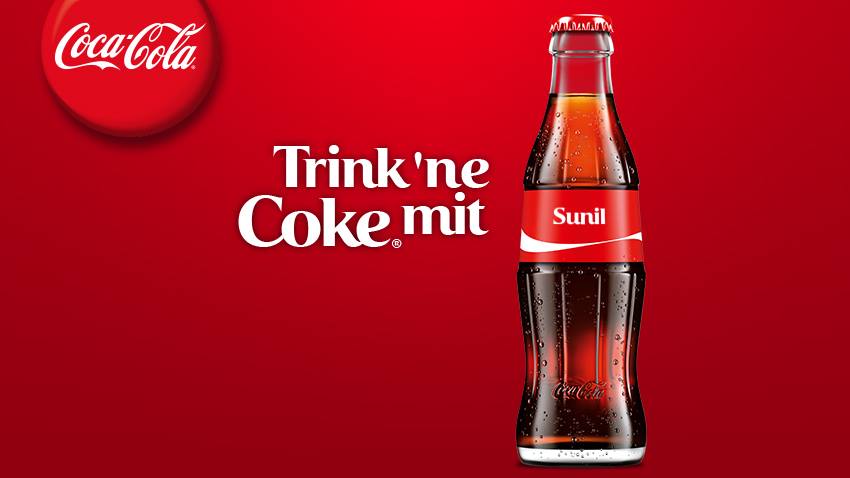
Enjoy a Coke with Sunil

Building on the success of this campaign Coca-Cola Israel decided to take the idea further with personalised billboards.

A mobile app was developed where consumers could enter their name. Then using geo-fence technology, the Coca-Cola billboard displayed the name when it was approached. The consumer at the same moment also received a message on their smartphone notifying them that their name was up there.

Since its launch the app has reached 100,000 downloads and is currently ranked #1 in Israel’s app store.

Why this extension makes sense

  • It keeps the personalization promise. The name is not only on the package. It shows up in the world around you.
  • Location makes it feel “for me”. The moment you approach the billboard, the experience becomes uniquely yours.
  • Mobile closes the loop. The phone notification confirms the moment and turns it into something you can share.

The reusable pattern

Start with a personalization mechanic people already understand. Then add a single “surprise and confirm” moment in the real world, powered by location and a simple mobile action.


A few fast answers before you act

What is Coca-Cola “Personal Road”?

It is a Coca-Cola Israel extension of the personalised-name campaign that uses a mobile app and geofencing so a billboard displays your name as you approach, and your phone notifies you.

How does the billboard know when to show a name?

The app uses geo-fence technology to detect proximity, then triggers the personalised billboard moment when the user approaches.

Why pair the billboard moment with a smartphone message?

The message confirms what just happened and makes it easy for the consumer to capture and share the experience.

What is the key takeaway for location-based campaigns?

Make the rule simple and the payoff instant: one input from the consumer, one visible personalised output, and one mobile confirmation that seals the memory.

Ring my bell

Shoe brand Aldo in Israel organized a guerilla stunt where passers-by had to stand on a welcome mat, take a picture of their shoes, upload it to Instagram, hashtag #ALDO and add their shoe size. After successfully completing this task they were asked to ring the bell in front of them and wait for 120 seconds. Post which they received a surprise gift. 😉

James Ready: Billboard coupon savings

James Ready beer and Leo Burnett Toronto are back with another campaign built around the same consumer truth. People want to afford more beer.

To help, James Ready introduced “billboard coupons,” a way to save money on life necessities like food, dry cleaning, and grooming. The idea is simple. If you save money elsewhere, you have more money left for beer.

By partnering with local retailers, the program lets people take a picture of a billboard and show the photo at the corresponding retailer to receive savings on selected products and services.

In promotion-heavy categories, the most scalable mechanics are the ones that turn a common behaviour into redemption. Here the behaviour is taking a photo.

A billboard that behaves like a coupon book

This flips the billboard role. Instead of being pure awareness, it becomes a utility object you can “carry” with you via a phone photo. That change matters because it extends the life of the message beyond the moment you drive past it.

Standalone takeaway: The best OOH-led promotions create a portable proof-of-value. If the audience can store it in their camera roll, the media becomes a tool, not just a reminder.

The mechanism: proof without printing

Traditionally, coupon programs rely on physical handouts or codes people forget. This uses a behaviour people already do without thinking. Photograph something. The photo becomes the redemption token.

The retailer partnership layer is what turns it from gimmick to program. It gives the billboard a reason to exist in specific neighbourhoods and creates a story local businesses can also talk about.

Why it works for a beer brand

James Ready positions itself around everyday value and a slightly cheeky, practical tone. Saving on dry cleaning and food is not glamorous, but that is the point. It makes the brand feel like it is on the consumer’s side.

There is also a subtle psychological move here. The “more beer money” framing makes saving feel like a win, not a sacrifice.

What to steal from billboard coupons

  • Use a universal behaviour as the trigger. Photos, texts, taps. Avoid anything that needs training.
  • Make redemption low-friction. “Show the photo” is simpler than entering codes or printing.
  • Partner for legitimacy. Retail partners turn a brand stunt into a usable savings program.
  • Design for memory. A billboard must communicate the entire mechanic in seconds.
  • Keep the value proposition honest. Small, real savings beat big, unbelievable promises.

A few fast answers before you act

What are “billboard coupons” in this James Ready campaign?

They are offers displayed on billboards that people photograph on their phones and then redeem by showing the photo at participating local retailers.

Why use photos instead of QR codes or SMS?

Because it reduces friction and works with basic phones and habits. Taking a photo is fast, familiar, and the image becomes a simple proof token.

What makes this more than a one-off stunt?

The retailer partnership network. When multiple local businesses honour the offers, the campaign becomes an ongoing utility rather than a single execution.

What is the biggest risk operationally?

Inconsistent redemption. If staff are not trained or offers are unclear, customers feel embarrassed and the brand takes the blame. Execution discipline matters.

How could a brand adapt this pattern today?

Keep the “portable proof” principle, but use a clearer redemption mechanism where appropriate. A scannable image or an in-wallet pass can preserve simplicity while improving tracking.