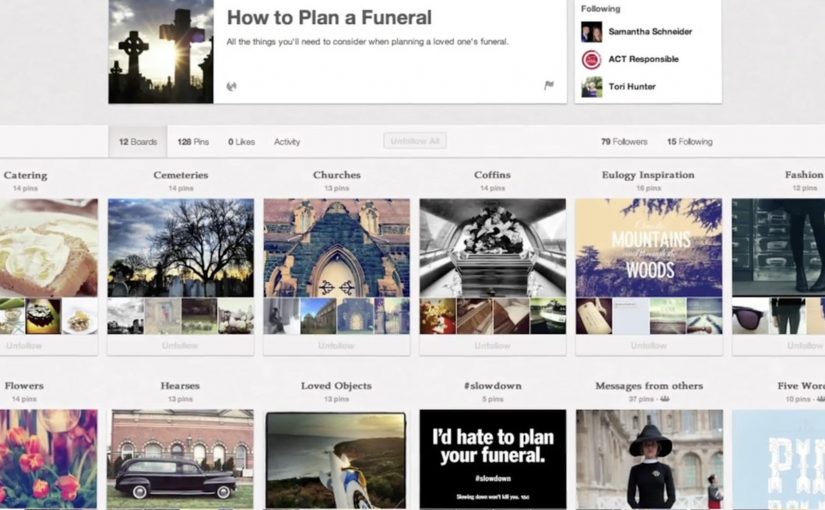
In September 2012, the Transport Accident Commission (TAC) in Australia runs a Pinterest campaign with a line that lands like a punch: How to plan a funeral.
The idea is aimed at girlfriends and mothers of young men. The case frames the problem bluntly. Young men are far more likely to die in a crash than young women, and speeding is positioned as a primary contributor to those fatalities.
How Pinterest becomes a road-safety channel
The mechanism uses Pinterest boards that look like practical inspiration for funerals. Images and pins map to real funeral-planning themes, then steer toward the campaign’s message: “I’d hate to plan your funeral. Slowing down won’t kill you.” That works because the planning format lowers resistance before the safety message lands.
In road-safety behavior change, the most effective interventions often come from trusted relationships rather than institutional authority.
Why it lands
It shifts the emotional weight. Instead of telling a driver what TAC wants, it lets a partner or parent express what they fear. Pinterest is a deliberate platform choice because the boards feel like a real place someone would browse for “ideas”, which makes the moment of recognition more personal and more unsettling.
Extractable takeaway: If you need behavior change, route the message through the person with social permission to say it, meaning someone whose concern will be heard as care rather than control. Then build the media experience so it feels like everyday browsing, not an “ad break”.
What the campaign is really optimizing for
This is not trying to win an argument about enforcement. It is trying to trigger a conversation at home. The work uses a shareable, repeatable line that people can copy in their own words, because a close person saying it carries more force than a government body broadcasting it.
The real question is how to make the warning come from someone the driver will actually hear before the risky behavior happens.
The stronger strategic move here is to design for the relationship, not for the institution.
What to steal for your own safety or health campaign
- Design for the messenger. Decide who the audience will actually listen to, then craft the creative for that relationship.
- Choose a platform that matches the behavior. If the message is “planning” and “ideas”, a board format can feel native.
- Use one line people can borrow. If supporters cannot repeat it verbatim or paraphrase it easily, it will not travel.
- Make the consequence concrete. “Funeral planning” is an action. It forces imagination to do the work.
A few fast answers before you act
What is the core idea of How to Plan a Funeral?
A TAC Pinterest presence that looks like funeral-planning inspiration, designed to help girlfriends and mothers deliver a more impactful “slow down” message to young men.
Why use Pinterest instead of a typical road-safety ad format?
Because the browsing context feels personal and practical. That makes the emotional message land as something a loved one would stumble into and share, not something an authority announces.
What is the key insight behind the campaign line?
A close relationship can say what an institution cannot. “I’d hate to plan your funeral” is a social message first, and a safety message second.
Who is the message really meant to activate?
Girlfriends and mothers of young men. The campaign is built for the people whose concern is more likely to be heard as care than control.
What is the biggest risk in copying this approach?
If the platform context feels forced or exploitative, people disengage. The creative must feel native to the behavior on that platform, and the tone must stay respectful.