
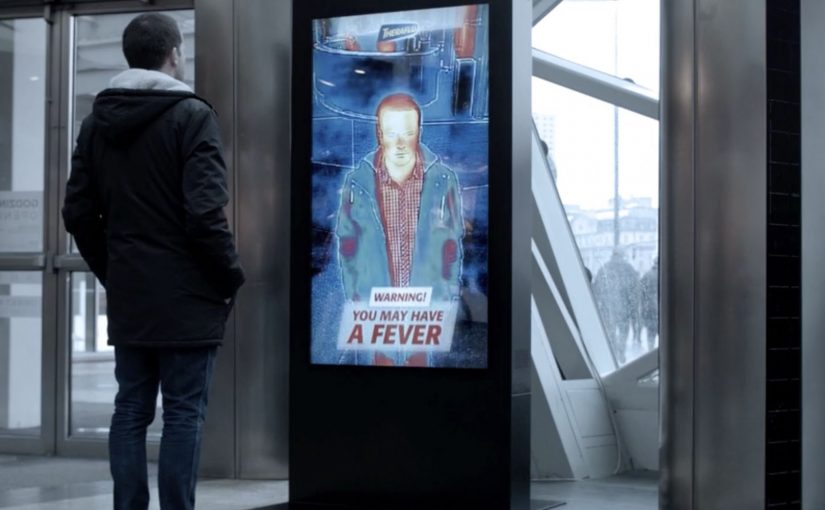
Theraflu: Thermoscanner

With the start of flu season, Theraflu in Poland wants to create a tool that lets passersby check if they have a fever without interrupting their daily commute.

So Saatchi & Saatchi develops what is billed as the world’s first outdoor ad with a live thermo-scanner camera, able to check the body temperature of the person standing next to it in real time.

The thermo-ad also lets people take a thermo-selfie, which here means a thermal-style image of themselves, download it via a microsite or QR code, and share it using the hashtag #TherafluThermoscanner, or send it by email to their boss as an explanation for absence.

Turning a symptom into an instant public check

The mechanism is a simple swap. Thermal cameras are usually associated with controlled environments like airports or clinics. Here, that same visual language is put into a familiar citylight so the “should I worry?” moment can happen on the street, in seconds. That shift matters because it turns a clinical signal into a low-friction commuter interaction, which is why the idea feels immediately useful instead of purely theatrical.

In European commuter cities, out-of-home works best when it adds utility without forcing people to break stride.

Why it lands

This works because it respects the reality of flu season behavior. Many people keep moving even when they feel off. The installation meets them where they already are, makes the result legible at a glance, and gives them an immediately shareable artifact that doubles as social proof and practical communication.

Extractable takeaway: If your message is health-related and time-sensitive, design a public utility that produces a clear personal output. Then make that output easy to reuse in the next real decision the person has to make.

What Theraflu is really buying

Beyond awareness, the ad builds a reason to act early. It reframes “flu medicine” from a product you remember later into a category you prepare for now, while the viewer is still in the mindset of assessing symptoms and deciding what to do next. The real question is how to make symptom checking feel immediate enough to trigger action before people default to pushing through the day. The stronger play here is utility-led brand framing, not spectacle for its own sake.

What to steal from the Thermoscanner

  • Embed the benefit inside the medium. If the media unit demonstrates the promise, the claim needs less persuasion.
  • Make the result portable. A shareable scan turns one interaction into many impressions.
  • Design for the commute. Fast, glanceable, and low-effort beats “immersive” when people are in motion.
  • Give sharing a job. Social posting is optional. Emailing a boss is a real utility hook.

A few fast answers before you act

What is the Theraflu Thermoscanner?

It is an interactive outdoor ad that uses a live thermal camera to estimate body temperature in real time and indicate whether a passerby may have a fever.

Why put a thermo-scanner in an outdoor ad?

It makes fever detection feel instant and accessible during daily routines, and it turns a brand message into a practical tool.

What is a thermo-selfie here?

It is a thermal-style image generated from the scan that people can download and share, or send as a message to explain they may be unwell.

What makes this more than a gimmick?

It is tied to a real, time-sensitive decision. “Do I have a fever?” and it delivers an output that can be reused immediately.

How can other brands apply the pattern?

Find a high-friction question people avoid answering, then build a quick public utility that returns a clear personal result and a shareable artifact.
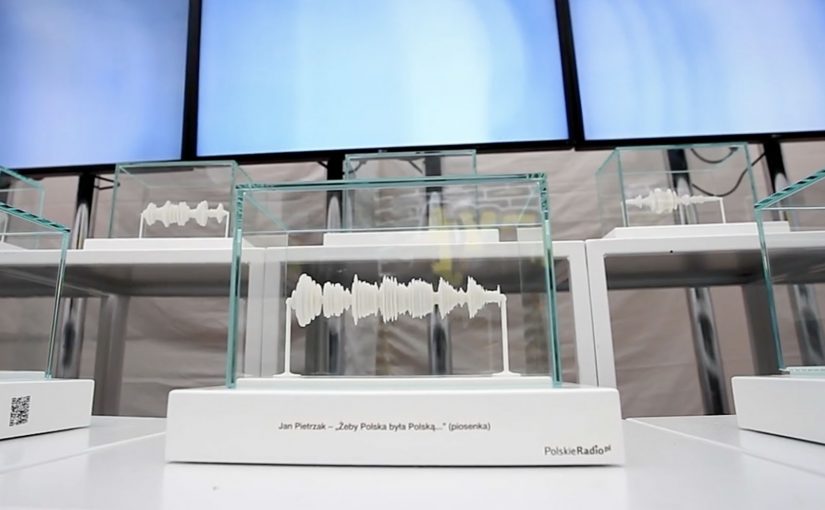
Touch the Sound: 3D printed radio history

PolskieRadio.pl is described as a news portal with the largest radio recordings database in Poland. To promote it at Science Picnic in Warsaw, Hypermedia Isobar creates a special event built around one simple idea: make sound physically touchable.

Using 3D printing technology, they print out some of the most famous historical radio recordings, turning audio into tangible objects that visitors can hold and explore as “important sounds” of the 20th century.

How “sound you can touch” is staged

The experience works because it is instantly legible on a crowded show floor. You see unusual 3D printed forms, you learn they represent famous recordings, and you understand the invitation without needing a demo or instruction manual.

Instead of asking people to browse a deep archive, the activation turns the archive into a physical exhibit. That shift changes the audience mindset from “searching content” to “discovering artifacts”.

The real question is whether your archive can become something people discover in the room before they ever search it online.

In European public media and culture marketing, giving people a hands-on way to experience an intangible archive can outperform any “come visit our site” message.

Why this fits Science Picnic

Science Picnic is positioned as a hands-on, experiment-first environment. A 3D printed sound object belongs there because it feels like a real scientific trick: invisible data becomes a thing you can touch, compare, and talk about with strangers.

Extractable takeaway: When your asset is intangible, design the first touchpoint as a hands-on reveal that people can explain to each other in a sentence.

How to make an archive feel physical

  • Materialize the invisible. If your product is digital, give people a physical handle on the idea.
  • Start with curiosity, then explain. A strange object earns attention before any copy does.
  • Turn an archive into a highlight reel. People engage faster when you curate “the famous 10” rather than expose “the full 10,000”.
  • Design for conversation. Installations that provoke “what is that?” get shared on the spot.

Last year tourists visiting the La Rambla neighborhood in Barcelona also experienced 3D printing technology. But at that time they were able to pose and create their very own three-dimensional statues.


A few fast answers before you act

What is “Touch the Sound” for PolskieRadio.pl?

It is a live event concept where famous historical radio recordings are turned into 3D printed objects, so visitors can literally touch “sounds” as physical artifacts.

Why use 3D printing for a radio archive?

Because it converts an intangible asset into a tangible experience. People understand the idea instantly and remember it because it feels like a scientific reveal.

Why does this kind of activation work at a science fair?

Science fairs reward hands-on discovery. A physical “sound object” matches the environment, so visitors treat it like an exhibit rather than an ad.

What is the key strategic benefit for the brand?

It reframes a large digital archive as cultural heritage worth exploring, and it creates a memorable story people can retell in one sentence.

What is the most transferable lesson?

If your brand owns data, recordings, or digital history, curate the best pieces and give people a tactile, participatory way to encounter them.

McDonalds Hamburger Timetable

You wait for a train at Warsaw’s Central Station and check the departure board. Everything looks normal at first. Destination, track number, platform. Then you notice the twist. The wait time is not shown in minutes. It is shown in hamburgers, cokes and fries.

The idea. Make waiting feel shorter by making it measurable

McDonalds in Poland finds a creative way to make waiting for the train less agonizing for passengers and more profitable for its trainside location. The board translates delay time into a simple, food-based unit people instantly understand.

How it works at the station

In cooperation with PKP (Polish State Railways), McDonalds installs a special timetable about 50 meters from the main hub of Warsaw’s Central Train Station. It displays departure time, destination, track number, and platform information as usual. The difference is the wait and delay time, which appears as burgers, cokes and fries.

In transit retail, waiting time is one of the few moments when attention and immediate purchase intent sit in the same place.

Why this lands as a smart retail nudge

Here, a retail nudge means a light prompt that changes the next action without forcing it. The mechanic does not interrupt. It reframes the moment. The real question is how to turn dead waiting time into a branded action without making the brand feel intrusive. Because the board converts minutes into food units, grabbing food becomes the obvious way to spend the time. McDonalds is right to keep this utility first, brand second, because that is what makes the prompt feel clever rather than pushy.

Extractable takeaway: When a brand translates spare time into a simple unit tied to an immediate action, the message feels useful first and persuasive second.

What the result signals

While making the train station a more enjoyable place for waiting passengers, McDonalds sees an increase of 4,500 customers in the first month itself. The business intent is clear: convert idle station time into store traffic at the moment of highest relevance.

What to steal for retail nudges in waiting moments

  • Translate time into a brand-shaped unit. When minutes become “one burger”, the next action becomes self-evident.
  • Place the nudge exactly at the decision point. The board sits in the flow of passengers, not in a separate ad zone.
  • Keep the mechanic utility-first. It still behaves like a timetable, so people accept it instead of resisting it.
  • Make the conversion instantly readable. If it takes explanation, the moment is already gone.

A few fast answers before you act

What is the McDonalds Hamburger Timetable?

It is a train timetable that displays delay and waiting time as McDonalds menu items, like burgers, fries and Coke, instead of minutes.

Why does converting minutes into food items influence behaviour?

Because it makes the wait feel like “time you can spend” rather than “time you lose”. It also provides a natural suggestion for what to do next without using a hard call-to-action.

What makes this feel helpful instead of salesy?

It behaves like a real timetable first and a brand cue second. That utility lowers resistance because the brand message is embedded in something people already need to read.

What is the core design lesson?

Translate a boring metric into a simple, brand-linked unit that is immediately understood, and place it exactly where the decision happens.

Where else can this pattern work?

Any waiting context with nearby commerce. Transit hubs, queues, ticketing areas, and event entry points all benefit when “time to kill” becomes “time to enjoy”.