
Renault Espace: iPad 360° View

Renault Espace: iPad 360° View

The Renault Espace is a large MPV from French car-maker Renault. With a new iPad app, Renault gives users an onboard view of the Espace like never before.

The application is a 360 degree interactive video. All you need to do is tilt your iPad and explore different angles as if you were right there.

A virtual showroom that behaves like your head

The mechanism is refreshingly direct. The app uses the iPad’s motion sensors to map physical movement to viewpoint changes inside the car. Instead of tapping through static photos, you “look around” by moving the device. It is a smart use of motion sensing because it keeps the interface invisible and the focus on the cabin.

In automotive consideration journeys, anything that increases spatial understanding of the interior helps bridge the gap between online browsing and a test drive.

Why it lands

Interior experience is one of the hardest things to communicate in standard car marketing. This solves that by letting the user control perspective. It also creates a calmer kind of interactivity. No menus, no instructions, no friction. Just tilt and explore.

Extractable takeaway: When your product has a strong spatial component, give people viewer control over perspective. It builds confidence faster than adding more copy.

What Renault is really trying to achieve

The real question is whether this kind of “tilt to explore” experience reduces uncertainty enough to make a showroom visit feel worth it.

This is a digital test-sit, a lightweight simulation of sitting in the cabin so you can judge layout and comfort before a showroom visit. It is designed to make the Espace feel accessible before a showroom visit, and to reduce uncertainty about cabin layout, visibility, and perceived comfort. Done well, it also keeps attention longer than a typical brochure flow.

Steal this for spatial product demos

  • Use motion as navigation. If the device supports it, motion control can feel more natural than UI controls.
  • Keep the interaction single-mode. One behaviour. Tilt to look. That simplicity is the feature.
  • Prioritise the interior. For family vehicles, cabin experience often sells more than exterior styling.
  • Let curiosity drive. Give users freedom to explore, rather than forcing a predetermined tour.
  • Make it fast to load. Interactive video dies when buffering becomes the dominant experience.

A few fast answers before you act

What is this Renault Espace iPad app in one sentence?

It is an iPad experience that uses a 360 degree interactive onboard video so users can tilt the device to explore the Espace interior from different angles.

Why use 360 video instead of a standard photo gallery?

Because it communicates space and layout more effectively. Users can look where they want, which reduces uncertainty faster than scrolling images.

What makes “tilt to explore” feel intuitive?

It mirrors how people look around in real life. Physical movement maps directly to viewpoint changes, so interaction feels natural.

What is the main execution risk?

Performance. If motion tracking feels laggy, or the video quality is poor, users will abandon quickly and the experience will feel like a gimmick.

What should you measure if you ship this type of experience?

Time spent, percentage of users who explore multiple viewpoints, completion rate, repeat sessions, and whether it correlates with test-drive requests or dealer inquiries.
Renault Wind Roadster: 12 Second Strip

Renault Wind Roadster: 12 Second Strip

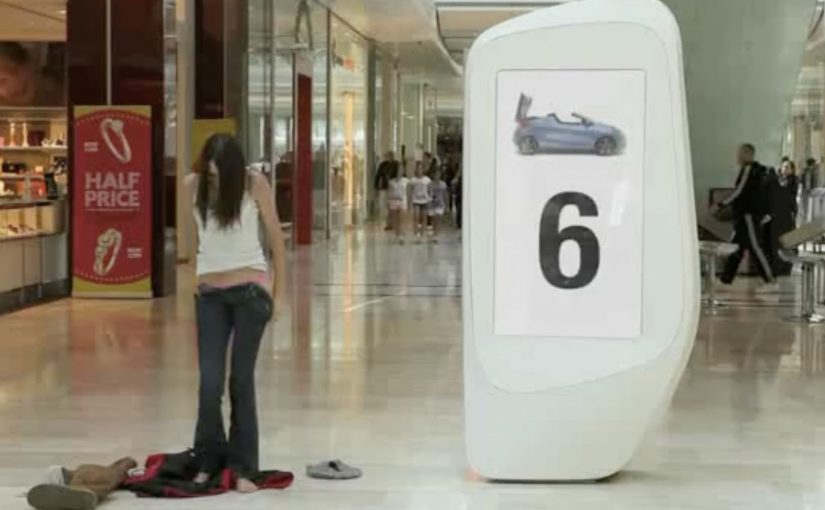
Renault UK and ad agency Publicis London set up “12 Second Strip”, a challenge that asks people to strip down to one layer of clothing in 12 seconds in the hope of winning the brand new Renault Wind Roadster.

The challenge involves people stripping down to one layer of clothing in just 12 seconds, which is the same amount of time it takes Renault’s new Wind Roadster to drop its top. To participate, people post their fun and tasteful strip videos on YouTube.

A product demo turned into a timed dare

The execution takes a single, memorable product fact. The roof moves in 12 seconds. Then it builds a challenge around that exact number, so the “proof” of the car becomes the rule of the game.

The mechanic: match the roof with your own 12 seconds

It is straightforward. Record a short clip where you race the clock to get down to one layer. Upload it. The format is repeatable, the constraint is clear, and the brand’s key claim stays embedded in every entry.

In UK automotive launches, time-based challenges work best when they translate a feature into something the audience can perform, share, and compare without needing a long explanation.

Why this lands as shareable UGC

The concept is light, competitive, and easy to understand at a glance. The “one layer” rule keeps it positioned as playful rather than explicit, while the 12-second constraint gives it a built-in hook that makes clips watchable and easy to forward.

Extractable takeaway: If you have one standout feature, convert it into a public constraint. Constraints create format. Format creates volume. Volume creates recall.

What Renault is really buying

The real question is whether a product claim can be turned into a repeatable public behavior without losing the brand point.

This is attention that carries product memory. Every participant repeats the roof story through action, and every viewer gets the same message without feeling like they are watching a conventional car ad.

What to steal for your next challenge-based campaign

  • Start with one sharp product truth. The best UGC formats begin with a single claim people can repeat.
  • Make the rule the message. If the rule changes, the brand meaning should not disappear.
  • Keep it simple to enter. Short clips, one constraint, one destination.
  • Write safety and tastefulness into the brief. Clear boundaries protect both the audience and the brand.

A few fast answers before you act

What is 12 Second Strip?

It is a Renault UK challenge that asks people to strip down to one layer of clothing in 12 seconds, mirroring the time it takes the Renault Wind Roadster’s roof to drop.

Why anchor the challenge to “12 seconds”?

Because it turns a feature into a format. The number becomes a rule that forces every entry to carry the same product story.

What makes this a strong user-generated format?

It is easy to understand, fast to produce, and inherently comparable. Viewers can instantly judge attempts and share the best ones.

How do you keep a provocative mechanic brand-safe?

Set a clear boundary inside the format. Here, the one-layer rule keeps the participation playful and recognizable without pushing it into something more explicit.

What is the main brand lesson here?

Make your most distinctive proof point performable. When the audience can reenact a claim, it travels further than a slogan.