
Radio Geister: When the Crash Site Talks Back

When you drive past a crash site, the warning follows you

One of the most chilling awareness ideas in recent memory does not start on a screen. It starts at the roadside.

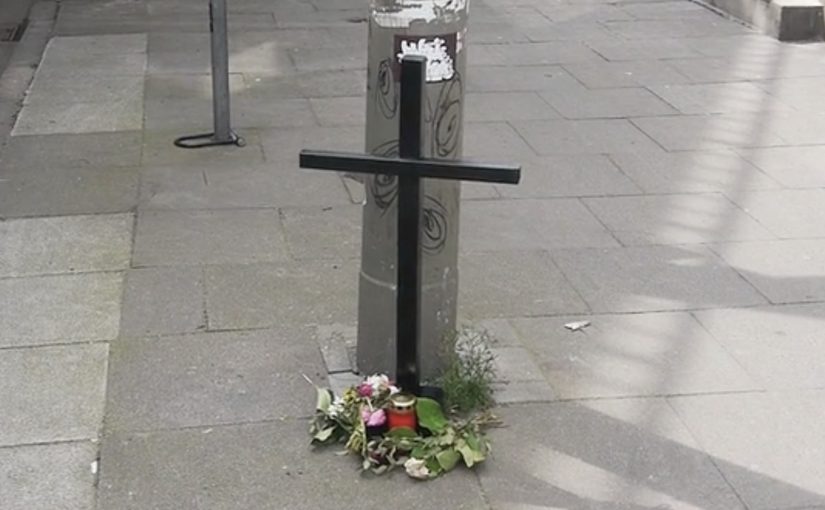
For “Radio Geister” (Radio Ghosts), small radio stations in the shape of wooden death crosses are placed around Hamburg at sites where alcohol-related car accidents had happened. As young drivers approach, these mini transmitters interrupt the signal of popular radio stations. In place of music, the driver hears a radio spot voiced from the perspective of someone who died in a drunk-driving crash.

The mechanic: audio interruption tied to the exact location

The project combines two moves. First, it uses physical markers that already mean something in the real world. The roadside cross. Second, it turns radio into a proximity medium by briefly overriding a station’s signal at the moment a driver is physically passing the place where something irreversible happened.

The radio spots themselves are written as first-person accounts from fatal accident victims, which makes the interruption feel less like an ad and more like a presence.

In European road-safety communication, the fastest way to break through denial is to connect a real place, a real habit, and a real consequence into one unavoidable moment.

Why it lands

This is a stronger road-safety intervention than a conventional awareness spot because it weaponizes context. The message does not arrive while someone is “in awareness mode.” It arrives while they are driving, listening to the stations they actually use, in a location that proves the stakes. The interruption is also proportionate. It is brief, but it is intrusive enough to create a jolt, which is exactly what complacency needs.

Extractable takeaway: If you need to change risky behavior, deliver the warning inside the behavior, not around it. Tie it to a specific place and a familiar channel, and the mind cannot file it away as generic advice.

What the campaign is trying to change

The framing used in campaign write-ups is stark. “One out of eleven deaths caused by car accidents has to do with drinking and driving.” Whether or not you accept the exact ratio, the creative intent is clear. Replace abstract statistics with a felt experience that young drivers will remember the next time they consider driving after drinking.

The real question is not whether young drivers know the rule, but whether the warning can reach them inside the exact driving moment when denial still feels safer than restraint.

What road-safety campaigns can steal from this

  • Use the environment as proof. A crash site is a more credible media placement than any billboard.
  • Interrupt the comfort loop. If the risky habit is paired with entertainment, break the entertainment briefly.
  • Write from a human perspective. First-person voice makes consequences feel immediate, not theoretical.
  • Keep it simple, keep it sharp. One moment of shock can beat a long lecture.

A few fast answers before you act

What is “Radio Geister” (Radio Ghosts)?

It is a road-safety awareness project that places cross-shaped mini transmitters at crash sites to interrupt popular radio stations with warnings voiced from the perspective of drunk-driving victims.

What is the core mechanic?

Location-triggered audio interruption. As drivers pass the crash site, their radio station is briefly overridden by the campaign message.

Why use radio for this instead of posters or video?

Because radio is already in the car, already on, and already trusted as a companion. The message arrives in the exact medium the driver is using in the moment that matters.

Why is the crash-site placement so important?

The location turns the warning into evidence. It signals that this happened here, to someone real, not in a hypothetical scenario.

What is the transferable lesson for behavior-change campaigns?

Do not ask people to imagine consequences later. Insert consequences into the live context where the decision is being made.
Shell: Pedestrian Ghost

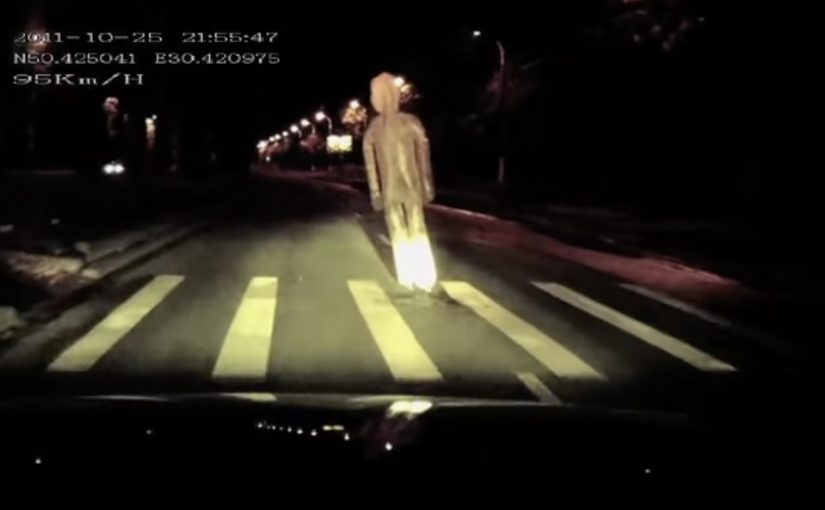
A driver approaches a crosswalk too fast. A “pedestrian” suddenly appears from a manhole cover, then shoots up into the sky like a soul escaping. The only sane response is to slow down.

Speeding cars and pedestrian safety is a huge problem in Ukraine. Ukraine is described as having the highest percentage of pedestrian collisions in Eastern Europe at 56%. To make people think twice about speeding, Shell along with JWT Ukraine created an ambient campaign called the Pedestrian Ghost, a person-shaped helium decoy that appears only when a driver is speeding. The campaign ran during Halloween and generated a lot of buzz over the internet.

A ghost that only shows up when you speed

The mechanism is built for one job. A radar detects an approaching vehicle that exceeds the speed limit. When the threshold is crossed, a hidden device integrated into a manhole cover inflates a person-shaped “ghost” using helium-filled balloons. The figure rises fast and disappears upward, creating a moment that feels like you just hit someone, even though nothing living is harmed.

In dense city streets where drivers routinely treat crosswalks as negotiable, the sharpest safety interventions are the ones that create a visceral consequence in the exact second a bad decision is made.

The real question is how to make speeding feel consequential before harm happens.

Why it lands

It works because it weaponizes surprise without needing explanation. The ghost is unmistakably human-shaped, the timing is unmistakably linked to speed, and the “escape” into the sky reads like consequence. That instant cause-and-effect loop is what resets behavior, at least for the next few blocks. For road-safety messaging, this is the right trade-off: simulate consequence hard enough to reset behavior, but never create real danger.

Extractable takeaway: If you want to interrupt dangerous habits, trigger the intervention only at the violation moment, and make the feedback so immediate and legible that drivers connect cause and effect without being told.

What this crosswalk ghost gets right

  • Trigger only on the infraction. The selectivity makes the moment feel targeted, not random.
  • Use a single, readable symbol. A human silhouette beats a statistic for behavior change.
  • Design for “I have to tell someone”. A story people can repeat in one sentence becomes earned media.
  • Keep the intervention non-injurious. The fear is simulated, the outcome is safe.

A few fast answers before you act

What is “Pedestrian Ghost”?

An ambient road-safety stunt where a ghost-like pedestrian figure rises from a manhole cover at a crosswalk when a radar detects a speeding car, forcing drivers to slow down.

What is the core mechanism?

Radar detects speeding. A concealed device inflates a person-shaped helium “ghost” and releases it upward. The driver experiences an immediate, consequence-like shock without any real harm.

Why does it change behavior better than a warning sign?

Because the feedback is timed to the violation and feels personal. The driver is not being advised. They are being startled at the exact moment of risk.

What is the biggest failure mode if I copy this pattern?

Unreliable triggering. If the effect fires at the wrong time, or too often, people stop believing the cause-and-effect link and the intervention becomes noise.

What is the simplest modern variant?

A violation-triggered intervention that is immediate, physical, and unmistakably tied to speed. For example light, sound, or motion that only activates above a threshold at the crosswalk.

Mercedes-Benz: Transparent Walls for PRE-SAFE

For the PRE-SAFE® precrash system from Mercedes-Benz, ad agency Jung von Matt in Germany set out to make chaotic traffic intersections safer.

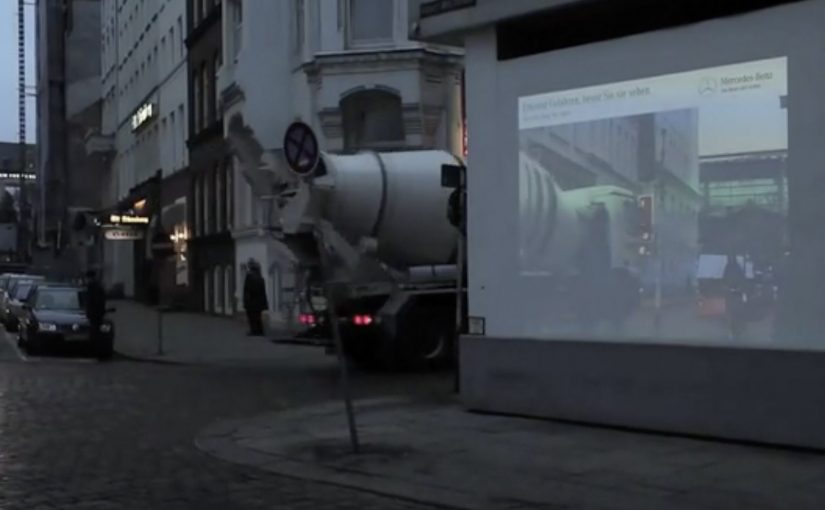
The idea was to let everyone “look around the corner” as if walls were transparent. In this execution, “transparent walls” means projecting a live camera view onto the building edge so the blind spot becomes visible. A camera filmed what was happening out of sight around the corner, and the live images were projected onto an 18/1-format billboard mounted on the building edge for approaching traffic to see.

When out-of-home becomes a live safety interface

This is not an awareness poster. It behaves like infrastructure. The corner. The blind spot. The moment of uncertainty. All become the media placement and the message at the same time.

The real question is whether your safety story behaves like a tool at the decision point, not a slogan people ignore.

How the mechanism creates “transparent walls”

  • Capture. A camera records the street view that drivers cannot see until they commit to the turn.
  • Project. A large-format display on the building corner shows that view in real time.
  • Anticipate. People approaching the intersection get a few extra seconds to recognise a cyclist, car, or hazard.

In urban mobility and automotive safety communications, making risk visible in the moment can change behaviour faster than warning copy.

Why it lands

Safety messages often fail because they arrive as abstract advice. This one arrives as immediate utility. It gives people a concrete, legible advantage at the precise point where bad outcomes happen. Because the live projection turns hidden risk into visible information, the benefit is believed without asking anyone to trust a claim. Safety-led brand work should earn attention through utility, not admonition. The result feels less like advertising and more like “someone fixed a problem.”

Extractable takeaway: The most persuasive safety communication is not a claim. It is a demonstrable reduction of uncertainty, delivered at the exact moment people need it.

What the brand intent looks like underneath

The stunt does double duty. It dramatizes what PRE-SAFE® is for without explaining sensors, thresholds, or system logic. It also signals a brand posture. Mercedes-Benz is not only selling performance. It is selling anticipation.

Steal this pattern: make uncertainty visible

  • Build the message out of the environment. Pick a real-world constraint your audience feels, then solve it visibly.
  • Make the proof self-evident. If people can understand the benefit in one glance, the idea scales.
  • Reduce uncertainty, not fear. Practical clarity outperforms shock in public safety-adjacent work.
  • Choose the right “moment.” Place the intervention where decisions are made, not where people are merely passing through.
  • Design for all road users. Intersections are shared systems. Make the benefit readable for drivers, cyclists, and pedestrians.

A few fast answers before you act

What is “Transparent Walls” in one sentence?

It is a digital out-of-home installation that shows live footage from around a blind corner on a building-edge billboard, so approaching traffic can spot hazards earlier.

How does this connect to PRE-SAFE®?

It demonstrates the value of anticipation. Seeing danger earlier is the human equivalent of what precrash systems aim to deliver technologically.

Why use a live camera feed instead of a scripted film?

Because real-time content makes the utility undeniable. People trust what they can see unfolding right now.

What are the main execution risks?

Latency, visibility in different lighting conditions, weather robustness, and ensuring the display informs rather than distracts drivers.

How would you measure success?

Observed speed adjustments, braking behaviour changes, near-miss reduction at the intersection, dwell/attention metrics, and sentiment around perceived usefulness.