

Durex: Xerud, The Lover’s Fortune Teller

Durex Taiwan’s sales were in decline, but reminding a young audience about the risks of unprotected sex came with a local constraint. Sampling works well in many markets, yet in Taiwan the category carries enough taboo that street promoters struggled to start conversations and hit daily contact targets.

OgilvyAction’s answer is a low-budget distribution idea disguised as something people already seek out. An unbranded fortune-teller machine called “Xerud”, placed in bars, nightclubs and karaoke venues.

The machine prints playful “predictions” about relationships and sex, then dispenses a discreet sample condom pack matched to the forecast and the product benefit. The pack also includes simple educational tips about safer sex.

A sampling machine that earns permission first

The core mechanic is not the giveaway. It is the cover story, meaning the socially acceptable reason to approach the machine. People approach “Xerud” for curiosity, not for condoms, which changes the emotional posture from embarrassment to play. The venue context does the rest. Lower inhibition, higher openness, and a built-in reason to talk about love.

In mainstream consumer marketing, the most efficient way to handle taboo topics is to place them inside a familiar cultural ritual, then let that ritual create permission to engage.

Why it lands

This works because it swaps confrontation for self-service. Nobody is being “sold” to in public. The user opts in privately, receives a personalized message, and gets a product sample that feels relevant rather than generic. The experience also makes the first sentence easier. It gives people a prompt to laugh about, which is often the fastest route into a serious subject.

Extractable takeaway: When your category is socially sensitive, design distribution that people can initiate themselves, inside a context that already legitimizes the topic. That one design choice can triple throughput versus direct promotion.

What the numbers are really saying

The case write-up reports that an average street promoter hands out about 23 samples per hour, while “Xerud” dispenses about 77. The real question is whether the framing removes enough shame to make self-initiated sampling scale better than promoter-led outreach. The headline is not “a clever machine”. It is that the right framing can outperform manpower when the bottleneck is shame, not reach.

What taboo-category marketers can steal

  • Use an unbranded entry point. Let the experience earn consent before the logo arrives.
  • Match the venue to the conversation. Nightlife lowers barriers for relationship and intimacy topics.
  • Personalize the “why this sample”. Relevance reduces awkwardness and increases retention.
  • Make education feel like a bonus. Tips land better when they arrive inside a playful ritual.
  • Measure throughput honestly. Compare against the real baseline, not a best-case scenario.

A few fast answers before you act

What is Xerud, in one sentence?

An unbranded fortune-teller machine placed in nightlife venues that prints love predictions and discreetly dispenses matched condom samples with safer sex tips.

Why does the “fortune teller” disguise matter?

It gives people a culturally familiar reason to approach, which reduces embarrassment and makes the first interaction feel voluntary rather than confrontational.

What is the main marketing objective?

Increase trial and restart conversation in a category where social taboo blocks normal sampling and awareness tactics.

What is the biggest execution risk?

If the machine feels too obviously “a condom stunt”, the protective disguise collapses and usage drops. The socially acceptable reason to approach has to feel legitimate in the venue.

How can other taboo categories borrow this approach?

Pick a trusted ritual or interface people already opt into, then embed sampling and education as an unobtrusive “extra” that follows the ritual’s logic.
GranataPet: Check In, Snack Out

GranataPet is one of the innovative leaders of high premium pet food in Germany. Their agency, agenta, was given the challenge to create awareness for GranataPet dog food on a slim budget.

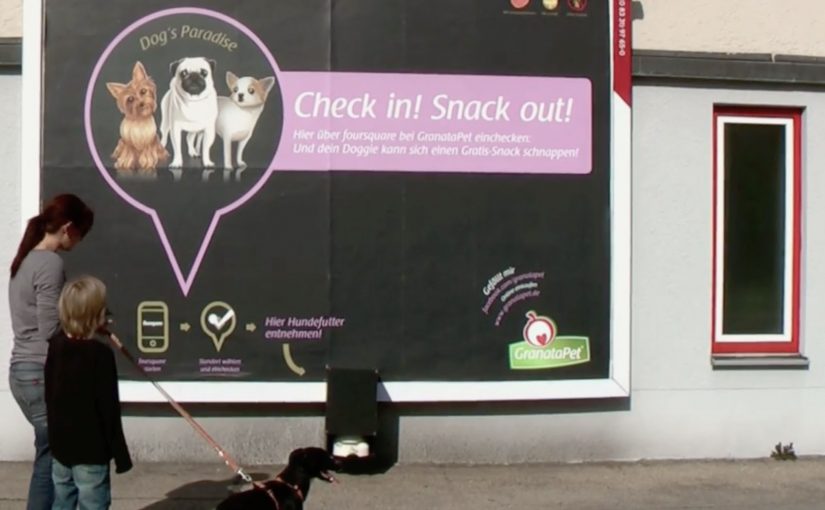
The idea targets dog owners at the exact moment they are most open to noticing pet-related messages. While walking their best friend. Socially activated installations are placed on key walking routes. Dogs catch the scent of treats, stop, and pull their owners toward a billboard that simply says “Check in. Snack out”.

A sampling demo that your dog starts for you

This is a classic trial mechanic with a smart trigger. Instead of asking humans to approach a promoter, the dog does the targeting. The owner follows the leash. Then the message becomes self-evident. Check in with Foursquare to activate a free bowl of dog food.

How the mechanism works

The billboard combines three parts. A location check-in prompt, a connected dispenser and bowl, and a social echo via the check-in behavior, meaning each check-in can create additional visibility beyond the street placement itself. When a user checks in at the billboard’s location, the system releases a portion of food into the bowl. The owner watches the dog’s reaction in real time, which functions as the product demo.

In pet food sampling, the highest-converting trial moments are the ones where the animal can deliver an immediate preference signal in front of the owner.

The real question is whether the brand can turn a routine walk into a low-friction proof moment that the owner trusts more than advertising copy. The stronger move here is to let the dog, not the promoter, make the case.

Why it lands

It is easy to trigger, well-timed, and emotionally loaded. The owner does not have to imagine whether the dog will like the food. They see it. That works because a visible reaction from the dog removes guesswork faster than any product claim can. The social layer then turns one local poster into distributed impressions, because check-ins can surface to friends depending on settings. The most important part is that the “proof” is not the copy on the billboard. It is the dog’s behavior.

Extractable takeaway: If your product decision depends on a third party’s preference, build a live demo where that third party delivers the verdict on the spot, and use a simple location trigger to scale it.

What the brand is really buying

This is awareness, trial, and measurable demand in one loop. The execution creates talk value, it generates trackable interactions per location, and it pushes owners toward retail purchase after a positive in-the-moment test. Trade coverage at the time also described increased local demand following the activation.

What pet food marketers can steal from this

  • Target the moment, not the demographic. Dog-walking routes beat broad reach when the category is specific.
  • Let behavior be the headline. A happy dog is more persuasive than any claim line.
  • Make the trigger simple. One action. One reward. No explanation tax.
  • Use the environment as your interface. The billboard is the call-to-action and the proof point.
  • Instrument the activation. Location check-ins can double as measurement, not just distribution.

A few fast answers before you act

What is “Check in, snack out” in one sentence?

An interactive billboard that dispenses free dog food when a nearby owner checks in using a location service.

Why does this outperform a normal sampling stand?

The dog initiates the interaction, and the product proves itself immediately through the dog’s reaction, which reduces hesitation for the owner.

What makes the social layer valuable here?

Check-ins can create secondary reach beyond the physical location, and they can be used to track which placements generate the most interactions.

What is the biggest operational risk?

Reliability. If the dispenser jams or the trigger fails, the experience collapses and the brand takes the blame.

How would you adapt this without Foursquare?

Keep the same structure. A location trigger plus instant physical reward. Use whatever mobile mechanism your audience already uses for quick opt-in and confirmation.

KitKat: Human Vending Machine

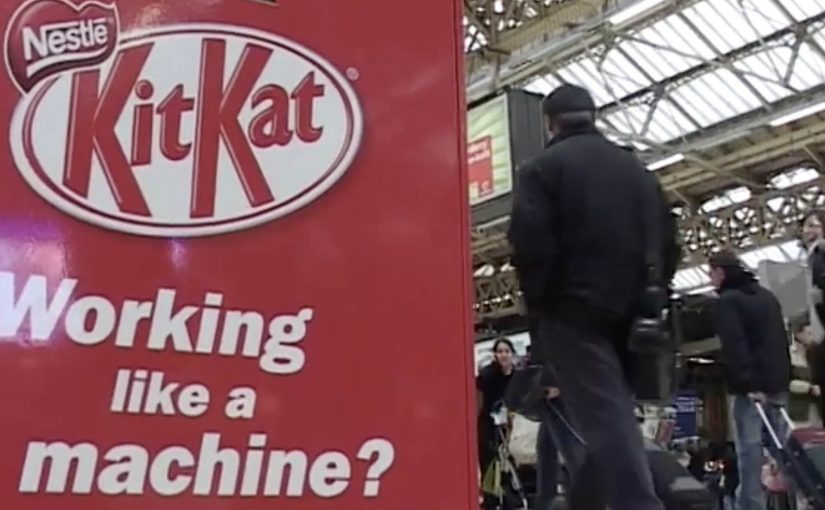
We all know how it feels to need a break from the routine of working like a machine. That is why KitKat brought a quirky trend from Japan over to the UK by installing a human vending machine in London’s busy Victoria Station.

Commuters were given a chance to buy a KitKat for 20p, but from a machine with a real difference. A real person operated it from inside, turning a quick purchase into a small moment of surprise and a quick chat. The money was described as going to charity.

A vending machine that replaces automation with a person

The mechanic is straightforward. It looks like a standard vending machine on the concourse. You put money in. You make a selection. Then a real “vendor” inside the unit hands you the bar, human-to-human, at vending-machine speed.

In high-traffic commuter environments, ambient activations (quick, in-the-flow brand interactions placed in public space) work best when the interaction is instant, the reward is obvious, and bystanders can understand the joke in one glance.

Why it lands

This works because it turns the very thing people are tired of, being treated like a machine, into the punchline. The vending format signals efficiency and routine. The human reveal breaks that expectation and delivers the “Have a break” idea as an experience, not a line of copy.

Extractable takeaway: If your brand promise is about relief, do not only describe relief. Stage a short, public interruption of routine where the consumer feels the promise in real time.

What the activation is really doing for the brand

The real question is whether you can make the “Have a break” promise felt without turning the commute into a bottleneck.

This is a strong format when the idea is obvious from a distance and the handoff stays genuinely fast.

At face value, it is a cheap bar and a good deed. Underneath, it is a behavioural prompt in a place where people are stressed, rushed, and receptive to a small uplift. The “human machine” also creates instant social proof. Every interaction becomes a tiny piece of live theatre that recruits the next person in line.

How to borrow the human-vending-machine pattern

  • Make the concept self-explanatory. The best stunts do not need instructions. The crowd teaches the crowd.
  • Build one clean reveal. A single unexpected moment beats multiple clever steps.
  • Design for the queue. Waiting becomes part of the experience and amplifies visibility.
  • Anchor the stunt to the brand line. The “break” is the product, and the bar is the proof.
  • Give people a reason to feel good. A charity tie-in can reduce cynicism and increase participation.

A few fast answers before you act

What is the “human vending machine” idea in one line?

A vending machine that dispenses KitKat bars, but the dispensing is done by a person inside the unit, turning a routine purchase into a surprise interaction.

Why does this work specifically in a commuter station?

Stations concentrate stress, repetition, and time pressure. A fast, playful interruption is more valuable there than a slow, explanatory brand experience.

What makes it feel like a KitKat idea rather than a random stunt?

The experience embodies the brand’s break positioning. It converts “take a break” from a slogan into a short, tangible moment.

What is the main execution risk?

Throughput. If the interaction slows down and the queue becomes frustrating, the stunt flips from “break” to “delay” and the mood collapses.

What should you measure beyond footfall?

Queue conversion rate (people who stop and join vs those who pass by), average interaction time, sentiment in on-site reactions, and whether the activation shifts purchase behaviour during the commute window.