
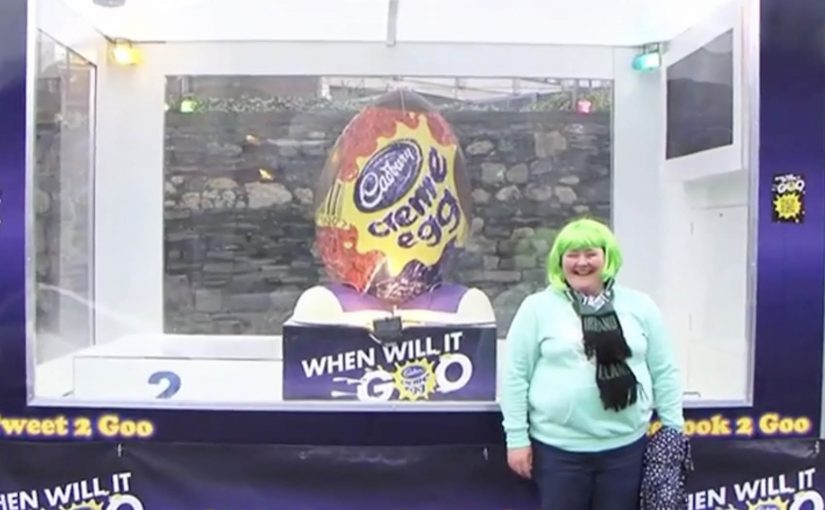
Cadbury Creme Egg: When Will It Goo

Cadbury, along with agency MCsquared Dublin, created an integrated campaign that enlisted the Irish public to help their giant Creme Egg release its Goo. Here, “Goo” is the campaign’s shorthand for the public release moment.

Eight rocking giant eggs, each protected in a transparent case, were placed around Dublin. Fans were asked to tweet “Goo” using #tweet2goo or enter via the campaign Facebook app. Every tweet and Facebook post made the egg get more “egg-cited” until it “egg-sploded”.

The entire Goo event was broadcast live on the Cadbury Ireland Facebook page, and participants were automatically entered into a draw to win tickets to the London 2012 Olympic Games.

From social input to physical payoff

The mechanic is a simple loop with a strong public proof moment. People post. The installation reacts. The reaction builds suspense. Then the payoff happens in public, with a clear “we did that” feeling for anyone who participated.

In Irish FMCG launches where seasonal products rely on impulse and talk value, turning participation into a shared street spectacle can earn attention that paid media cannot easily buy.

Why it lands

This works because it turns a familiar product truth, the goo, into a shared mission. Because people can see progress building toward a public release, each post feels consequential rather than disposable. The spectacle turns remote social actions into something you can physically witness, and the ticking progress effect gives people a reason to keep posting and to pull friends in. The live broadcast also gives the event a second stage, so even people not in Dublin can follow along and contribute.

Extractable takeaway: If you want social participation at scale, design a public system where every small action visibly moves a shared object toward an inevitable moment. The promise of that moment does the acquisition work.

What the campaign is really buying

It is not just awareness. It is repeat behavior during a short seasonal window. The real question is how to turn a short seasonal sales window into repeat participation instead of one-off attention. The hashtag and the Facebook entry mechanic reward persistence, and the prize draw adds a practical reason to participate even if you are not nearby.

What to steal for seasonal participation campaigns

  • Make the participation rule obvious. One hashtag, one word, one job.
  • Translate digital actions into physical feedback. That is what creates credibility and excitement.
  • Build suspense, not just a reveal. Progress is a stronger engine than surprise.
  • Give it two stages. Street spectacle plus a live stream extends the audience.
  • Add a lightweight incentive. A draw works best when the core experience is already fun.

A few fast answers before you act

What is “When Will It Goo”?

A Cadbury Creme Egg activation where tweets and Facebook entries drive giant public eggs toward a live “goo-splosion” moment.

Why does the physical installation matter?

It turns online participation into something visible and real, which increases belief, excitement, and sharing.

What is the role of the hashtag?

It is the simplest participation interface. It makes the action easy to repeat and easy to recruit others into.

What is the biggest execution risk?

If the installation feedback is slow, unclear, or unreliable, people stop participating because they cannot see impact.

How can a smaller brand replicate the pattern?

Use one shared object, one simple input, and one visible progress signal. The object can be smaller, but the loop must stay legible.
MINI: Fan the Flame

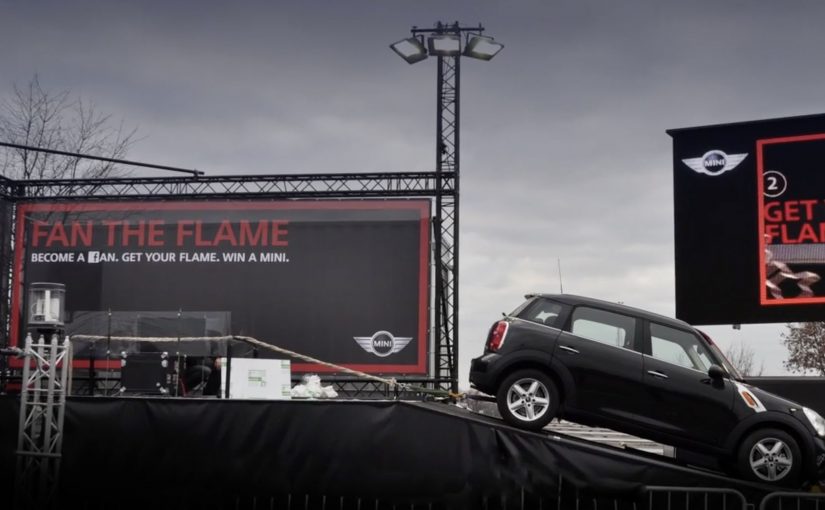
MINI, together with TBWA\Agency.com, creates a social spectacle to grow the fan base for its newly launched Facebook page in Belgium and Luxembourg.

The setup is as physical as it gets. A MINI Countryman is attached to a thick rope in the parking lot of the Brussels Motor Show, with a burner placed beneath the rope. Facebook fans are encouraged to remotely trigger the burner and shoot flames at the rope. A webcam broadcasts the scene 24×7, and the fan whose flame ultimately breaks the rope wins the MINI Countryman.

Why this is a “like” campaign people actually talk about

Most fan-growth ideas are transactional: click like, get content. This one makes the click feel consequential. Each interaction is a tiny act of sabotage against a real-world object, with a visible scoreboard outcome. The page is not just where the brand posts. It is the control panel for the event. This is the better pattern when you need fast fan growth without training people to expect freebies.

Extractable takeaway: If you want people to talk, make the social action change a visible system, then let the audience verify progress live.

The mechanism: remote control plus live proof

Mechanically, the campaign combines three ingredients: a simple trigger (fan action), a physical system (rope and flame), and continuous proof (the live webcam). The webcam is crucial because it converts a remote interaction into trust. People can see that something is actually happening, continuously, with no editing.

In European automotive social campaigns, linking digital participation to a live physical outcome is one of the fastest ways to create earned attention, meaning people talk and share without paid amplification, beyond the fan base itself.

What the prize is really doing

The real question is whether your social channel is just a feed, or a place where the audience can change something that matters in real time.

The MINI Countryman is not only incentive. It is also the symbol. The closer the rope gets to breaking, the more the prize feels “reachable”, which keeps people checking back and telling friends to join. The prize turns time into tension.

What to copy for your next live activation

  • Make the interaction visible. Live video proof makes remote participation feel real.
  • Use a simple mechanic with cumulative progress. People return when they believe their action contributes to a final outcome.
  • Put the brand in the role of facilitator. The page becomes the place where something is happening, not just the place where posts appear.
  • Design for suspense. A slow-burn system creates anticipation and repeat visits.

A few fast answers before you act

What is “MINI Fan the Flame” in one line?

A live contest where Facebook fans remotely trigger flames to burn through a rope holding a MINI Countryman, with the fan who breaks it winning the car.

Why does the webcam matter?

It provides continuous proof that the event is real and progressing, which sustains trust and repeat engagement.

What behavior is this campaign optimizing for?

Fan acquisition plus repeat visits. The tension mechanic encourages people to return and recruit others.

What is the transferable lesson for other brands?

If you want scale, connect digital actions to a visible physical outcome and design the system so progress builds suspense over time.

What is the minimum viable version of this mechanic?

Combine one clear trigger, one physical system that visibly changes, and one always-on proof stream so participants can verify progress without edits.

Prigat: Smile Stations

Publicis Israel and e-dologic are back with a new campaign for Prigat, a leading company in the Israeli fruit juice market.

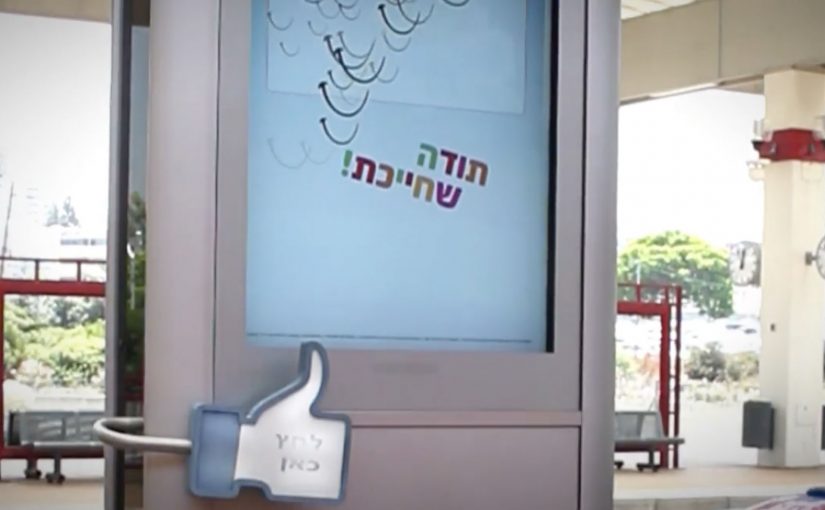
This time they use innovative digital billboards called “Smile Stations” to send real-time messages at various train stations. The aim is to get passers-by to smile, and “like” the moment.

The mechanic: turn a Facebook message into a station moment

It starts on the Prigat Facebook Page. People send messages that are pushed to screens at train stations. Commuters walking by can approach the screen and press a physical “Like” button.

That button press triggers a simple payoff. The billboard captures the moment, then broadcasts the video back to the person who sent the message. Users who generate the most smiles win a prize.

In busy public transit environments, interactive out-of-home works best when the action is obvious, the feedback is immediate, and the reward is shareable.

Why it lands: it makes public emotion measurable

Most out-of-home asks for attention. Smile Stations asks for a reaction, then turns that reaction into proof you can send back to the originator.

Extractable takeaway: If you want participation at scale, close the loop. Let a remote user trigger a real-world moment, let a passer-by respond with one physical action, then send that response back as a personal artifact the originator can keep and share.

Reported figures put this at over 10,000 messages sent to station screens, with thousands of people responding by hitting the Like button.

What the brand gets from this

The real question is whether a public display can turn a remote social prompt into a personal moment worth sharing.

This is stronger than passive digital out-of-home because the physical Like button reduces effort and the returned video turns a fleeting reaction into a personal memory both sides can own.

The campaign does not just generate impressions. It creates a two-sided interaction where both parties feel like they caused something to happen. That is a stronger memory structure than “I saw an ad”, especially in a context as repetitive as commuting.

What to steal for your own social-plus-out-of-home activation

  • Design a one-step physical interaction: one big button beats a complicated interface in public space.
  • Make the response visible: the passer-by should understand instantly that their action “counts”.
  • Return a personal artifact: sending the video back is what turns participation into sharing.
  • Gamify without friction: “most smiles wins” is a clean mechanic with no explanation overhead.
  • Pick locations with dwell time: stations work because people pause, look up, and wait.

A few fast answers before you act

What is a “Smile Station”?

It is an interactive digital billboard at a train station that displays user-submitted messages and invites passers-by to respond by smiling and pressing a physical Like button.

What makes this different from a normal digital billboard?

It is two-way. Remote users trigger messages, commuters respond physically, and the response is captured and sent back as video, creating a closed feedback loop.

Why include a physical Like button?

Because it removes friction. A single, tangible action is faster and more intuitive than asking people to pull out a phone, scan, or type.

How do you measure success for an activation like this?

Message volume, unique senders, Like-button presses, response rate per message, video shares by originators, and dwell time around the screen locations.

What is the main execution risk?

Latency and unclear feedback. If the system feels slow or people are unsure what their button press did, participation drops quickly in a commuter setting.