
Starbucks: Tweet a Coffee

In March 2012, Amex card members could sync their credit cards with their Twitter account, then re-tweet offers to load them onto their card. Fast forward to 2013 and Starbucks USA is allowing customers to “Tweet a Coffee”.

In the current beta version, the first 100,000 US-based customers can tweet $5 Starbucks Card eGifts to Twitter friends and followers. All it takes is linking your Starbucks and Twitter accounts, then tweeting @tweetacoffee to @TheirNameHere.

A checkout moment that looks like a message

The mechanism is account linking plus a structured tweet. The tweet becomes the purchase trigger, and the recipient receives a redemption flow that feels like a social interaction rather than an ecommerce checkout. Because the purchase trigger lives inside a normal message action, it reduces steps, which is why the gifting moment feels unusually low-friction.

In US consumer retail and payments ecosystems, this kind of channel integration turns gifting into a low-friction habit that rides on existing identity and loyalty rails (the linked accounts and stored-value programs customers already use).

The real question is whether your payment flow can hide the transaction inside a native social action without losing control of redemption and risk.

Why it lands

It compresses generosity into a familiar behavior. You do not have to open an app, browse, or remember an email address. You just use the interface you already use to talk to people. The “$5” constraint also matters. It is small enough to be spontaneous, but concrete enough to feel real. This is the better starting pattern for social payments because it keeps the action familiar while keeping the value transfer explicit.

Extractable takeaway: If you want social commerce to scale, make the transaction look like native social behavior, then constrain the first use case to one simple, giftable unit with an obvious price point.

Patterns to borrow for social payment experiments

  • Start with gifting, not buying. Gifting has a built-in emotional reason to happen, which reduces the need for persuasion.
  • Make the trigger public, keep the redemption controlled. The tweet creates visibility. The redemption link manages fraud, fulfillment, and policy.
  • Use a single, repeatable format. One command pattern makes it easy to learn and easy to copy.
  • Design for “small yes” transactions. Low-value, high-frequency gifts teach the habit without asking for big trust on day one.

A few fast answers before you act

What is “Tweet a Coffee” in one line?

It lets eligible Starbucks US customers send a $5 Starbucks Card eGift to someone on Twitter using a structured tweet after linking accounts.

Why is gifting the right first use case for social payments?

Because it has a clear social motive and a clear recipient. That reduces friction compared to asking people to buy something for themselves in a new way.

What makes this different from a promo code tweet?

The tweet is not just marketing. It triggers a real value transfer, and the recipient experiences it as a personal gift rather than an offer broadcast.

What is the minimum pattern to copy without relying on Twitter?

Use an identity-linked account, a simple public trigger that looks native to the channel, and a controlled redemption step that protects fulfillment and policy.

What is the biggest risk when brands copy this idea?

Trust breakdown. If account linking feels heavy, or if redemption feels spammy or unreliable, users will abandon the flow and may blame the brand rather than the platform.
Fiat 500 America: TwitBid Twitter Auction

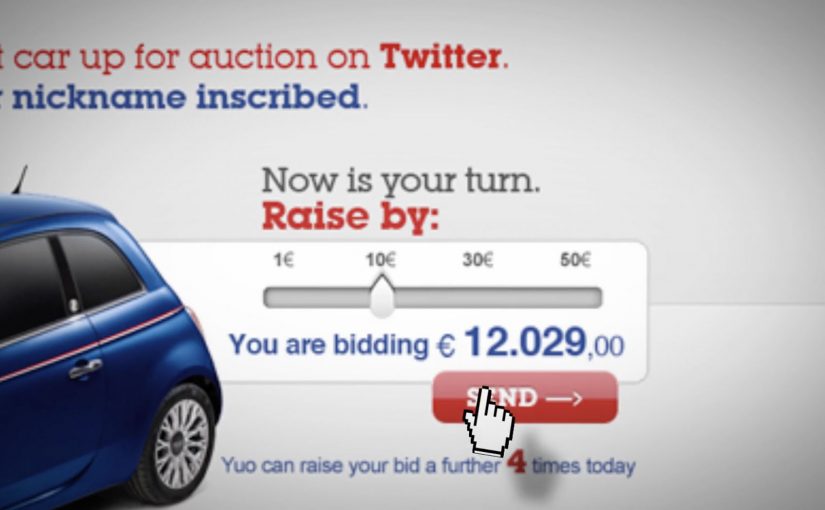
Fiat unveiled an exclusive limited edition run of 500 cars inspired by U.S. style at the Geneva Motor Show. Then, through a Twitter based auction, they made it possible to win the “number one” car (distinguished by a badge on the external pillar bearing the serial number 1/500 and the winner’s Twitter nickname) starting from a bid of €1.

To win the Fiat, participants were directed to follow @fiatontheweb on Twitter and then place a bid at www.500America.fiat500.com using their Twitter account. As a result, Fiat received 700 bids from 293 users, across 11 countries. A Twitter follower with a bid of €15,165 was declared the winner of the limited edition Fiat 500 America.

TwitBid turns a car launch into a public scoreboard

TwitBid is a Twitter-linked auction mechanic where each bid is tied to a visible handle. The smartest part is not the auction itself. It is the visibility layer. A bid is not a private transaction step. It becomes a social signal tied to an identity, which encourages escalation and turns the bidding ladder into content other people can watch unfold.

In brand launches with collector energy, mechanics that let fans compete in public create more momentum than mechanics that keep participation hidden.

What the mechanism is really doing

  • Make entry frictionless. The opening bid starts at €1, which makes “having a go” feel low risk.
  • Use identity as fuel. Bids are placed via Twitter, so the participant’s handle becomes part of the story.
  • Turn the object into proof. The “number one” car carries a visible 1/500 marker and the winner’s nickname, which makes the win feel permanent and collectible.

In global consumer launches where scarcity is real, a public scoreboard can turn a product drop into shared entertainment.

Why it lands

The real question is whether your launch mechanic turns every participant move into something other people can see. Most automotive launches ask people to admire. This one asks people to compete. The auction format creates scarcity pressure, and the Twitter layer adds social proof. Even if you do not bid, you can still follow the narrative of who is winning and how high it goes.

Extractable takeaway: If you want real participation, attach identity to action and make progress public. People engage longer when their move is visible, comparable, and tied to status.

What Fiat is really buying with this

The obvious outcome is a high price for the first car. The deeper outcome is attention that behaves like earned media. Each bid acts like a micro-broadcast, and the “number one” badge ties the online moment back to a physical artifact. That is a clean bridge between social platforms and product storytelling.

Launch moves to copy from TwitBid

  • Pick one scarce artifact. A single “first off the line” item is easier to explain than multiple prizes.
  • Make the ladder visible. Competition needs a scoreboard, not a form.
  • Build identity into the reward. A name, handle, or serialisation marker increases perceived ownership value.
  • Engineer the minimum increment. Small step sizes keep the contest active and make it feel winnable.

A few fast answers before you act

What is TwitBid in plain terms?

It is a Twitter-linked online auction where people place bids using their Twitter account to compete for a specific limited-edition item.

Why tie bidding to Twitter instead of a normal auction site?

Because every bid is tied to an identity and can become visible in the social stream, which increases reach and reinforces the competition dynamic.

What makes the “number one” car feel more valuable than the other 499?

It is positioned as the first unit off the line and visibly marked with serial number 1/500 plus the winner’s nickname, which makes it a one-off collectible.

What is the biggest risk with social auctions?

Friction and trust. If sign-in, bidding, or confirmation steps are unclear, participation drops. If rules feel opaque, the brand takes reputational damage.

What should you measure if you run a similar mechanic?

Unique bidders, bids per bidder, bid velocity over time, conversion from followers to registrants, and how much incremental reach the bidding activity creates versus paid media.

Kellogg’s Tweet Shop: Pay with a tweet

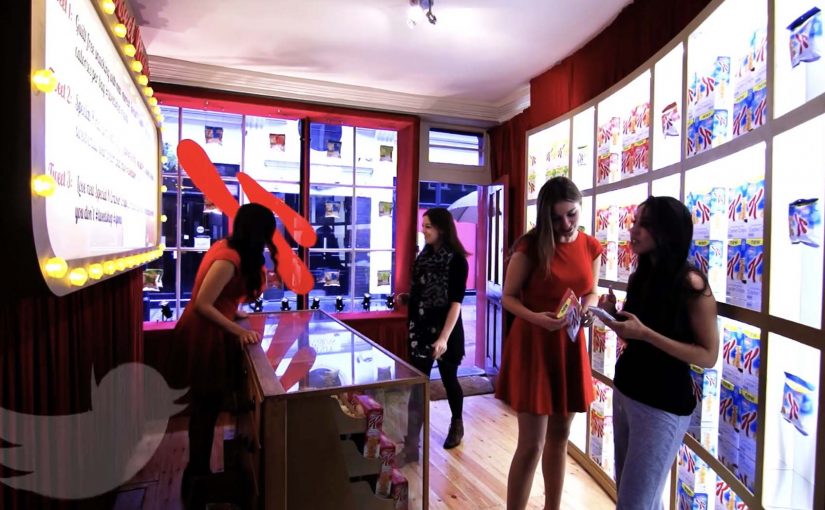
Last month in London, Kelloggs setup a pop up store where passers-by who walked in could try the low calorie snacks and then post a review on Twitter. “Special K girls” in red dresses who manned the store, checked each customer’s tweet before handing over a packet of Special K Cracker crisps.

How the Tweet Shop turns sampling into distribution

The mechanic is deliberately lightweight. Walk in, try the product, then publish a short reaction on Twitter before you leave. Staff verify the tweet on the spot, then you get a pack to take away.

A “pay with a tweet” activation is a pop-up retail format where the transaction is a public social post rather than money, converting product sampling into earned reach and searchable social proof.

In global FMCG marketing, this kind of social-to-sample loop, where a public post unlocks a take-away sample, works when the “payment” is fast, public, and directly tied to a tangible reward.

Why it lands: the tweet is both receipt and recommendation

Most sampling disappears into a bag with no trace. Here, the brand creates a visible record of trial. Each tweet acts like a receipt that confirms participation, and a micro-endorsement that other people can stumble on later.

Extractable takeaway: When you turn trial into a public trace and close the reward immediately, posting feels like participation, not payment.

The real question is whether the post feels like a fair exchange for the product, not a forced endorsement.

The red-dress staffing is not just costume. It makes the interaction unmistakably “Special K” in photos, which helps the moment travel beyond the store.

This is a smart trade only when you can keep the ask lightweight and the reward immediate.

What Kellogg’s is buying with “social currency”

  • Frictionless trial. People try a new product with zero financial risk.
  • Instant word of mouth. Reactions publish in real time, while the experience is still fresh.
  • Searchable proof. A hashtag-based trail can cluster impressions and sentiment in one place.
  • High street theatre. A pop-up adds “I was there” energy that a standard promo rarely achieves.

Design rules for your next “pay with a post” idea

  • Make the ask specific. Tell people exactly what to post and keep it short enough to do without thinking.
  • Verify fast. The handover moment should feel immediate, or it stops being fun.
  • Reward honesty. If you only want praise, people feel manipulated. If you invite real reactions, the format feels fair.
  • Design the store for photos. If the space is not camera-ready, you waste the free distribution you just created.

A few fast answers before you act

What is the “Tweet Shop” concept in simple terms?

It is a pop-up shop where people receive a product after posting a tweet about their experience, with staff checking the post before the handover.

Why would a brand accept tweets instead of money?

Because a public post can create awareness and credibility at scale, while the product cost stays predictable and controlled.

What makes this different from a normal free sample?

The sample creates a visible social trace. Each person who tries it leaves behind a shareable review that others can discover.

What is the biggest risk with “pay with a tweet” activations?

If the ask feels forced or takes too long, people opt out. If the experience is not worth sharing, the format collapses into awkward bribery.

How do you judge whether this worked?

Track trial volume, unique posts, sentiment, and whether conversation continues after the pop-up closes, not just during the event.