
Homeless Fonts: Fonts from Cardboard Signs

Homeless Fonts: Fonts from Cardboard Signs

When you walk by a homeless person holding a cardboard sign, you usually see an anonymous face struggling to survive. Homeless Fonts flips that moment. It turns the most visible part of street life. The handwriting. Into something people and brands can actually pay for.

From street sign to typeface

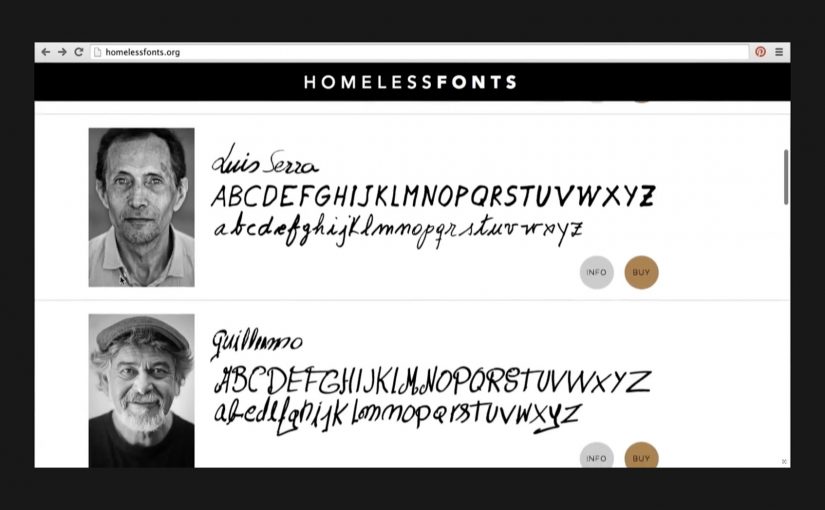
The Cyranos McCann teamed up with the Arrels Foundation in Barcelona to launch HomelessFonts.org. The site features fonts built from the real handwriting of local homeless people, available for purchase by marketers who want something more human than a default type library.

Here, a “font” is a downloadable typeface file that designers can license and use across ads, packaging, and digital interfaces, just like any other professional typeface.

In urban European cities, design-led micro-commerce can convert overlooked skills into dignified income streams.

Where the money goes

The money raised from the website is intended to support accommodation, food, social programs, and health care for people experiencing homelessness. For more information visit www.HomelessFonts.org.

Why this lands

It works because it asks brands to buy a useful asset instead of “donating to a cause.” You are not funding an abstract promise. You are paying for a tool that visibly changes the tone of your message, and the purchase itself carries a story your audience can recognize instantly.

Extractable takeaway: If you want purpose marketing to stick, attach the donation mechanic to a practical, reusable brand input (a font, a template, a dataset, a sound pack) so the act of funding also improves the work.

What it’s really trying to change

The real question is whether brands will pay for contribution instead of performative concern.

This is a stronger model than pure cause messaging because it gives people commercial value, not just visibility.

Beyond fundraising, the campaign reframes homeless people from passive recipients to contributors with identity and craft. The typefaces carry names and personality, and that shifts the conversation from pity to participation.

What to steal from Homeless Fonts

  • Sell a tool, not a feeling. Build the fundraising mechanic around something buyers genuinely need.
  • Make the proof visible. The output (handwriting) is instantly recognizable, which makes the story easy to retell.
  • Design for everyday reuse. The more places the asset can live (print, digital, packaging), the more sustainable the model becomes.
  • Keep the transaction simple. Clear product. Clear price. Clear destination for proceeds.

A few fast answers before you act

What is Homeless Fonts?

It’s a collection of purchasable fonts created from the handwriting of homeless people in Barcelona, sold via HomelessFonts.org.

Who created it?

The project was launched by the Arrels Foundation in partnership with Cyranos McCann.

How do brands actually use the fonts?

Like any licensed typeface. Designers can apply them in headlines, posters, packaging, social content, landing pages, and campaign visuals to add a distinctly human texture.

What does buying a font change versus asking for donations?

It turns support into a market exchange for a useful asset. That reduces “charity fatigue” and gives brands a concrete output that carries the story forward every time it’s used.

Where is the money intended to go?

The campaign describes proceeds being used for accommodation, food, social programs, and health care supporting people experiencing homelessness.

Cornetto: Love Plane

Cornetto: Love Plane

A couple tweets a love message with a hashtag, and a few minutes later it appears on a banner flying over the beach. Cornetto’s Love Plane turns summer flirting into public media, with the sky as the timeline.

A Twitter feed you can read in the air

Summer is the season of crazy, unexplainable romances. Cornetto launches the Love Plane in Spain and attaches a Twitter-based banner feed to it.

The mechanism: hashtag in, banner out

People who want to declare their love both online and in the sky tweet using the hashtag #cornettoskytweet. The most popular tweets are then painted on the banner and flown over the beach. To keep things moving, the banner creative is changed every 15 minutes.

In European FMCG summer activations, a simple real-time mechanic can turn social posting into a shared public moment that people notice even if they are not online.

Why this lands

This works because it upgrades a small, personal gesture into something you cannot ignore. A tweet becomes physical, scarce, and time-bound, which raises the perceived stakes and makes participation feel like a mini event rather than just another post.

Extractable takeaway: If you want social participation at scale, convert digital inputs into a visible, time-boxed output in the real world, so the reward is public and immediate, not buried in a feed.

What Cornetto is really doing

Cornetto is smart to make participation public instead of leaving the interaction inside Twitter. The brand is borrowing the emotional energy of summer romance and using it to create a repeatable content loop. By a repeatable content loop, this means each new tweet can create another visible banner moment and another round of attention.

The real question is how a brand turns disposable social chatter into a public moment people want to trigger and watch.

People supply messages. The campaign outputs spectacle. Onlookers become an audience. Participants become distributors.

What summer activation teams should steal

  • Make the reward unmistakably public. Participation feels bigger when others can witness it.
  • Use a simple popularity rule. “Most popular tweets win” is easy to understand and easy to compete in.
  • Keep the cadence fast. Refreshing every 15 minutes creates urgency and repeat attention.
  • Match channel to emotion. Romance works when the output feels bold, not subtle.

A few fast answers before you act

What is the Cornetto Love Plane?

It is a plane flying over beaches with a banner that displays selected tweets, turning social posts into a public sky message.

How do people participate?

They tweet a message using the hashtag #cornettoskytweet. The most popular tweets are selected to appear on the banner.

Why change the banner every 15 minutes?

Frequent updates create urgency and make the activation feel live, which encourages repeated participation and attention.

What does this communicate about the brand?

That Cornetto “owns” summer romance moments, and that the brand can turn small gestures into shared experiences.

What is the main operational risk with this idea?

Moderation and logistics. You need tight filtering for messages, plus reliable production timing so the “real-time” promise holds.

McDonald’s Free WiFi: Turning SSIDs into Ads

McDonald’s Free WiFi: Turning SSIDs into Ads

In Spain, McDonald’s offers free WiFi to all its customers. Since the WiFi signal reaches quite far, customers in surrounding restaurants also tend to use the McDonald’s network.

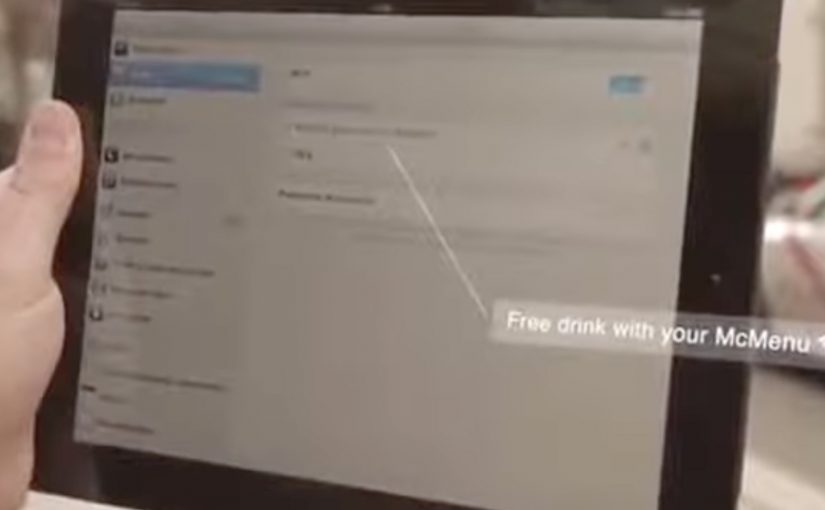
So McDonald’s decided to attract new customers via their own WiFi network. They simply changed the signal’s name into a message and embedded a promotion into it.

The simplest media channel you already own

This is a tiny idea with a very clear mechanism. A WiFi network name is a broadcast surface. That name is the SSID, the label devices show in the network list. It shows up exactly when people are deciding where to sit, what to order, or whether to move.

Instead of treating WiFi as utility, McDonald’s treated it as a micro-channel for demand capture.

Why the WiFi name works as advertising

In high-footfall retail settings where people scan for quick utility, the WiFi list becomes a decision interface and the SSID becomes a tiny billboard in that interface.

Extractable takeaway: When people already scan a utility list, naming inside that list can outperform bigger media because it meets intent at the moment of choice.

  • High intent moment. People looking for WiFi are already in “connect me now” mode.
  • Local reach. The signal spills into nearby venues, where potential switchers sit.
  • Zero-click visibility. You see the message before you even connect.
  • Low cost, repeatable. Updating an SSID is simple, fast, and scalable.

Where this crosses from clever to strategic

The real question is whether you treat owned infrastructure as a distribution channel, or just as a cost line.

The strategic move is not the pun. It is the use of owned infrastructure as a distribution channel. When your message sits inside a system people actively scan for, you reduce friction and increase the odds of action.

This is worth doing wherever you run guest WiFi and can keep the message instantly understandable.

It is also a reminder that not all “digital” has to be an app. Sometimes it is just naming.

What to take from this if you run retail or CX

  1. Audit your hidden touchpoints. SSIDs, receipts, kiosks, queue screens, packaging, all are media surfaces.
  2. Message at the decision point. Proximity channels work best when they align with immediate behavior.
  3. Keep the offer instantly understandable. People scan lists quickly. Clarity beats cleverness.
  4. Test and rotate. Like any channel, vary the message to learn what actually moves footfall.

A few fast answers before you act

What did McDonald’s do with its free WiFi in Spain?

It changed the WiFi network name into a message and embedded a promotional offer into the SSID to attract people nearby who could see the network on their devices.

Why does the WiFi signal matter here?

Because it reaches beyond the restaurant itself, meaning people in surrounding venues can still see and use the network, making it a local acquisition channel.

What is an SSID in this context?

It is the WiFi network name that appears in a device’s list of available networks. Changing it changes what people see before connecting.

Is this a “growth hack” or a real marketing tactic?

It is both. It is a lightweight tactic, but it is grounded in a real channel. Owned infrastructure that reaches potential customers at a high-intent moment.

What is the transferable lesson for brands?

Look for owned, ambient digital surfaces where people already scan for utility, then place a clear message there that can drive immediate action.