Starbucks: Tweet a Coffee

In March 2012, Amex card members could sync their credit cards with their Twitter account, then re-tweet offers to load them onto their card. Fast forward to 2013 and Starbucks USA is allowing customers to “Tweet a Coffee”.

In the current beta version, the first 100,000 US-based customers can tweet $5 Starbucks Card eGifts to Twitter friends and followers. All it takes is linking your Starbucks and Twitter accounts, then tweeting @tweetacoffee to @TheirNameHere.

A checkout moment that looks like a message

The mechanism is account linking plus a structured tweet. The tweet becomes the purchase trigger, and the recipient receives a redemption flow that feels like a social interaction rather than an ecommerce checkout. Because the purchase trigger lives inside a normal message action, it reduces steps, which is why the gifting moment feels unusually low-friction.

In US consumer retail and payments ecosystems, this kind of channel integration turns gifting into a low-friction habit that rides on existing identity and loyalty rails (the linked accounts and stored-value programs customers already use).

The real question is whether your payment flow can hide the transaction inside a native social action without losing control of redemption and risk.

Why it lands

It compresses generosity into a familiar behavior. You do not have to open an app, browse, or remember an email address. You just use the interface you already use to talk to people. The “$5” constraint also matters. It is small enough to be spontaneous, but concrete enough to feel real. This is the better starting pattern for social payments because it keeps the action familiar while keeping the value transfer explicit.

Extractable takeaway: If you want social commerce to scale, make the transaction look like native social behavior, then constrain the first use case to one simple, giftable unit with an obvious price point.

Patterns to borrow for social payment experiments

  • Start with gifting, not buying. Gifting has a built-in emotional reason to happen, which reduces the need for persuasion.
  • Make the trigger public, keep the redemption controlled. The tweet creates visibility. The redemption link manages fraud, fulfillment, and policy.
  • Use a single, repeatable format. One command pattern makes it easy to learn and easy to copy.
  • Design for “small yes” transactions. Low-value, high-frequency gifts teach the habit without asking for big trust on day one.

A few fast answers before you act

What is “Tweet a Coffee” in one line?

It lets eligible Starbucks US customers send a $5 Starbucks Card eGift to someone on Twitter using a structured tweet after linking accounts.

Why is gifting the right first use case for social payments?

Because it has a clear social motive and a clear recipient. That reduces friction compared to asking people to buy something for themselves in a new way.

What makes this different from a promo code tweet?

The tweet is not just marketing. It triggers a real value transfer, and the recipient experiences it as a personal gift rather than an offer broadcast.

What is the minimum pattern to copy without relying on Twitter?

Use an identity-linked account, a simple public trigger that looks native to the channel, and a controlled redemption step that protects fulfillment and policy.

What is the biggest risk when brands copy this idea?

Trust breakdown. If account linking feels heavy, or if redemption feels spammy or unreliable, users will abandon the flow and may blame the brand rather than the platform.
Starbucks: Pledge

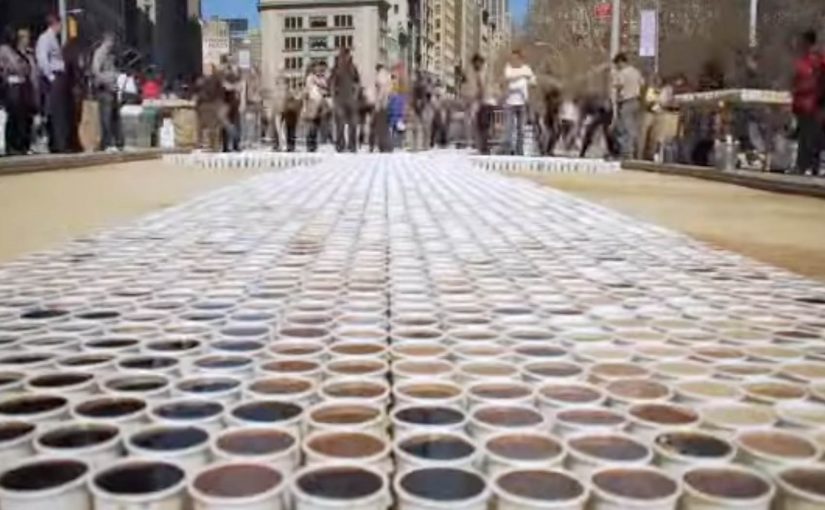
One person can save trees, together we can save forests! For the good of the planet, Starbucks encouraged everyone to switch from paper cups to reusable travel mugs and get free brewed coffee. So on April 15th thousands of New Yorkers made the switch…

Why this worked as a real-world nudge

The execution is straightforward. Bring a reusable travel mug. Get free brewed coffee. That simple exchange removes excuses and turns a “good intention” into an immediate, rewarding action. By a “nudge” here, I mean the campaign changes the choice context so the desired action is the easiest option in the moment. In a small habit switch like this, an incentive-led swap beats awareness messaging. The real question is whether you are designing behavior change as a one-step value exchange, or as a message people can ignore.

Extractable takeaway: If you want a repeatable habit, make the first repetition feel like a win, not a sacrifice.

  • Clear incentive. The reward is easy to understand and feels fair.
  • Low friction. The behavior change is small, and the benefit is instant.
  • Social proof at scale. “Thousands of New Yorkers” makes the switch feel normal, not niche.

In city-scale consumer campaigns, the fastest way to shift a default is to pair a tiny effort with an immediate payoff.

What to take from it

If you want people to adopt a repeatable habit, design the first step to be obvious and satisfying. The goal is not to lecture. The goal is to make the better choice feel easier in the moment it matters.

  • Start with an obvious first step. Make the initial action easy to understand and satisfying to complete.
  • Turn values into an exchange. Convert “good intentions” into a clear trade that removes excuses at the point of choice.
  • Let participation show. Visible uptake helps the new behavior feel normal instead of niche.

A few fast answers before you act

What did Starbucks ask people to do?

Switch from paper cups to reusable travel mugs, with free brewed coffee used as the incentive to prompt the change.

Why does a free coffee mechanic help?

It turns sustainability into an immediate value exchange, which increases participation and makes the first behavior change feel rewarding.

What is the core behavior-change pattern here?

Remove friction, add a clear reward, and make participation visible so people feel part of something larger than themselves.

How does this become more than a one-day stunt?

By making the first switch easy and positive, the campaign increases the chance that the reusable mug becomes the default habit afterwards.

Starbucks love project

At exactly 8:30 a.m. ET on Monday, December 7th, Starbucks joined forces with (RED) and creative agency BBDO to coordinate a global sing-along. Musicians worldwide performed The Beatles classic “All You Need Is Love” at the same moment, positioning the Love Project as a proof point for how connected the world is and how a small decision by one person can make a grand difference elsewhere.

The performance was broadcast live via the internet from far reaches such as Gabon and Fiji, with participation spanning over 100 countries. The initiative raised money and reinforced awareness for Africa’s fight against AIDS, while giving people a clear way to take part in the solution.

The campaign. A global moment that lives online

The performance was streamed live online at starbucksloveproject.com and acted as the anchor moment. Here, “anchor moment” means the single shared live event that gives the campaign a timestamp and a reason to gather.

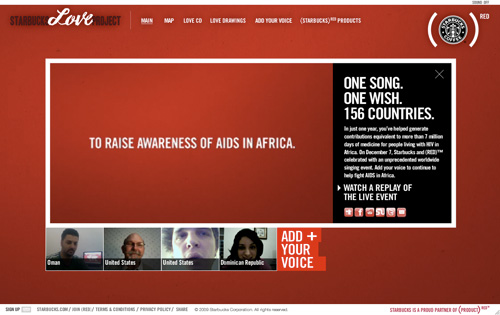
Homepage of starbucksloveproject.com

After the live sing-along, people continued the campaign by going to the Starbucks website and uploading their own:

  • versions of “All You Need Is Love” videos
  • love drawing sketches

Each uploaded performance generated a donation from Starbucks to the cause, supporting (RED) and the Global Fund’s work.

In global consumer brands, the hardest part of cause marketing is turning a feel-good message into a repeatable participation mechanic.

The real question is how you design participation so it feels personal, public, and causally linked to impact.

Why it lands: participation that feels causal

This works because the mechanism makes the “how do I help?” step obvious and measurable. When contribution is triggered by a specific user action, scale stops being a vague aspiration and becomes a compounding loop that people can explain to each other.

Extractable takeaway: If you want a cause campaign to travel, make the participation act simple, visible, and directly tied to a concrete contribution.

The distribution layer. Partnering with Facebook

Starbucks partnered with Facebook to spread the message through the social network. The campaign was positioned as the largest global campaign ever for both Facebook and Starbucks.

The commercial layer. Turning participation into a product

The song was also commercially sold in stores on Starbucks’ Love CD, extending the fundraising and awareness beyond the live moment and the online uploads.

The scale signal. A record for global participation

A Guinness World Record was set for the “Most Nations in an Online Sing-Along,” reinforcing the Love Project as a massive organizational task that reaped the benefits of integrated marketing. Here, “integrated marketing” means the same idea expressed through a live anchor event, social distribution, and a product extension.

Steal this for your next global cause moment

  • Stage one timestamped anchor moment: Give the world a single time to show up, then let everything else ladder back to that moment.
  • Make participation generate impact: Tie a clear user action (uploads) to a concrete contribution (a donation) so people can explain the loop.
  • Design for sharing as distribution: Pick a network layer (Facebook here) that makes participation visible without extra effort.
  • Extend beyond the moment: Add a second way to participate (the Love CD) so the campaign does not end when the livestream ends.
  • Use proof signals carefully: If you claim scale (records, “largest ever”), ensure the mechanism and operations actually support it.

A few fast answers before you act

What is the Starbucks Love Project?

A global sing-along campaign with (RED), coordinated with BBDO, anchored by a simultaneous performance of “All You Need Is Love.”

How big is it?

The campaign described participation spanning over 100 countries, with performances broadcast live online from locations including Gabon and Fiji.

How does participation continue after the live event?

People upload their own “All You Need Is Love” videos and love drawing sketches on Starbucks’ campaign site.

How does it drive donation impact?

Each uploaded performance generates a donation from Starbucks to the cause, supporting (RED) and the Global Fund.

What role does Facebook play?

Facebook is presented as the distribution partner used to spread the message and participation through the social network.

What else extends the campaign beyond the moment?

The song is also sold commercially on Starbucks’ Love CD in stores.