
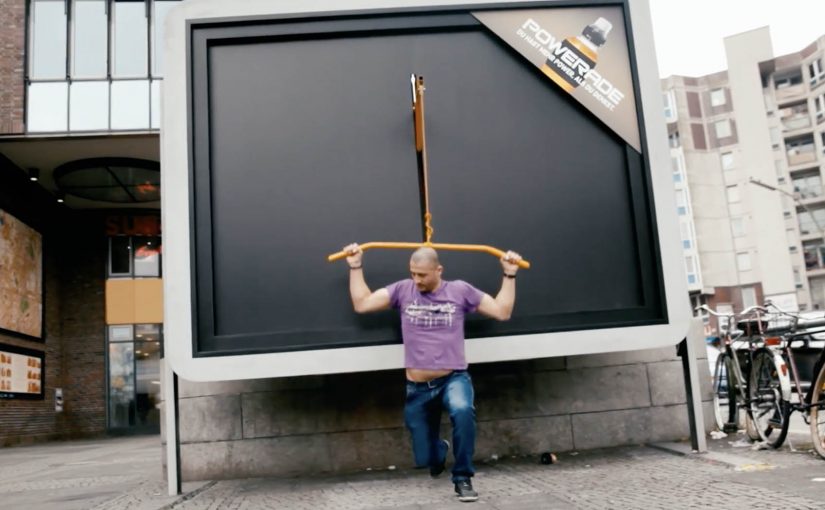
Powerade: Workout Billboards in Berlin

A billboard does not just tell you to train. It invites you to climb it, lift it, or punch it, right there on the street, then hands you a Powerade when you are done.

Powerade, with the help of Ogilvy & Mather, set up several workout billboards in Berlin that, apart from advertising the product, also doubled up as workout equipment to emphasize the brand’s attitude, “You have more power than you think”. Here, “workout billboards” means the billboard structure is built to be used as simple exercise equipment.

People practicing their rock climbing, weight lifting, and boxing skills on the unique billboards were also rewarded with some free Powerade to help replenish their electrolytes.

Why this works as outdoor advertising

The mechanism is a clean value exchange. The brand offers an activity that creates immediate proof of effort. The participant gets a short challenge and a visible outcome. The product then shows up as the natural next step, not as an interruption. Because effort comes first, the product feels like a reward rather than an ad.

Extractable takeaway: When outdoor media gives people a small, safe task to complete, the brand message lands as earned proof, not as a claim.

In sports and performance brands competing for attention in dense urban spaces, turning an ad surface into a usable experience is a direct way to earn participation instead of only impressions.

What Powerade is really buying

This is not mainly about reach. It is about association. The ad makes the brand feel like a training partner, not a poster. It also turns physical engagement into a public spectacle, which draws more people in and makes the moment more memorable than a standard billboard.

The real question is whether your activation gives people something they can do in public, not just something they can look at.

Steal-worthy moves for participatory OOH

  • Make the product a logical reward. The drink lands because effort comes first.
  • Design for participation, not just viewing. If people can do something, they will stop and watch others do it too.
  • Keep the idea explainable in one line. “Billboard that is also a workout” travels fast.
  • Let the environment do the distribution. Public performance creates its own audience.

A few fast answers before you act

What is a “workout billboard” in this campaign?

A billboard installation that doubles as real workout equipment, so people can climb, lift, or punch as part of the brand experience.

Why does turning a billboard into equipment change behavior?

It shifts the role from passive viewing to active participation, which increases time spent, memorability, and the likelihood people talk about it.

What is the main value exchange for the audience?

A quick public challenge plus a tangible reward. Free Powerade after effort makes the product feel earned and relevant.

What is the biggest execution risk?

If it looks unsafe, complicated, or embarrassing, people will not try it. The interaction has to feel obvious and low-risk at first glance.

What is the simplest way to apply this idea without building hardware?

Create a participatory moment that produces visible effort and a clear reward, even if the “equipment” is replaced by a simpler challenge format.
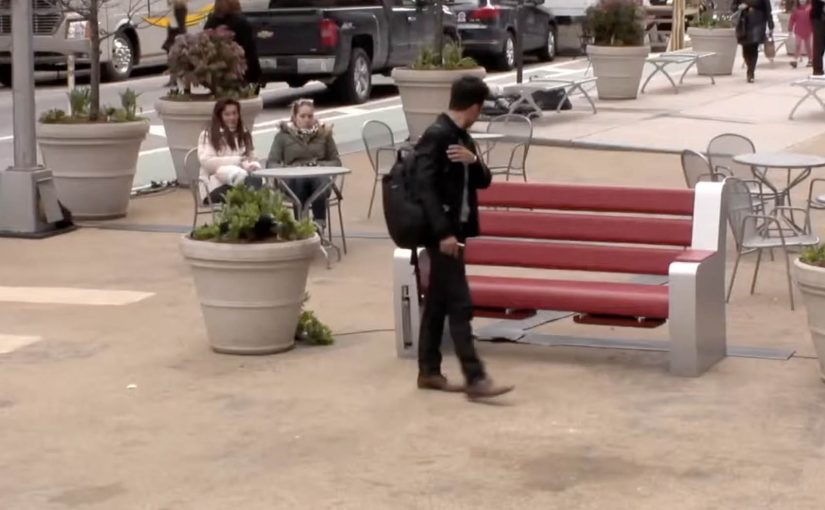
Virgin Atlantic: No Ordinary Park Bench

Virgin Atlantic wanted to give the people of New York a taste of their onboard services. So with the help of Y&R New York they took over an ordinary bench and gave unsuspecting park-goers an unforgettable Virgin Atlantic experience.

How an “ordinary” bench becomes an airline product demo

The mechanism is a simple swap. Take a familiar public object. Upgrade it with unmistakable “premium” cues. Then add a layer of surprise service so the bench behaves less like street furniture and more like a seat with hospitality. The passersby reaction becomes the content, and the content carries the brand promise further than a static poster ever could.

In premium service brands, the fastest route to belief is letting people experience the service promise before they ever buy.

Why it lands

This works because it compresses a complex claim, “we make flying feel special”, into a single, legible moment in the real world. You do not need a fare sale, a cabin diagram, or a spec sheet. You just need the contrast of ordinary versus treated-like-a-guest.

Extractable takeaway: When your differentiation is a feeling, stage a public, bite-sized version of that feeling. Make it easy to understand in one glance and easy to retell in one sentence.

What the stunt is really doing for the brand

It turns an intangible benefit, service, into something tangible and shareable. The real question is how you make an intangible service promise feel credible before purchase. The bench is not the point. The point is credibility by demonstration. It is a live proof point that “Virgin Atlantic service” is a thing you can recognize, even on the ground.

What premium service brands can borrow

  • Choose a familiar object: the more ordinary the baseline, the stronger the contrast when you upgrade it.
  • Make the promise physical: show the service, do not describe it.
  • Design for bystanders: build a moment that attracts a crowd without requiring explanation.
  • Keep the story clean: one setup, one surprise, one payoff.
  • Capture reactions: human responses are the most efficient proof of “this is different”.

A few fast answers before you act

What is the “No Ordinary Park Bench” idea?

It is a Virgin Atlantic street activation where an ordinary park bench is transformed into a branded service moment, giving park-goers a taste of the airline’s onboard experience.

Why use a bench instead of a pop-up booth?

A bench is instantly understood and frictionless. People sit without committing to “an activation”, which makes the surprise feel more genuine and the reactions more watchable.

What makes this effective for premium brands?

Premium is hard to prove with claims alone. A live demonstration makes the promise tangible, and it gives people a story to repeat.

What is the core pattern to reuse?

Pick one everyday touchpoint, upgrade it dramatically, and deliver the brand benefit in a way people can feel immediately.

What is the biggest risk with this format?

If the experience feels staged, intrusive, or confusing, the audience will not lean in. The best versions are simple, respectful, and clearly additive to the public space.

TNT: A Dramatic Surprise on an Ice-Cold Day

In the quiet town of Dordrecht, a familiar red button sits waiting. When innocent passers-by dare to push it, pure TNT drama unfolds, with a slightly new twist: close participation from the public.

In April last year TNT launched their digital channel in Belgium with a big red push button in a quiet Flemish square.

Now, to launch their movie channel in the Netherlands, they created a new dramatic piece of the now-famous red button, this time pulling bystanders closer into the action.

The mechanic that makes the button irresistible

The mechanism is a simple dare plus instant escalation. A single, universal instruction invites a tiny act of curiosity. The moment someone commits, the environment “answers” with a choreographed sequence that feels bigger than the setting. The new twist is the proximity: the public is not only watching the drama, the public is forced to navigate it.

By “close participation”, the stunt means the action breaks the invisible line between performer and audience, so bystanders become part of the scene rather than spectators at a safe distance.

In channel launches and entertainment branding, public stunts that turn bystanders into participants are a shortcut to earned attention.

Why it lands

This works because it transforms a brand promise into a physical consequence. “We know drama” is not a slogan you politely agree with. It becomes something you experience in real time, in a place that looked ordinary seconds earlier. The tension comes from the button. The payoff comes from the world changing around the person who pushed it. That works because one visible action creates instant narrative clarity: everyone can see the cause, the consequence, and the brand promise in one beat. The real question is whether the escalation makes TNT’s promise legible in seconds, not whether people will press the button. This is a strong launch format because the button is only the trigger, while the readable escalation is what sells the channel.

Extractable takeaway: If you can convert a brand line into a simple action and an immediate, escalating response, you create a story people retell accurately. That accuracy is what makes the idea travel.

Design moves worth borrowing

  • One action, one trigger: make the entry point obvious and almost impossible to resist.
  • Escalation with clarity: raise the intensity quickly, but keep the through-line readable for anyone who arrives mid-scene.
  • Let the environment do the branding: the best stunts feel like the place itself has changed, not like a pop-up was installed.
  • Design for the crowd: build moments that work for the person in it and for everyone filming from the edges.
  • Keep the “twist” singular: here it is proximity. One twist is enough when the production is big.

A few fast answers before you act

What is “A Dramatic Surprise on an Ice-Cold Day”?

It is a TNT red button sequel staged in Dordrecht, where pushing the button triggers a choreographed chain of dramatic events that pulls bystanders into the action.

What’s different versus the earlier “quiet square” button?

The key twist is the closeness of participation: the drama happens nearer to the public, and the public is more directly swept into the scene.

Why does a single button work so well?

Because it creates instant viewer control. One obvious action produces an immediate consequence, which makes the story easy to understand and easy to share.

What’s the core marketing job this format does?

It turns a positioning line into a lived moment, then uses the crowd’s reactions and recordings as distribution.

What’s the biggest execution risk?

If the escalation feels confusing or unsafe, the narrative flips. The format depends on clear choreography and the audience feeling surprised, not threatened.