
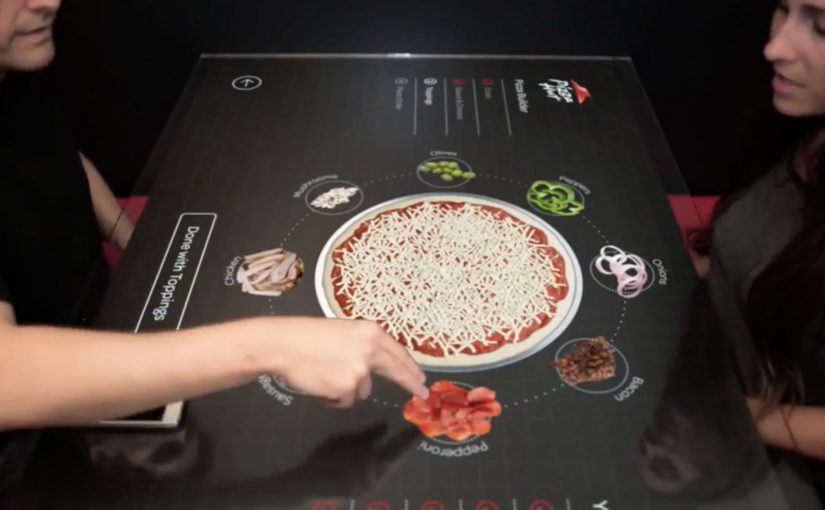
Pizza Hut Interactive Table: order by touch

Multi-touch media that uses highly engineered glass and companion technologies feels like the future. So Pizza Hut partners with Chaotic Moon Studios in the USA to create an interactive concept table that lets customers in retail outlets create and customize their pizzas on the spot.

The promise is simple: instead of a static menu, the table becomes the interface, turning ordering into something you can explore, assemble, and adjust with your hands.

A table that turns ordering into a build experience

The mechanism is a multi-touch tabletop UI that walks you through base, sauce, toppings, and sides as a sequence of visual choices. Your pizza is assembled live on-screen, so the product takes shape while you decide.

In quick-service restaurants, the easiest way to increase customization confidence is to make choices visual and immediate.

Why it lands: it reduces friction and adds play

Ordering pizza can be surprisingly error-prone: misheard toppings, unclear sizes, forgotten extras, awkward group decisions. A touch-first interface turns that into a shared, visible process where everyone can see what is being built before it is submitted.

Extractable takeaway: When customization is the product, make the build visible to everyone, so groups converge on one order with fewer misunderstandings.

What Pizza Hut is really trying to prove

Beyond “cool tech,” this kind of table concept signals modernity in the dine-in experience. It frames Pizza Hut as a place where the experience is part of the product, not only the food.

These interfaces are worth doing only when they reduce ordering errors and keep dine-in throughput intact.

The real question is whether turning ordering into a shared build process increases confidence without slowing the line.

Borrowable patterns for touch-first ordering

  • Make the product assemble itself. Visual construction beats textual configuration for speed and accuracy.
  • Design for groups, not only individuals. Shared screens turn indecision into collaboration.
  • Keep the interaction shallow. Limit the flow to a few obvious steps with minimal typing.
  • Let the interface do the upsell quietly. Sides and add-ons perform better when they appear as natural next steps.

A few fast answers before you act

What is the Pizza Hut Interactive Concept Table?

It is a multi-touch tabletop ordering concept designed to let dine-in customers build and customize pizzas directly on the table interface.

What problem does a touch-table solve in restaurants?

It reduces ordering friction by making customization visual, shared, and less dependent on staff hearing, memory, or paper menus.

Is this an ordering system or a marketing concept?

It is presented as a concept experience to demonstrate a possible future dine-in flow, with the interface itself acting as the headline.

Why is multi-touch a good fit for pizza customization?

Pizza is modular. When options can be added, removed, and previewed instantly, customers feel more confident and order faster.

What is the main takeaway for experience design?

If you want people to customize, make the choices tangible. Let them see the product changing as they decide.

Mercedes-Benz: Tweet-Fueled Road Trip Race

In February this year four two-person teams left four cities, Chicago, Los Angeles, New York City, and Tampa Bay, to goto Dallas, Texas in a custom-designed Mercedes-Benz car that was fuelled by Twitter.

Of course the cars were not physically running on tweets, but virtually they were. The reason for Mercedes-Benz saying that the race was “Tweet-Fueled” was because each of the four teams had to get the support of their home cities to drum up enough support on Twitter to get them to the finish line in Dallas.

In the end the campaign had almost 30,000 active participants with over 72,000 Facebook Fans and 77,000 Twitter Followers who generated over 150,000+ tweets to power the cars. The campaign videos generated about 2 million views, while the twitter reach pushed over the 25 million mark.

Why “tweet-fueled” is more than a gimmick

The smart move is that social support is not commentary. It is the engine of progress. That turns spectators into participants, because every tweet has a clear meaning. It helps your team move. In large consumer brands, this kind of real-time mechanic works best when the audience action maps to a visible outcome.

Extractable takeaway: When the audience can see their social action move a scoreboard, participation scales beyond one-off commenting.

  • Clear cause and effect. Tweets translate into distance and momentum.
  • City pride as a driver. Chicago vs LA vs NYC vs Tampa gives the story a natural rivalry.
  • Built-in recruiting. Teams need their cities, so they recruit friends to contribute.

How the campaign design created scale

The structure is simple. Four teams. One destination. A visible race. But it is the social mechanics that create the volume.

The real question is whether your campaign turns audience action into trackable progress that people can influence in real time.

  1. Teams need advocates. Supporters feel like they are part of the outcome.
  2. Progress is trackable. People return when they can see movement and standings.
  3. Video extends the narrative. Moments from the road give the audience something to share beyond the scoreboard.

In real-time social entertainment, participation scales when the audience can visibly change the outcome, not just comment on it.

What to take from this if you build real-time social campaigns

  1. Make participation meaningful. If the social action changes the outcome, people care more.
  2. Create teams and identity. Groups recruit. Individuals browse.
  3. Design a visible progress loop. Standings and milestones keep engagement alive.
  4. Use content to refresh attention. Videos give people new reasons to re-share and re-engage.

A few fast answers before you act

What was the Mercedes-Benz Tweet-Fueled race?

It was a social-powered race where four teams drove from Chicago, Los Angeles, New York City, and Tampa Bay to Dallas, and their progress was powered virtually by Twitter support from their home cities.

Why were the cars called “tweet-fueled”?

Not because tweets powered engines physically, but because tweets served as the mechanism that enabled teams to accumulate the support needed to reach the finish line.

What were the reported results?

Almost 30,000 active participants, over 72,000 Facebook fans, 77,000 Twitter followers, more than 150,000 tweets, about 2 million video views, and Twitter reach exceeding 25 million.

Why does the city-based structure matter?

It creates rivalry and pride, which motivates supporters to participate and recruit others to help their team advance.

What is the transferable lesson?

If you can turn social activity into measurable progress toward a clear goal, you can convert audience attention into sustained participation.