
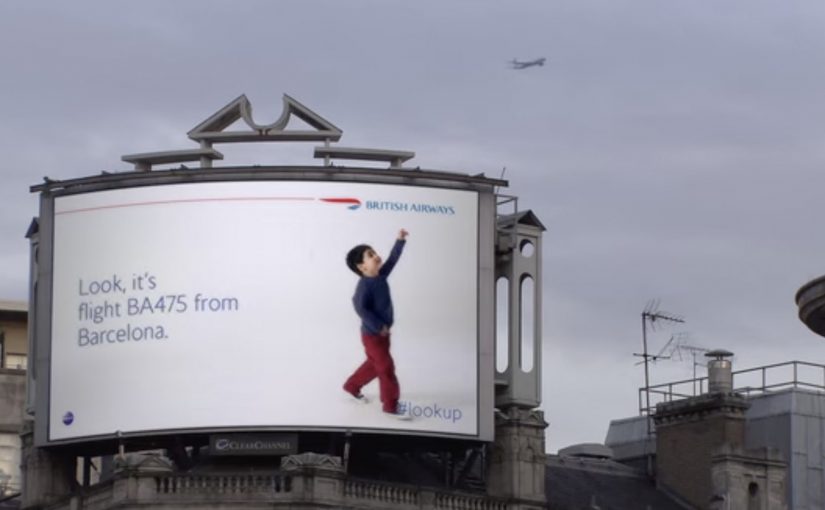
British Airways: #lookup points to planes

Last month, British Airways set up an interactive digital billboard in London’s Piccadilly Circus. It uses custom-built “surveillance technology” to track British Airways flights passing overhead. Here, that means identifying aircraft and matching them to British Airways flights in real time, not tracking individuals on the street.

On detecting a BA flight, the boy in the ad gets up and points to the plane. An accompanying message displays the flight number and the place it is arriving from.

In high-traffic city centres, digital out-of-home works best when it reacts to the environment rather than shouting at it.

Interactive advertisements are getting more popular with brands. In May, a Spanish organization called ANAR used lenticular printing to show different messages to kids and adults in their campaign for anti-child abuse.

How #lookup works (and what “surveillance” means here)

The magic is simple. The screen stays “normal” until the exact moment a British Airways aircraft is in view. Then the creative switches to a scene that makes you do what the boy does. You look up, spot the plane, and connect the brand to the real object above you.

“Surveillance technology” sounds heavier than what’s happening in practice. In this execution, it is reported as hardware and software used to identify aircraft and match them to British Airways flights in real time. The storytelling trigger is the aircraft, not the crowd.

Definition you can reuse: Context-aware DOOH is outdoor creative that changes based on live signals from the environment (location, time, weather, movement, or public data feeds). It works when the signal is instantly understandable and the change earns attention rather than interrupts it.

In European city-centre media buys, context-aware DOOH is one of the few formats that can earn attention without relying on volume.

Why it lands: a micro-surprise that answers a real question

Most outdoor advertising asks for attention first, and only then offers meaning. #lookup flips that order. It gives you meaning first. A child pointing at something real. Then it rewards your curiosity with an answer you cannot get from a static poster. What flight is that, and where has it come from? Because the trigger is a plane you can actually see, the data reveal feels like an answer to curiosity, not an interruption.

Extractable takeaway: If the environment makes people ask a question, your creative should answer it instantly with one human-readable data point that completes the scene.

The real question is how you turn ambient curiosity into a brand-credit moment people choose to share.

This is the rare “brand moment” where the interface and the emotion line up. A real plane prompts real curiosity. The billboard supplies the missing information. The brand gets credited for the experience.

What British Airways is really buying with this idea

At one level, it’s a smart stunt. At a deeper level, it’s a reframing of air travel. Instead of selling price, routes, or amenities, it sells the feeling of possibility and the breadth of the network.

It also turns a passive medium into an earned-media engine. When a billboard reacts to reality, people record it, talk about it, and share it because it feels like “proof,” not persuasion.

How to borrow the #lookup pattern

  • Pick a signal people already notice. Planes, trains, weather shifts, match scores, queue length, local landmarks. The trigger should be obvious without explanation.
  • Make the reaction immediate and legible. If the audience needs to read a paragraph to understand the mechanic, the moment is lost.
  • Answer a question the environment creates. “Where is that going?” is stronger than “buy now.” Build the creative around curiosity.
  • Use data as a storytelling ingredient, not a dashboard. Flight numbers and origins feel human when they complete the scene, not when they look like telemetry.
  • Keep privacy optics clean. If you must use loaded terms like “surveillance,” clarify what is being detected and what is not.

A few fast answers before you act

What makes the British Airways #lookup billboard “interactive”?

It changes its creative in real time based on a live external trigger. A British Airways aircraft passing overhead. That trigger causes the billboard to play a scene and display flight details tied to the specific plane.

Is this the same as QR codes or touchscreens in outdoor ads?

No. QR codes and touchscreens require deliberate user input. #lookup is environment-triggered interaction. The “input” is a real-world event, not a tap.

Why does real-time data improve out-of-home advertising?

Because it turns a static message into a situated experience. When the content matches what is happening around you right now, attention feels earned and the brand feels more relevant.

What’s the simplest way to replicate this pattern without complex engineering?

Use a clean, reliable signal you can access easily (time of day, weather, local transit status) and design one dramatic creative switch that is instantly visible from a distance.

What’s the biggest risk with “reactive” outdoor ads?

Overcomplication. If the trigger is rare, hard to understand, or the creative change is subtle, the concept will not land. Optimise for clarity and frequency of payoff.
MINI: Salutes You in London

In August I wrote about how Coca-Cola Israel used technology to personalise billboards for people who drove by.

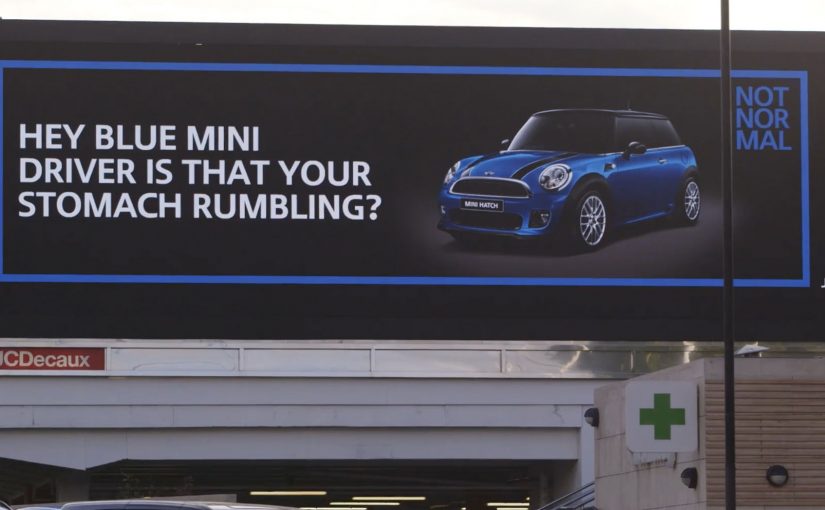
Now, as part of its ongoing Not Normal campaign, MINI decides to give MINI drivers in London a custom message by taking over a run of giant billboards along a fast-paced road for a two-week period. “Not Normal” is the positioning line for celebrating owners over product claims.

Reportedly, the campaign reached out to 1,941 MINI drivers in London during the run.

How the billboards “recognise” drivers

The mechanism is deliberately human. Spotters use iPads to identify approaching MINIs and trigger the right creative. Each message is sent with pictures of the make and model of the MINI it relates to, so the driver sees something that feels directed, not generic.

In urban out-of-home advertising, combining live triggers with personalised creative can make a brand message feel like a service moment, not just media.

A human-triggered approach is the right call on a fast road, because it keeps the moment specific without pretending you have perfect recognition tech.

Why this lands on a road, not in a feed

Most personalised media is private and one-to-one. This flips it into a public setting. The driver gets a direct salute, and everyone else sees a brand that appears to be paying attention to its community in real time. That publicness is the multiplier, because it turns a personal moment into shared talk value, meaning people retell it.

Extractable takeaway: Public personalisation works when the proof cue is instantly legible to bystanders, not just meaningful to the target.

What the campaign is really doing for MINI

The work reinforces the Not Normal positioning by celebrating owners rather than pushing product claims. It also turns “existing drivers” into the hero audience, which is a neat way to build loyalty and social proof at the same time.

The real question is whether the salute feels like a genuine community nod, not a clever stunt.

Transferable moves from MINI Salutes You

  • Use a simple trigger and a clear payoff. Recognition plus a tailored line is enough if the timing is perfect.
  • Keep it brand-native. A salute fits a community brand. A hard sell would break the spell.
  • Make personalisation visibly specific. Showing the make and model is the proof cue that prevents it feeling random.
  • Design for safety and readability. Short messages, high contrast, instant comprehension.

A few fast answers before you act

What is “MINI Salutes You” in one line?

A digital out-of-home activation that displays personalised messages to MINI drivers as they pass selected London billboards.

How are the personalised messages triggered?

Human spotters using iPads identify approaching MINIs and trigger the relevant creative, including make and model visuals.

Why use billboards for personalisation?

Because it makes recognition public. The driver feels noticed, and bystanders see a brand visibly celebrating its community.

What do you need to make this work without advanced tech?

A small set of tightly written messages, clear proof cues (like make and model), and a reliable human trigger that can fire the right creative at the right moment.

What is the main transferable lesson?

If you can time a simple personalised moment perfectly, you do not need complex tech to create a campaign people retell.

Benefit Cosmetics: Temptation Telephone

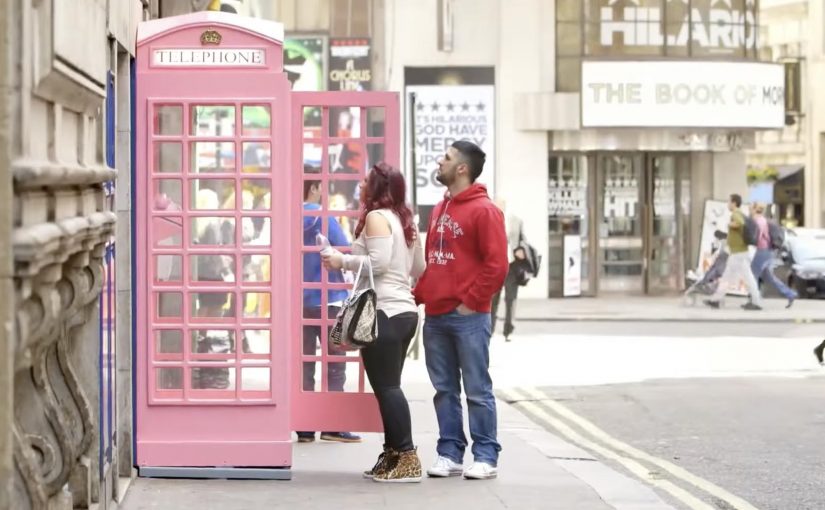
‘Ring ring…’ A pink telephone starts ringing in the middle of London. The question is simple. Do you pick it up.

Benefit Cosmetics places a pink phone booth on a busy street for a day and turns the call into a dare. If you answer, you are pulled into a pop-up “celebrity moment”. A quick makeover, then a trip to Café de Paris where you are pushed onto the stage to sing Whitney Houston’s “I Wanna Dance With Somebody” with a live band in front of a packed room.

The temptation mechanic

The mechanism is built around a single micro-decision, meaning one small public choice with immediate consequences. Answering a ringing phone in public. The payoff is immediate escalation. You are not given a flyer or a discount. You are given a story you will retell. The booth, the ring, the dare, the stage. The whole thing is designed to transform a passerby into the headline.

In beauty retail and experiential marketing, the fastest way to earn attention is to convert curiosity into a socially shareable moment that makes the participant feel chosen.

Why it lands

This works because it exploits a universal impulse. Most people want to know what happens if they answer. The booth creates theatre, the ringing creates urgency, and the venue creates legitimacy. That sequence works because the first action feels harmless, while the public payoff turns a passing impulse into a memorable story. The participant does not feel like they “took part in advertising”. They feel like they got a once-only experience, which is exactly what makes the footage feel authentic and replayable.

Extractable takeaway: When you can own a clear “dare”, design it around a tiny public action with a big, fast reward, then stage the reward somewhere iconic so the story carries your brand without further explanation.

What Benefit Cosmetics is really selling

The real question is whether Benefit can make confidence feel like something you step into, not something you buy. Benefit is not really selling makeup here. It is selling permission to be bold. The makeover is a prop. The real product is the feeling of stepping into the spotlight for ten minutes.

What to steal from Benefit’s temptation loop

  • Engineer a single, obvious trigger. One action. One choice. Answer or walk past.
  • Pay off immediately. Curiosity dies fast. Reward it fast.
  • Borrow an iconic container. A recognizable venue turns a stunt into “a real event”.
  • Make the participant the content. Their nerves and laughter do more than scripted copy ever will.

A few fast answers before you act

What is Benefit’s “Temptation Telephone”?

A one-day street activation where a ringing pink phone booth lures passersby into answering, then escalates into a makeover and a live on-stage performance at Café de Paris.

Why does the ringing phone work as a trigger?

Because it creates an unavoidable question. Who is calling. What happens if I answer. That curiosity produces voluntary engagement.

What role does Café de Paris play in the idea?

It supplies instant credibility and spectacle. The venue makes the payoff feel like a “real night out”, not a brand demo.

What makes this feel shareable rather than staged?

The participant’s reaction arc. Hesitation, commitment, then performance. Viewers watch to see whether the person goes through with it.

When is this pattern a good fit?

When your brand can credibly promise confidence, fun, or transformation, and you can deliver a fast, memorable payoff tied to a single public decision.