
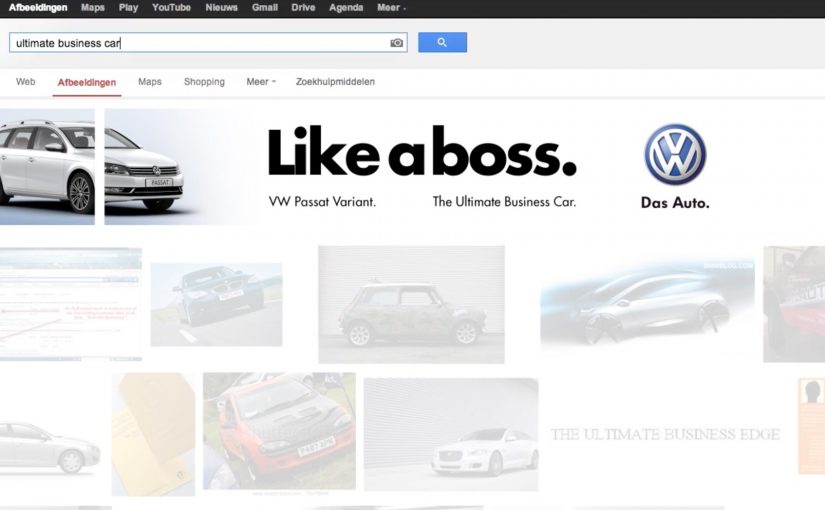
Volkswagen: Image Search SEO as an “Organic Ad”

Volkswagen: Image Search SEO as an “Organic Ad”

When the “ad” is the search results page

Everyday millions of people are searching for products and brands on Google. So in this latest example of search optimisation, SEA Team from UK created a search engine advertising campaign for Volkswagen which positioned the car in a unique “organic ad” created by optimising the first five individual URLs of a Google Image Search.

By “organic ad” here, I mean unpaid image results arranged to read like a single designed creative.

The campaign does feel realistic but when I searched for “ultimate business car”, I got only images from people posting about the campaign.

The hack: assemble a creative out of ranked tiles

The idea is essentially compositional SEO. By compositional SEO, I mean deliberately ranking separate assets so the grid reads as one coherent “ad.” You do not buy a placement. You engineer multiple image results so the interface itself becomes the creative. The medium is the interface people already trust.

In consumer brands and automotive marketing, this only holds when the search behavior is stable enough to be predictable.

Why it is both clever and fragile

It feels native because it lives inside an everyday behavior. Searching. But the moment the campaign becomes the story, the query gets polluted. That contamination is when coverage and commentary replace the normal mix of competing results.

Extractable takeaway: If your “creative” depends on organic authenticity, assume the interface will amplify attention first and destroy repeatability second.

What this is really trying to achieve

The real question is whether you can borrow organic credibility without turning the query into a PR artifact.

Borrow the credibility of organic results while delivering the impact of a designed creative. A brand moment that lives exactly where intent lives. It is clever, but I would not treat it as a repeatable acquisition lever.

Steal the container, not the banner

  • Use interface-level creativity. Sometimes the container is the canvas.
  • Plan for contamination. Once the stunt spreads, organic authenticity degrades fast.
  • Choose mechanics that survive attention. Pick queries where the effect can outlive press and copycats.

A few fast answers before you act

What was the Volkswagen “organic ad” concept?

A campaign that optimized the first five source URLs in a Google Image Search so the image grid formed a single Volkswagen creative.

Was this paid search?

No. The idea is to engineer multiple image results so the grid becomes the creative, rather than buying a placement.

Who created it?

The post credits SEA Team from the UK.

Why does it feel realistic at first?

Because it appears inside an organic search behavior and uses the familiar image-results interface as the placement.

What problem did the post observe when trying it later?

Searching for “ultimate business car” returned mostly images of people posting about the campaign, rather than a clean, normal-looking result set.

Frijj: You LOL You Lose

Frijj: You LOL You Lose

Frijj, a UK-based milkshake brand, and Iris Worldwide developed a campaign to help people build their tolerance to the unexpected. The aim was to make Frijj’s new flavours, Honeycomb Choc Swirl, Jam Doughnut, and Sticky Toffee Pudding, feel like a challenge worth trying.

So they created an advergame, a branded game designed to promote a product through play. It pits you against friends from your social networks in a challenge of who can keep a straight face for the longest period of time while the web app serves up funny and weird YouTube videos.

A “don’t laugh” game that sells flavour confidence

The mechanic is straightforward. You start a session, the site throws escalating clips at you, and you try not to crack. The moment you smile, you lose. The format turns passive viewing into competitive viewing, which is exactly what makes it sticky. Here, “flavour confidence” means making unusual flavours feel safe and fun to try rather than risky or strange.

In FMCG launches, simple competitive mechanics are a reliable way to turn a product message into repeatable social behavior.

Why it lands

This works because it reframes product novelty as a playful test. Instead of saying “these flavours are bold”, it says “prove you can handle bold”. Social comparison does the rest. You want a better score than your friends, so you replay, you share, and you bring others into the same loop. The use of face tracking is also a smart constraint. If the system can “catch” a smile, the challenge feels fair and measurable rather than self-reported.

Extractable takeaway: If your product promise is “unexpected”, build a mechanic where the audience has to demonstrate composure or control. The brand benefit becomes the rule of the game, not the line of copy.

What Frijj is really buying with this advergame

This is a strong launch mechanic because it turns trial curiosity into repeatable social play at scale. The real question is whether the product promise can become a rule people want to test with friends. The game creates time spent, repeat visits, and a socially distributed invitation mechanic, all while keeping the brand message consistent. New flavours that might feel risky in a supermarket become a badge of fun online.

Design rules worth borrowing from Frijj

  • Make the rule binary. Smile equals lose. Simple rules travel.
  • Use content people already understand. YouTube “weird and funny” clips need no explanation.
  • Turn replay into the product benefit. Each retry reinforces “unexpected” as the brand’s territory.
  • Design social competition as the default. Friends, scores, and bragging rights beat generic “share this”.
  • If you use webcam detection, be explicit. Clear consent and clear on-screen feedback keep trust intact.

A few fast answers before you act

What is the core idea of “You LOL You Lose”?

A straight-face challenge where the “payment” is composure. You watch funny clips and try not to smile longer than your friends.

What is an advergame?

An advergame is a branded game designed to promote a product by turning the message into gameplay rather than traditional advertising.

How does the game know you “lost”?

It is described as using face tracking through your webcam to detect a smile. When you smile, the session ends.

Why is this a good fit for launching unusual flavours?

Because it converts “new and unexpected” into a playful challenge, which makes novelty feel fun instead of risky.

What should you measure if you run something similar?

Repeat plays per user, share and invite rate, average session duration, and any lift in branded search or retail trial during the launch window.

Mountain Dew: Paintball Street Art in London

Mountain Dew: Paintball Street Art in London

Paintballing meets street art in Mountain Dew Energy’s UK campaign. The idea is built around a simple collision: take the raw physicality of paintballing and merge it with graffiti culture.

The campaign is centred on a Facebook app designed to find and showcase the brand’s official street artists. Rather than appointing talent from the top down, Mountain Dew Energy lets fans decide who represents the brand on the street.

The campaign video shows the Graffiti Kings creating large-scale street art using paintballs inside London’s graffiti hub, the Leake Street Tunnel. The featured artists, Knoxville and Grohl, are not random selections. They were chosen by fans following a teaser phase that invited participation before a single wall was painted.

When the medium becomes the spectacle

The mechanism is the twist on technique. Graffiti is usually associated with spray cans and markers. Paintballs introduce unpredictability, force, and performance. The act of creation becomes as interesting as the final artwork, giving the campaign strong visual momentum.

In youth and culture-led marketing, credibility rises when the brand builds a participatory system and lets the community validate the outcome.

In UK culture-led brand marketing, credibility compounds when the community is allowed to validate who gets the wall.

The real question is whether you will let fans choose the makers before you ask them to share the outcome.

Why fan selection changes the power dynamic

Letting fans choose the artists shifts authorship. The brand steps back from curating taste and instead creates a framework where the community validates talent. That makes the outcome feel earned rather than manufactured, which matters in street culture.

Extractable takeaway: If you need cultural credibility, move selection upstream and let the community choose the creators before you invest in production.

This also gives the campaign a built-in narrative arc. The teaser phase creates anticipation. The vote creates ownership. The execution becomes a payoff that fans feel partially responsible for.

The intent behind the paintballs

The business intent is not just awareness. It is cultural alignment. Mountain Dew Energy positions itself close to street culture, creativity, and youth expression. By avoiding polished studio aesthetics, the brand signals that it understands the messier, louder edges of its audience. Brands should not borrow street-culture signals unless they also borrow the audience’s decision rights.

Moves to copy from paintball graffiti

  • Hybridise formats. Combining two cultures can create immediate distinction.
  • Make creation performative. If the process is entertaining, it becomes shareable.
  • Let fans decide. Participation before execution increases emotional investment.
  • Choose the right setting. Leake Street Tunnel adds credibility that no set could replicate.
  • Design the buildup. Teasers and voting give the campaign a rhythm, not just a reveal.

A few fast answers before you act

What makes this campaign different from typical street art sponsorships?

The use of paintballs turns graffiti into a live performance, not just a finished visual, and makes the act of creation central to the story.

Why involve fans in choosing the artists?

It transfers credibility. When the community selects the talent, the brand avoids looking like it is imposing taste from above.

Does the Facebook app actually matter?

Yes. It is the coordination layer, meaning the simple system that collects votes and points fans to the official artists, and gives the campaign a reason to unfold over time.

What audience behaviour is this trying to encourage?

Engagement, sharing, and identification with the brand as part of a creative subculture rather than just a beverage choice.

What is the key takeaway for brand-led cultural campaigns?

Create a platform, not just a placement. When people can influence the outcome, they are more likely to care about the result.