Herta, described as a Nestlé brand in Belgium, launched Knacki FootBall. Small meatballs designed to look like footballs. Instead of relying on standard sampling, the brand and BBDO Brussels turned a train-station moment into a game people could not ignore.
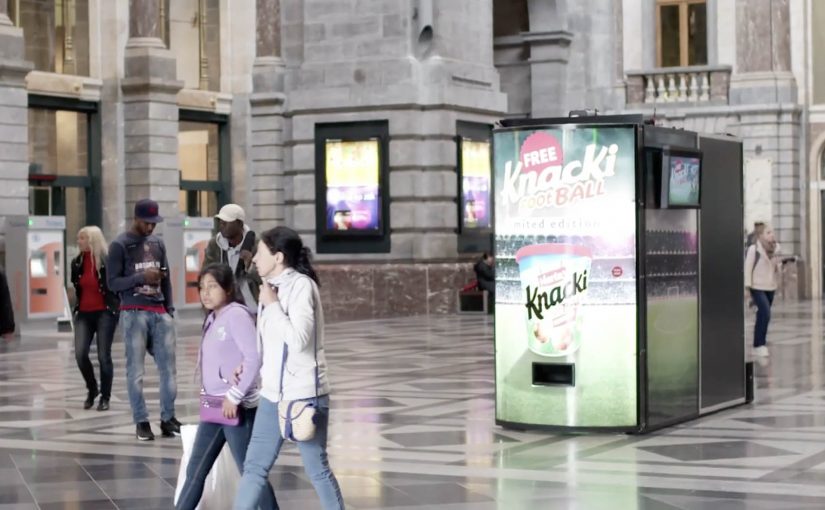
At Antwerp Central Station, a vending machine offered the product for free. Then came the twist. Press the button and the machine opened into a miniature football pitch, with Belgian football legend Leo Van Der Elst waiting inside. To walk away with the snack, you had to score.
Free is easy. Earning it is memorable.
The mechanic is deliberately unfair in the right way. People approach expecting a quick handout. The reveal forces a choice. Walk away, or step in and play. That decision point creates tension, and tension creates attention. In high-traffic commuter environments, the best sampling ideas turn “free” into a short challenge with a story-worthy payoff. The real question is whether your sampling moment earns attention before it earns a bite.
Extractable takeaway: Sampling gets retold when it includes a moment of risk or effort. The product becomes a trophy, not a giveaway.
A vending machine that behaves like a stadium
The physical design does most of the communication. The moment the door opens, everyone nearby understands what is happening. It becomes a spectator event, which is crucial in a station setting where most people do not want to stop unless something is already happening.
Why the celebrity opponent matters
Leo Van Der Elst is not a generic “host.” He is the difficulty setting. His presence turns the activation into a genuine duel, and that makes the outcome feel earned whether you win or lose. It also gives the content a built-in headline when the story travels online.
What the brand is really reinforcing
Knacki FootBall is a novelty product, so the job is not deep education. It is instant association. Football. Fun. A quick bite. The machine makes those associations physical, then anchors them to a specific place and moment people remember.
How to copy The Football Machine
- Build a single, obvious action. Press the button. The rest happens to you.
- Make the reveal legible from 10 meters away. If bystanders cannot decode it fast, you lose the crowd effect.
- Turn sampling into a challenge. Effort increases perceived value and shareability.
- Use a real “difficulty signal.” A credible opponent or constraint makes the game feel legitimate.
- Design the exit. Winning should end with a clear reward and a clean photo moment.
A few fast answers before you act
What is Herta Knacki FootBall “The Football Machine”?
It is a vending machine activation where commuters expecting a free sample discover a miniature football pitch inside, and must score a goal to win Knacki FootBall.
Where did the activation run?
It is described as being installed at Antwerp Central Station in Belgium.
Why use a vending machine for a food launch?
Because it creates a familiar expectation. Then you can subvert it. That contrast generates surprise, crowd attention, and strong word of mouth while still delivering the product sample.
What makes this work in a train station specifically?
Stations are full of people who are time-poor. A reveal that is instantly understandable, plus a short game loop, one attempt that takes seconds, can stop people without requiring explanation.
What is the biggest operational risk with this kind of live activation?
Throughput and safety. If the game takes too long, queues become friction. If the experience feels unsafe or embarrassing, people avoid participation and the crowd effect collapses.