
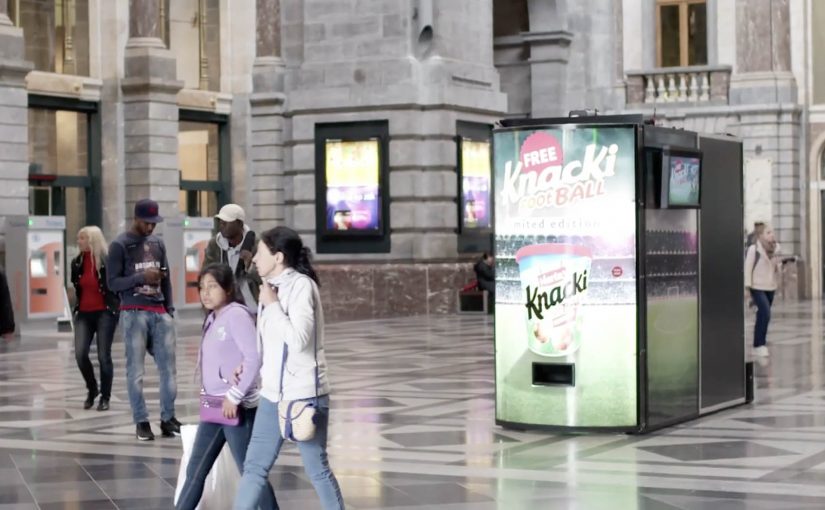
Herta Knacki FootBall: The Football Machine

Herta, described as a Nestlé brand in Belgium, launched Knacki FootBall. Small meatballs designed to look like footballs. Instead of relying on standard sampling, the brand and BBDO Brussels turned a train-station moment into a game people could not ignore.

At Antwerp Central Station, a vending machine offered the product for free. Then came the twist. Press the button and the machine opened into a miniature football pitch, with Belgian football legend Leo Van Der Elst waiting inside. To walk away with the snack, you had to score.

Free is easy. Earning it is memorable.

The mechanic is deliberately unfair in the right way. People approach expecting a quick handout. The reveal forces a choice. Walk away, or step in and play. That decision point creates tension, and tension creates attention. In high-traffic commuter environments, the best sampling ideas turn “free” into a short challenge with a story-worthy payoff. The real question is whether your sampling moment earns attention before it earns a bite.

Extractable takeaway: Sampling gets retold when it includes a moment of risk or effort. The product becomes a trophy, not a giveaway.

A vending machine that behaves like a stadium

The physical design does most of the communication. The moment the door opens, everyone nearby understands what is happening. It becomes a spectator event, which is crucial in a station setting where most people do not want to stop unless something is already happening.

Why the celebrity opponent matters

Leo Van Der Elst is not a generic “host.” He is the difficulty setting. His presence turns the activation into a genuine duel, and that makes the outcome feel earned whether you win or lose. It also gives the content a built-in headline when the story travels online.

What the brand is really reinforcing

Knacki FootBall is a novelty product, so the job is not deep education. It is instant association. Football. Fun. A quick bite. The machine makes those associations physical, then anchors them to a specific place and moment people remember.

How to copy The Football Machine

  • Build a single, obvious action. Press the button. The rest happens to you.
  • Make the reveal legible from 10 meters away. If bystanders cannot decode it fast, you lose the crowd effect.
  • Turn sampling into a challenge. Effort increases perceived value and shareability.
  • Use a real “difficulty signal.” A credible opponent or constraint makes the game feel legitimate.
  • Design the exit. Winning should end with a clear reward and a clean photo moment.

A few fast answers before you act

What is Herta Knacki FootBall “The Football Machine”?

It is a vending machine activation where commuters expecting a free sample discover a miniature football pitch inside, and must score a goal to win Knacki FootBall.

Where did the activation run?

It is described as being installed at Antwerp Central Station in Belgium.

Why use a vending machine for a food launch?

Because it creates a familiar expectation. Then you can subvert it. That contrast generates surprise, crowd attention, and strong word of mouth while still delivering the product sample.

What makes this work in a train station specifically?

Stations are full of people who are time-poor. A reveal that is instantly understandable, plus a short game loop, one attempt that takes seconds, can stop people without requiring explanation.

What is the biggest operational risk with this kind of live activation?

Throughput and safety. If the game takes too long, queues become friction. If the experience feels unsafe or embarrassing, people avoid participation and the crowd effect collapses.
Coca-Cola Peace Machines

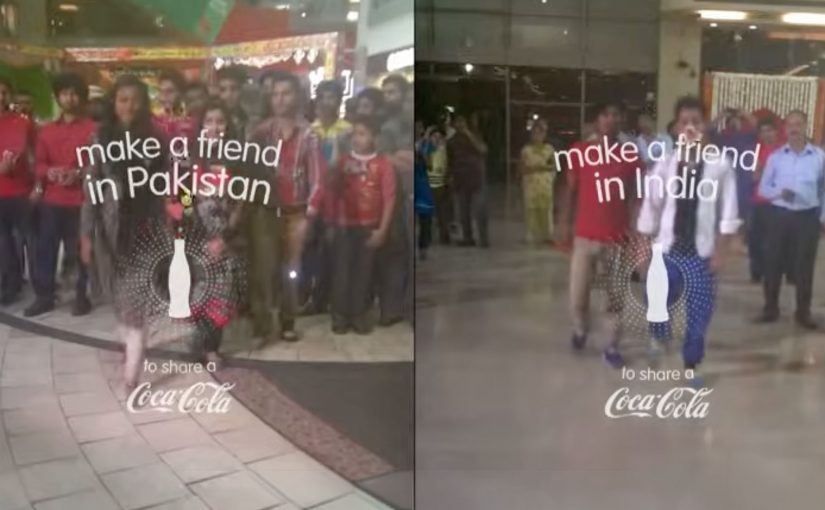
Small World Machines. India and Pakistan meet through a Coke

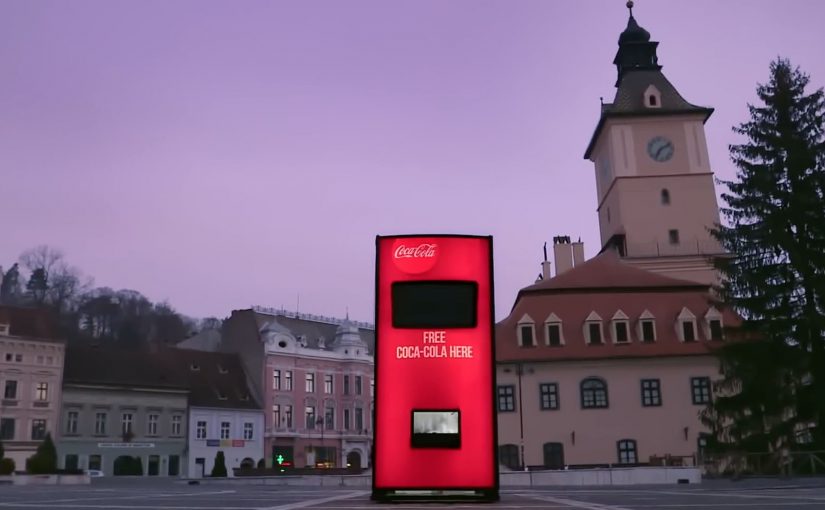
Over the years Coca-Cola keeps experimenting with vending machines and tries to make them much more than the average soda-spitter-outer. It places two machines, one in India and the other in Pakistan, and turns them into a communication portal. These “Small World Machines” allow citizens from both countries to interact with each other and complete shared tasks. Here, “shared tasks” means actions designed to be completed together, not alone. The machines reward them with a Coke. The results…

Fair Play Machines. Inter and Milan fans can only give to rivals

The success of that has inspired Coca-Cola to once again bring fighting parties together. Now instead of bringing together nations at odds, it has tapped into the rivalry between Italian soccer teams Inter and Milan.

To ease the aggression between the fans, Coca-Cola installed their “Fair Play Machines” on opposite sides of Milan’s San Siro stadium as the teams faced off. Pressing the button of one machine dropped a Coke can down the chute of that on the side of the rival team. So this way rivals could only receive Cokes from each other. The results…

The real question is whether you can design an interaction where the easiest way to get your reward is to give something to the other side first.

In global consumer brands, especially when audiences are polarized, experience rules travel further than slogans.

What this teaches about “peace” as a design problem

The strongest move is not messaging. It is creating a constraint that makes cooperation the easiest path to a reward. A constraint is a built-in rule of the experience that limits options so the intended behaviour becomes the easiest one. This works because the reward is gated behind a cooperative act, so the social friction becomes part of the game instead of a barrier. When a machine encodes that rule, behaviour shifts without anyone needing to preach.

Extractable takeaway: If you want two sides to act differently, stop asking for goodwill. Change the rules of the interaction so the smallest “yes” becomes the default move.

Design moves you can borrow from Peace Machines

  • Gate the reward behind a give-first action. Make the path to getting something run through giving something to the other side.
  • Keep the rule legible in one glance. If people need an explanation, the moment is gone.
  • Turn tension into a shared task. Use a simple co-action that feels like play, not reconciliation.

A few fast answers before you act

What are Coca-Cola “Peace Machines” in this context?

They are vending machine concepts that turn a simple Coke transaction into a social interaction, designed to reduce tension between rival groups.

What is the core mechanic of the Fair Play Machines?

Pressing the button on one machine sends a Coke to the machine on the rival side. Rivals can only receive Cokes from each other.

How do Small World Machines relate to this?

They use the same principle. A machine becomes a bridge, enabling people in opposing contexts to interact and complete shared tasks that lead to a reward.

What does “constraint” mean in experience design?

It is a built-in rule that limits options so the intended behaviour is the easiest one to choose.

What is the main design lesson for brands?

If you want behaviour change, build the rule into the experience. Make the cooperative action the trigger for the reward, and keep it simple enough to understand instantly.

Coca-Cola: Give a Coke, Be Santa

A vending machine that asked you to choose who you are

The strongest holiday ideas turn seasonal sentiment into a simple action people can take in public. Coca-Cola’s holiday vending machine is a clean example of that move.

Coca-Cola wanted to bring out the Santa in everyone. So for the 2013 holiday season, they created a special vending machine that prompted users to either get a free Coke or give a free Coke.

The two-button mechanic that made sharing the story

If the user chose a free Coke, the machine quickly dispensed the drink for the user to enjoy.

However, if the user decided to share, then the machine did something a little more special. Watch the video below to find out.

In high-traffic FMCG retail settings, a binary choice lets a brand value show up as behavior in seconds.

Why “give” feels better than “get” in December

The psychology here is straightforward. A free product is nice, but it is forgettable. A choice that reflects identity is sticky.

Extractable takeaway: If you want a value like generosity to travel, put it into a visible choice where the “better self” option is easy to pick and easy to witness.

By putting “give” and “get” side by side, the machine turns a small decision into a moment of self-image and social proof, meaning other people can see the choice and validate it. During the holidays, people want to see themselves as generous, and they want to be seen that way by others.

The business intent behind bringing out the Santa

The intent is not simply distribution.

The real question is whether your brand promise can be expressed as a choice people are proud to make in public.

This is a stronger holiday move than a message-only campaign because it makes the value legible and repeatable at the point of interaction.

Coca-Cola uses the vending machine to translate a brand promise into behavior. The brand is associated with warmth and sharing because the consumer enacts it, not because the brand claims it.

How to reuse this give-or-get choice design

  • Turn values into a choice. Make the brand idea something people can do, not just hear.
  • Reward the “better” behavior. If sharing is the story, make sharing the more memorable path.
  • Keep the interaction instantly legible. Two clear options beat complex instructions in public spaces.
  • Design for a public moment. When others can witness the decision, the story travels faster.

A few fast answers before you act

What did Coca-Cola build for the 2013 holiday season?

A special vending machine that offered users a choice: take a free Coke or give a free Coke.

What was the core mechanism?

A simple two-option prompt. Choosing “get” dispensed a Coke immediately. Choosing “give” triggered a more special outcome.

Why does the “give” option matter so much?

Because it turns a freebie into an identity moment. People remember what they chose, and others can witness it.

What business goal did this support?

Making Coca-Cola’s holiday positioning feel real by linking the brand to a visible act of sharing, not just a message about sharing.

What is the main takeaway for brands?

If you want to own a value like generosity, design an interaction where people can demonstrate that value in the moment.