
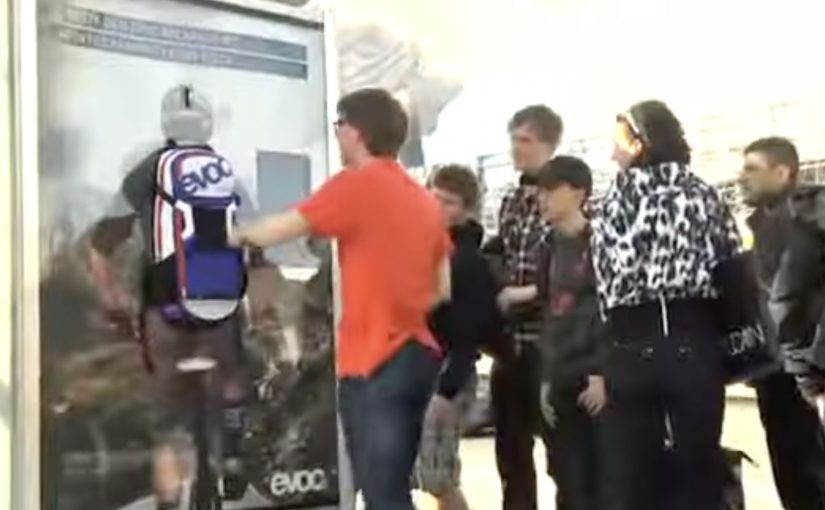
A backpack is mounted into a bus stop billboard. People step up, throw their hardest punch, and a display instantly shows the force of the hit and how much of it the backpack absorbs.
EVOC wanted to highlight its LITESHIELD protective technology, positioned as shock absorption with everyday wearing comfort. Publicis Munich created a billboard that lets passers-by physically test the backpack’s impact absorption. The unit also ties into Facebook, described as photographing participants and posting the image so they can tag and share their attempt.
The hardest recorded punch is reported as 11.30 kN. Definition-tightening: kN, kilonewton, is a unit of force, so the number is the proof-point for how much impact the demo measured, not a vague “strong” claim.
A product demo disguised as street entertainment
The mechanism is simple. Turn the product into the interface. The billboard does not claim protection, it measures an impact in public and shows both the hit and the absorbed portion in real time.
In performance-driven consumer categories, an outdoor experience that converts a spec into a felt moment can create belief faster than any explanation panel ever will.
Why the Facebook loop matters
The punch is the hook, but the share is the multiplier. By capturing the moment and attaching a score, the activation creates a lightweight competition mechanic, then hands people a reason to post that is about them, not about the brand.
Extractable takeaway: Proof travels when the moment is both measurable and share-ready, so design the interaction and the publishing loop as one system.
Reported results from coverage include around 97 hits per hour and a 220% increase in Facebook fan activity during the campaign window. Those figures are part of the story because they show what happens when the product truth is both playable and publishable.
What EVOC is really buying
This is credibility and recall. If you let someone try to break your protective promise in public and the product holds, the brand earns a kind of trust that polished messaging struggles to achieve.
The real question is whether your proof moment is verifiable at a glance, or whether it reads like a gimmick.
Proof-led stunts are worth doing only when the measurement is instantly legible and the audience feels it cannot be faked.
Proof-led activation moves worth copying
- Instrument the claim. If you say “absorbs impact,” measure impact and show the absorbed portion.
- Make the demo social by default. Photo plus score is a repeatable share trigger.
- Keep the interaction one-step. No instructions wall. One obvious action, one immediate payoff.
- Design for bystanders. Watching someone else punch is part of the persuasion.
A few fast answers before you act
What is EVOC’s “Indestructible Billboard”?
An interactive bus stop billboard in Berlin that lets people punch an EVOC backpack, then displays the measured force and the absorbed portion as a live product demonstration.
What does LITESHIELD refer to?
EVOC’s protective backpack technology, positioned around impact absorption and back protection while still being wearable for sport use.
Why add Facebook to an outdoor activation?
Because it turns a one-off street moment into shareable content. A photo plus a score gives participants a reason to post and compare attempts.
What does “11.30 kN” mean in plain language?
It is a reported peak force reading from the activation. kN is a unit of force, so the number is meant to quantify the strongest recorded hit.
What is the biggest risk with “proof” stunts like this?
If the measurement is unclear or feels fake, trust collapses. The display must be instantly readable and the interaction must feel authentic.
