

Mirakl Santa Quits

A Christmas brand film about commerce under pressure

Mirakl, the ecommerce software and marketplace platform provider, has launched a Christmas campaign built around a 60-second brand film titled “Santa Quits”. The point is not the plot twist or the production method. It is how the film turns seasonal commerce pressure into proof of how an agent-driven operating model is meant to respond.

The film was created with AiCandy Australia. Mirakl describes every character and scene as AI-generated, then shaped into a finished narrative through human creative direction and filmmaking craft.

Santa quits, the world panics, and an elf restarts operations

In the film, Santa resigns under modern seasonal pressure, triggering worldwide protests as people demand Christmas be saved. The resolution is deliberately on-theme. An elf restarts the operation using “agentic commerce” powered by Mirakl Nexus, restoring gift delivery in time for Christmas Eve.

Here, “agentic commerce” means software-driven agents that can search, decide, and execute commerce workflows across systems under defined guardrails, with humans setting policy and handling exceptions.

When the plot is the product truth

The real question is how a B2B commerce platform proves it is built for an agent-driven future without hiding behind abstract slides and buzzwords. This film answers by turning the operating model into the story: seasonal demand overwhelms legacy operations, then an agentic system orchestrates recovery.

By using generative AI to produce the film while telling a story about AI-powered commerce, Mirakl makes the medium itself part of the evidence, which is why “agentic commerce” lands as an operating model rather than a feature label.

In global B2B ecommerce infrastructure categories, credibility comes from showing how your system holds together when pressure spikes and timelines are non-negotiable.

For enterprise teams, that maps directly to the commerce stack: marketplace operations, catalog and offer logic, fulfillment coordination, and exception handling have to stay aligned when demand spikes.

Why this lands for commerce and platform leaders

For operators, platform leaders, and marketers, the move is not “AI-made ad”. It is alignment. Message and medium point to the same idea: when expectations become impossible, throwing more people and more dashboards at the problem stops working. You need infrastructure designed for AI-assisted execution, not just human effort at higher speed.

Extractable takeaway: A B2B brand film earns attention when it behaves like a systems demo, showing what breaks under stress, what orchestrates the fix, and what enterprise teams can reliably expect from the operating model behind it.

The production lesson: AI changes the economics of craft

AiCandy’s claim is not that AI makes creativity optional. It is that AI filmmaking can deliver cinematic work faster and on tighter budgets, as long as human direction stays in charge of narrative, tone, and finishing. That mirrors Mirakl’s product posture: automation scales execution, while humans define intent and manage exceptions.

What commerce and MarTech leaders should take from this

This is a smart B2B move because it turns a future-facing concept into a concrete failure mode and a concrete recovery path across the operating model. If you reduce it to “AI-made brand film”, you miss the platform logic.

The film works because it connects three things into one coherent story:

  • A familiar cultural moment, Christmas pressure.
  • A clear operational failure mode, the system cannot scale.
  • A product and platform truth, agentic commerce needs infrastructure.

Copy the system, not the gimmick. Design the narrative around the operating model you want buyers to believe in, then prove it through one measurable workflow where AI reduces cycle-time, exception load, or service risk.


A few fast answers before you act

What is “Mirakl Santa Quits”?

“Santa Quits” is a Mirakl Christmas campaign built around a 60-second brand film. Mirakl positions it as a story about seasonal commerce pressure and how agentic commerce can restore operations at scale.

Who created the film and how was it produced?

The film was created with AiCandy Australia. Mirakl states that characters and scenes were produced via generative AI, then shaped into a finished narrative through human creative direction and filmmaking craft.

What does “agentic commerce” mean in this context?

In this story, agentic commerce refers to software-driven agents that can execute commerce operations with a degree of autonomy, such as coordinating tasks and workflows to restart and run delivery operations under defined guardrails. In the film’s narrative, an elf uses agentic commerce powered by Mirakl Nexus to restore gift delivery.

Why does this matter beyond the campaign itself?

Mirakl uses AI to tell a story about AI-powered commerce, aligning message and medium. More importantly, it translates platform logic into an operating scenario buyers immediately recognize: seasonal pressure, service risk, and the need for coordinated recovery under constraint.

What’s the real business point behind the “Santa Quits” story?

The plot frames seasonal demand as an operational stress test. The resolution suggests that automation and agentic systems can restart and scale commerce operations quickly, restoring reliability when timelines are non-negotiable.

What is a practical way to apply this idea without making “AI theatre”?

Start with one high-frequency content format and define clear quality criteria and approval checkpoints. Then measure cycle-time, cost, and consistency. If you cannot show repeatable outcomes, you are experimenting, not building a scalable capability.

From Idea to Pipeline: Self-Service Acquisition

What Nas.io is really showing: a compressed acquisition workflow

What Nas.io is really pitching is a compressed self-service acquisition workflow. Describe the offer, generate the front door, create promotional assets, and start capturing demand without handing the work across multiple specialists.

In the demo, the product is presented as an end-to-end “just type” machine. A complete landing page and lead-capture form. Multiple promotional assets for social ads. Then, outreach support that claims to surface prospective customers and their email addresses. All in one compressed flow.

What makes this different. The workflow collapses into one prompt

The video does not explicitly discuss coding, but the repeated “just type” framing signals a zero-code, no-technical-knowledge approach. In enterprise terms, this is not just a page-builder story. It is a front-door demand workflow touching offer design, lead capture, creative production, consent-sensitive outreach, and measurement.

Extractable takeaway: When acquisition workflows collapse into a single prompt, your competitive edge shifts from asset production to offer clarity, distribution, and governance that can keep up with iteration speed.

The promise is clear. Website generation, ad creative, and lead capture become a push-button process that almost anyone can run.

If tools like this keep evolving in the same direction, the operating model changes. Marketing becomes more like self-service infrastructure than a sequence of specialist tasks. The constraint shifts from execution capacity to offer clarity, positioning, and distribution.

In enterprise marketing organizations, the constraint is governance, brand consistency, and compliance at iteration speed.

That makes workflow design, approval logic, and measurement discipline the real scaling advantage.

The strategic implication. Marketing becomes a productized loop

By “productized loop,” I mean a repeatable sequence that ships, measures, and iterates without manual handoffs.

The interesting part is not that AI can generate assets. We have seen that already. The real move is the compression of the loop:

  • Define the offer in plain language
  • Generate the page and capture mechanism
  • Produce creative variants for distribution
  • Trigger outreach and follow-up workflows

Because those steps become one continuous flow, the advantage goes to teams that can manage iteration speed, quality thresholds, and governance. Not just output volume. The real advantage comes when that front-end speed is connected to CRM, consent controls, analytics, and approval logic, so throughput rises without losing accountability.

The risk. Speed amplifies compliance and brand debt

One element in the demo deserves a responsible lens. Any promise around finding “prospects and email addresses” must be treated as a compliance topic, not a growth hack. Brand debt here means the accumulation of inconsistent claims, off-brand creative, and untraceable variations that become expensive to unwind.

Do not use any prospect-sourcing output unless data provenance and consent are provable for the target region and channel.

The real question is whether a self-serve pipeline can run inside your brand and privacy boundaries without creating hidden risk.

Data provenance, consent, regional privacy requirements, and outreach legitimacy will determine whether this is scalable or brand-damaging.

The right question is not “can we do this fast”. It is “can we do this safely, consistently, and on-brand”.

The takeaway. Self-service only matters when it is governed

This video is a strong preview of what marketing and entrepreneurship could look like when the path from idea to pipeline becomes self-service.

  • Productize one workflow. Pick one repeatable path (offer, page, capture, follow-up) and define allowed inputs and review points.
  • Make governance machine-speed. Build brand, legal, and data checks into templates so iteration does not bypass safety.
  • Instrument for outcomes. Track cycle time, conversion, and quality signals so “faster” translates into measurable lift.

The opportunity is not to generate more assets faster. It is to turn repeatable acquisition work into governed self-service workflows that reduce cycle time, lower manual effort, and protect brand and compliance standards at the same time.


A few fast answers before you act

What does “from idea to pipeline” mean in a marketing context?

It describes the full path from a raw concept to an executed, measurable marketing workflow. The emphasis is on turning ideas into repeatable production, not one-off campaigns.

What does “marketing self-service” actually mean?

Marketing self-service means teams can create, test, adapt, and ship marketing outputs without waiting on long queues. The goal is faster throughput with guardrails, not uncontrolled decentralization.

What is the biggest risk when marketing becomes AI-enabled self-service?

The main risk is inconsistency. Brand voice drifts, claims become sloppy, and teams flood channels with low-quality variations. Without governance and quality criteria, speed turns into noise.

What guardrails should teams define before scaling?

Define who owns the workflow, what inputs are allowed, what must be reviewed by humans, and which outputs are prohibited. Set brand and legal checks, define escalation paths, and log what is generated so issues can be traced and corrected.

How do you make AI outputs measurable and finance-credible?

Start with baselines and a small number of outcome metrics that matter, such as cycle time, cost per asset, conversion uplift, and quality measures. Instrument the workflow so improvements are attributable, not anecdotal.

What is a practical first step to move from pilots to a pipeline?

Pick one workflow with clear demand and measurable output. Standardize the pattern, including prompts, templates, checkpoints, and KPIs. Prove repeatability, then scale the same pattern across adjacent use cases.

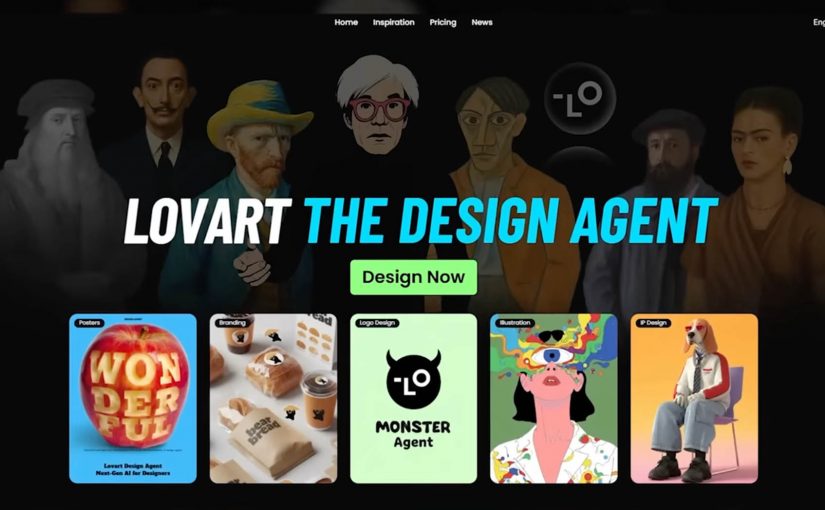
Lovart AI: Photoshop, Now as Simple as Paint

The Lovart AI ‘designer for everyone’ moment just got real

For decades, creative software demanded expertise. Layers. Masks. Rendering. Color theory. Not because it was fun, but because the tools were built for specialists.

Lovart frames a different future. Instead of learning the tool, you describe the outcome, and an AI design agent orchestrates the work across assets and formats.

What Lovart is really selling. Creative output as an agent workflow

The shift is not “design got easier”. The shift is that the workflow collapses into intent. You type what you are trying to achieve, and the system produces a coordinated set of outputs.

In enterprise brand teams, the main unlock from agentic design tools is faster option generation while governance and taste still decide what ships.

For consumer experience teams, that matters because the same system can start feeding campaign adaptation, ecommerce assets, CRM creative, and localized variants from one brief.

In the positioning and demos around Lovart, the promise is that you can move from a prompt to a usable bundle of creative. Brand identity elements. Campaign assets. Even video outputs. Without tutorials, plugins, or the classic “maybe I will learn Photoshop someday” hurdle.

By “agentic design tools,” I mean systems that plan and execute multi-step creative work across assets and formats, not just generate a single output.

Why Photoshop starts to feel like Microsoft Paint

This is not a diss on Photoshop. It is a reframing of value.

When an agent can produce a coherent set of assets quickly, the advantage shifts away from operating complex software and toward higher-order thinking:

  • What is the offer.
  • What is the story.
  • What is the differentiation.
  • What should the system optimize for. Consistency, conversion, memorability, or speed.

If everyone can generate assets, the edge belongs to people who can direct the system with clarity and taste, not just execute.

The commercial test is simple. Does this reduce cycle time, lower production friction, and increase useful variation without weakening brand control.

The real constraint moves upstream. Taste, strategy, and governance

The future hinted at here is not more content. It is a faster creative pipeline, which means the operating challenge moves to guardrails, approvals, and reusable brand logic.

Extractable takeaway: When production gets cheap, the advantage shifts to upstream constraints. A shared definition of “good”, plus guardrails and review rhythms, beats faster output alone.

  1. How do you keep quality high when output becomes abundant.
  2. How do you keep brand coherence when anyone can spin up campaigns in minutes.

For enterprise teams, the real decision is where this sits in the stack. Concepting, campaign adaptation, localization, ecommerce variation, or CRM asset production, and who owns briefing, review, and quality control.

The real question is whether you can define “good” once and enforce it consistently when output becomes abundant.

Brand teams should treat agentic design as a governance problem first, not a production shortcut.

This is where the craft does not disappear. It relocates. From hands-on production to creative direction, guardrails, and decision-making.

Directing agentic design without losing the brand

Lovart is a signal that creative tooling is becoming agentic. The barrier is no longer the interface. The barrier is whether your team can turn brand intent into reusable rules, decision criteria, and review checkpoints across channels.

  • Write the brief like a spec. Describe the offer, the audience, the constraints, and what “good” looks like before you generate.
  • Decide the guardrails up front. Clarify what must stay consistent across assets, and what can vary for speed and experimentation.
  • Keep humans as the decision layer. Use the agent for options and iteration, then apply taste and governance to choose what ships.

The pressure point is not adoption alone. It is whether your operating model, approval flow, and content stack are ready for it.


A few fast answers before you act

What is Lovart in one sentence?

Lovart is a design-oriented agent experience that turns a brief into a guided workflow. It plans, generates, and iterates across assets, rather than handing you a blank canvas.

How is this different from using Photoshop plus AI tools?

The difference is orchestration. Instead of switching between tools and prompts, the workflow becomes “brief to deliverables” with the system managing steps, versions, and outputs.

Does this replace designers?

It can replace some production tasks and speed up concepting. It does not replace taste, direction, brand judgment, and the ability to decide what is worth making.

What should brand teams watch closely?

Brand safety, rights and provenance, and consistency. Faster creation increases the need for clear guardrails, review, and a shared definition of “good.”

What is the simplest way to test value?

Pick one repeatable asset type, run the same brief through the workflow, and compare speed, quality, revision cycles, and brand-control effort against your current process.