A test drive takes a sexy turn

TNT’s “A dramatic surprise on an ice-cold day” meets Pepsi MAX’s “Jeff Gordon test drive prank” in this latest test drive video for the all new Renault Clio.

In the video a couple of guys are seen taking the Renault Clio for a spin. After a regular beginning, the salesman shows of the “va va voom” button, which initiates a romantic scene between a couple set against the Eiffel Tower and then…

And here is a version for the ladies…

Mikado Resistance Test

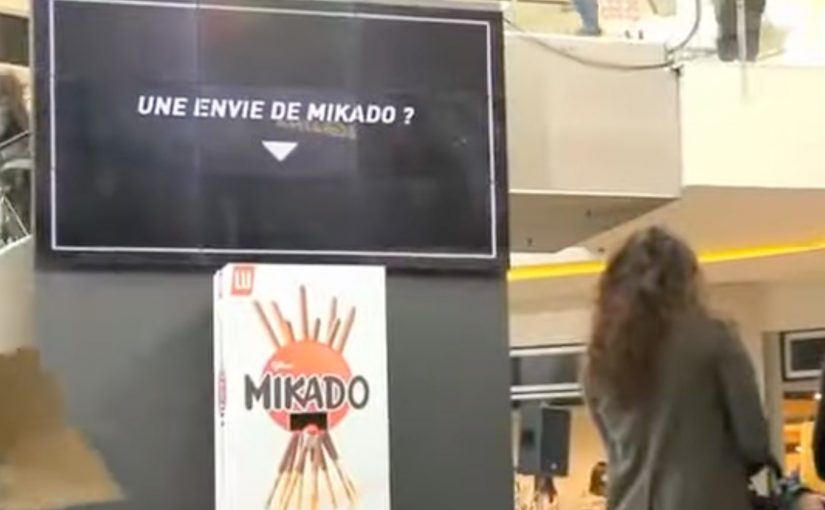
You are doing your shopping in a mall, and you spot a giant Mikado dispenser. Above it, a message scrolls: “Une envie de Mikado ? Vous ne devriez pas…”. A free box is right there. The temptation is immediate. People hesitate for half a second, then they reach for it anyway.

The moment the “victim” takes the Mikado, reality shifts. In a beat, they “fall” into an absurd, high-stakes scene. A nightmare wedding. A robbery. A knife-throwing scenario. Six variations. Each one staged to make a single point feel physical: Mikado is hard to resist, even when you are warned not to.

The idea in one line

Turn “irresistible” from a claim into a public dilemma. Then prove it by watching people choose temptation in front of everyone.

What Buzzman builds for Mikado

This is a deliberately simple setup with a brutal logic loop:

Step 1. Offer the product for free, but add a warning

The dispenser invites you, then immediately tells you not to do it. That contradiction creates tension and curiosity in the exact moment of decision.

Step 2. Make the consequence entertaining, not moralizing

When the actor takes the box, they “drop” into a surreal scenario. The audience in the mall watches the fall. Then they watch the scene unfold. The humor is the proof mechanic.

Step 3. Extend it into a digital series with repeat value

The campaign runs as a set of videos with multiple protagonists and outcomes. The variety matters because it turns one stunt into a format.

Step 4. Make the viewer complicit

At the end of the video experience, you can choose who becomes the next “victim.” That interactive twist is not a gimmick. It reinforces the theme: you are part of the temptation chain.

Why it works

It turns a brand truth into a behavioral test

The campaign does not explain why Mikado is irresistible. It sets up a moment where resisting is the story.

The warning is the creative fuel

“You shouldn’t” is what makes people want to do it. The copy creates the tension. The action resolves it.

The audience reaction is the distribution engine

People do not only watch the “victim.” They watch the crowd. The social proof is built into the scene itself.

The deeper point

If you want a product attribute to stick, stop describing it. Build a situation where people demonstrate it for you. Especially when the attribute is emotional (irresistible, addictive, impossible to ignore), the most persuasive proof is behavior under temptation.


A few fast answers before you act

What is the core mechanic?

A public dispenser offers free Mikado while warning you not to take it. When someone does, the stunt flips into a staged “consequence” scenario that proves irresistibility.

Why multiple scenarios?

Because a single stunt becomes a repeatable content format. Six outcomes keep it watchable and shareable.

What is the role of interactivity?

Viewers can choose the next “victim” at the end of the video experience, extending participation beyond the mall moment.

What is the transferable pattern?

Design a public “temptation test” where the desired product truth is demonstrated through behavior, not explained through messaging.

What is the biggest risk?

If the consequence feels mean-spirited or unsafe, the tension flips from funny to uncomfortable. The stunt has to stay playful.

British Airways: Barcode Reader

You pick up a travel guide, walk to the barcode reader, and scan it to check the price. Instead of only showing numbers, the scanner delivers a British Airways message that nudges you toward destinations beyond the UK.

The placement is the whole strategy. British Airways runs this in the travel section of a bookstore, right when people are already thinking about leaving town. If someone is browsing Rome, New York, or Buenos Aires, the brand can show up in a way that feels like a useful prompt rather than a random interruption.

The mechanic is simple. The barcode scan is the trigger, and the barcode reader becomes the display. British Airways uses that moment to broaden perception of its route network, aimed at Brazilians who may only associate BA with the UK.

In travel marketing, the planning moment is the highest-intent moment, and well-timed messages can feel like help rather than advertising.

Why the bookstore aisle is the right “media channel”

Travel guides are a proxy for intent. People do not usually buy a destination book by accident. So a bookstore travel aisle acts like a real-world keyword search, with the added benefit that the customer is already in decision mode.

What makes the barcode reader feel credible

The message arrives from the same device people trust for pricing and checkout. That matters because it borrows the authority of a functional tool. The ad does not ask for a click or a download. It simply uses an existing action and adds a relevant layer.

What the campaign is really trying to change

This is not a fare promotion first. It is a mental map update. The brand wants travellers to store British Airways as “global option,” not “UK airline.” The work is credited to AGE Isobar São Paulo and was later shortlisted in the Direct Lions under Ambient Media, small scale.

What to steal for your own context-first activation

  • Target the moment of intent. Find the real-world behaviour that signals “I am planning.”
  • Use the tools already in the environment. Functional devices carry trust and reduce friction.
  • Make the message additive. Add information that fits the action, do not derail it.
  • Design for instant comprehension. If it needs explanation, it will be ignored.

A few fast answers before you act

What is the British Airways Barcode Reader activation?

It is a contextual bookstore execution where scanning travel books on a barcode reader triggers British Airways messaging about flying to destinations beyond the UK.

Why does it work better than a generic travel ad?

Because it appears at the exact moment people are considering travel. The placement creates relevance before the copy even starts.

What is the core behaviour the campaign hijacks?

Price checking. The scan is already happening, so the brand adds a message to an existing action rather than asking for a new one.

What business problem is this solving?

Route perception. It aims to expand awareness that British Airways serves many destinations, not only the UK, in a market where that belief is limited.

What is the main risk with this kind of tactic?

If the message feels intrusive or slows down the checkout flow, it turns from helpful to annoying. The execution has to stay lightweight and quick.