Proof marketing at the counter, not in a tagline
In fast-food marketing, “fresh” claims are easy to say and hard to believe. Proof marketing means giving customers evidence at the point of purchase, not just a promise. Burger King’s Whopperface is a clean example of turning a claim into visible proof inside the restaurant.
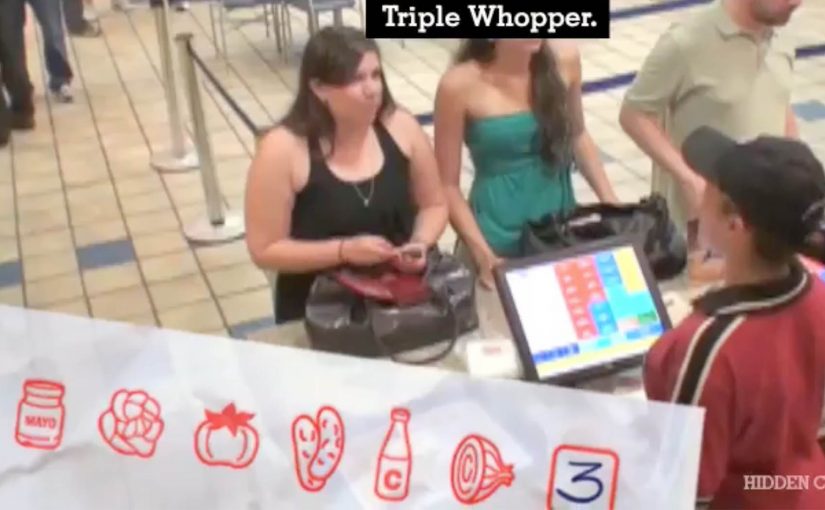
One cashier, one hidden cam, one printer. That is all Ogilvy Brasil needed to prove that Burger King sandwiches are made to order.
When a customer ordered a Whopper, they took a picture without anyone noticing. Then the customer got their freshly made sandwich with their face on it. Burger King proved that each sandwich is unique and made to order for each customer.
How Whopperface created “made to order” evidence
The mechanism is simple. Capture identity at the moment of order, then attach it to the product that comes out of the kitchen.
The hidden camera took the photo. The printer produced the personalized output. The handoff at the counter delivered the proof. The customer did not just hear “we make it fresh”. They received a physical, personalized marker that could only exist if the sandwich was made for them in that moment. Because the print is generated after the order, it converts timing into evidence, which short-circuits the usual “was this pre-made?” doubt.
Why it lands psychologically
In quick-service restaurants, the counter is the trust bottleneck for freshness. People trust what they can verify. Whopperface works because it lets the customer verify “made to order” with a marker tied to their identity.
Extractable takeaway: When skepticism is the barrier, attach a unique, customer-linked artifact to the output so the claim becomes self-evident at the moment of truth.
A customized face print is not a vague reassurance. It is a unique token. It signals individual attention and removes doubt about whether the item was pre-made. It also triggers a social instinct: if you receive something with your identity on it, you are more likely to show it, talk about it, and remember it.
The business intent behind the stunt
The intent was to rebuild credibility around freshness and ordering, using retail experience as the media channel.
The real question is whether your brand can turn its most fragile claim into something customers can verify in the moment.
Instead of spending budget repeating a claim, Burger King invested in a moment that created both belief and shareable content. The proof lived in the customer’s hands, and the story traveled naturally from there.
If trust is the issue, spend on proof at the counter before you spend on more media.
Proof patterns to borrow from Whopperface
- Turn claims into artifacts. If you want belief, create something physical that acts as evidence.
- Place proof at the point of truth. The point of truth is the exact moment and place the customer decides whether to believe you.
- Use personalization as verification. Identity markers make “made for you” tangible.
- Keep the system minimal. Simple setups scale. One camera, one printer, one process.
A few fast answers before you act
What was Burger King’s Whopperface?
A retail stunt where customers received their freshly made sandwich with their face printed on it, proving the order was unique and made specifically for them.
What was the core mechanism?
A hidden camera captured the customer at order time, and a printer produced a personalized output that was attached to the fresh sandwich at handoff.
Why does this prove “made to order” better than a claim?
Because it creates a unique, verifiable artifact that can only exist if the sandwich was produced for that specific customer in that specific moment.
What business goal did it support?
Increasing trust in freshness and differentiation by turning the restaurant experience into proof and shareable content.
What is the main takeaway for other brands?
If trust is the barrier, design a simple proof mechanism that customers can see, hold, and share.