
Budweiser: Poolball, football on a pool table

Budweiser: Poolball, football on a pool table

Coming to a Buenos Aires pub near you is the newly minted sport of Poolball, created by Ogilvy Argentina for Budweiser.

Two teams meet on a giant 7×3 meter pool table. Fifteen soccer balls are reskinned to look like pool balls. The competitors use their feet instead of cues to score.

A new bar sport with a brand stitched into it

Poolball takes two things that already belong in the same evening. Football and beer. Then it adds a third. The “I could play that” simplicity of pool. The result feels less like a stunt and more like a playable product.

Extractable takeaway: Poolball is a brand activation that fuses two familiar games into one instantly understandable format, so people stop watching and start participating without needing instructions.

The mechanic: one rulebook, two rituals

The mechanic is the entire idea. A pool table scaled up to human size. Pool-ball visuals on footballs. Pool rules translated into foot play. When the mechanic is this legible, the content is self-explaining and the crowd becomes the amplification layer.

BTL is often used as shorthand for below-the-line activity. In practice, it means a brand experience designed to be felt in the real world, then shared because it is worth retelling.

In busy city bars and event spaces, the formats that spread fastest are the ones everyone can read at a glance.

Why it works in a pub

Bar-friendly activations win when they create quick status moments. You either played it, you watched someone nail a shot, or you filmed the chaos. Poolball naturally creates all three, because every “pocket” attempt is a mini highlight.

It also lowers the risk of participation. You are not learning a new sport. You are remixing two you already know, with rules you can copy by watching one play.

The intent behind the fun

The real question is whether your activation is a game people still want to play when the camera is off.

Budweiser is not selling a feature here. It is selling association. Big-game energy. Competitive banter. Social proof that the brand belongs in the centre of group nights out.

When the game is branded but not fragile, the brand becomes the host of the experience rather than the interruption inside it.

Poolball patterns worth stealing

  • Fuse, don’t invent. Combine two known behaviours so the audience understands the format instantly.
  • Make the object the media. A giant playable artefact beats a screen when your goal is participation.
  • Design for highlights. Build in repeatable “shot” moments people want to film and replay.
  • Keep rules visible. If someone can learn it by watching one round, you have the right complexity level.
  • Let branding be structural. Brand the experience itself, not every surface area with logos.

A few fast answers before you act

What is Poolball?

Poolball is a branded game format that combines football and pool. Players kick footballs designed like pool balls on a giant pool table and score using pool-style goals.

Why does this kind of activation travel well across venues?

Because it is easy to understand, easy to spectate, and it produces repeatable highlight moments. Venues like it because it creates crowd energy. Brands like it because the crowd documents it.

What makes the mechanic “shareable” without forcing sharing?

The visual contrast does the work. A human-scale pool table and “pool ball” footballs create an immediate “what is that” reaction, so filming feels natural rather than incentivised.

How do you keep a branded game from feeling like a gimmick?

Make it genuinely playable. Simple rules. Clear scoring. Quick rounds. If the experience is fun without the brand name, the brand credit comes for free.

What’s the minimum viable version of this idea?

A single hybrid rule, one striking physical cue, and one repeatable scoring moment. If people can explain it in one sentence, you have the right foundation.
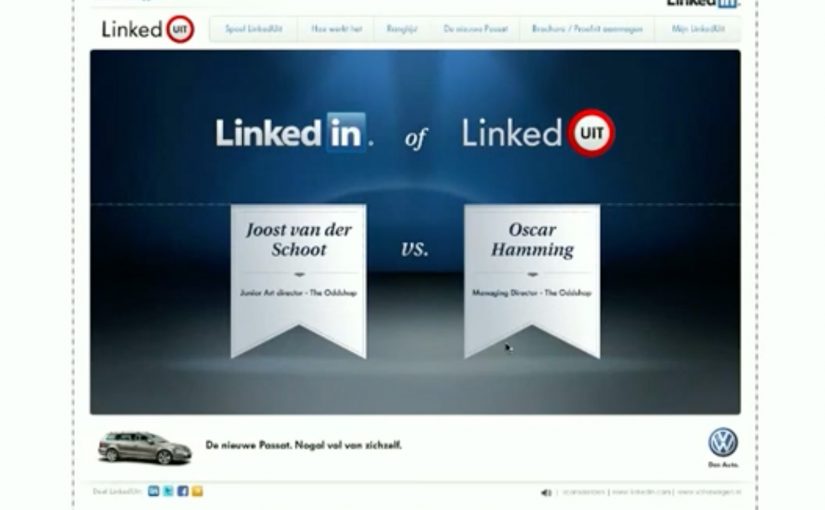
Volkswagen LinkedUit: A LinkedIn API Campaign

Volkswagen LinkedUit: A LinkedIn API Campaign

Volkswagen has released a LinkedIn-based campaign which takes full advantage of the new LinkedIn API. Here, “LinkedIn API” simply means the permissioned interface that lets an app read profile information after you sign in.

The campaign is called “LinkedUit” (LinkedOut) and gives anyone who challenges a friend on LinkedIn a chance to win a Volkswagen Passat.

The game is really simple. After signing in using your LinkedIn profile, the app lets you choose others in your network to challenge. A LinkedIn victor and a LinkedOut loser is then chosen based on education, experience, recommendations and connections.

Mechanically, the app pulls profile fields after sign-in and turns them into a score you can compare against someone in your network. This pattern is worth copying when you can explain the scoring in plain language and keep participation clearly opt-in. Because the inputs are already curated, the result feels personal with almost no extra work.

In European automotive marketing, platform-native games like this only stay credible when the data use is explicit and the scoring feels fair.

The real question is whether the value of the interaction outweighs the discomfort of being compared.

Why this is a smart use of platform data

This campaign uses something people already curate and care about. Their professional identity. Instead of asking for attention, it uses existing LinkedIn data as the raw material for the experience.

Extractable takeaway: If you can make a platform’s identity data the mechanic, you lower friction and raise relevance. But you only earn repeat use when people can predict why they won or lost.

  • Low input for users. The profile is already built. The game simply reads it.
  • High personal relevance. Comparisons feel personal because they are based on your own history.
  • Built-in social spread. Challenges create a natural loop through networks.

The Passat benefit: “feature-rich” as a metaphor

The creative link is straightforward. Passat equals feature-rich. LinkedIn profile equals information-rich. The experience makes the metaphor tangible by turning profile depth into a competitive score.

That kind of metaphor works when it is easy to explain in one sentence and easy to experience in one click.

What makes this type of social game succeed or fail

  1. Fair scoring logic. If the rules feel arbitrary, people reject the result.
  2. Fast time-to-result. The payoff must arrive quickly after sign-in.
  3. Friendly rivalry. Challenges should feel playful, not judgmental.
  4. Clear reward. A chance to win a Passat is a simple, memorable incentive.

What to take from this if you are building platform-native campaigns

  • Use the platform’s native data as the experience. The more you rely on what already exists, the lower the friction.
  • Make the mechanic social by default. Challenges, invites, and comparisons drive distribution.
  • Keep the brand connection clean. One strong metaphor beats multiple weak links.
  • Design for credibility. When you use personal data, transparency and perceived fairness matter.

A few fast answers before you act

What is Volkswagen “LinkedUit”?

It is a LinkedIn-based campaign that uses LinkedIn profile data to create a challenge game, giving participants a chance to win a Volkswagen Passat.

How does the game determine a winner?

The app compares elements such as education, experience, recommendations, and connections to choose a “LinkedIn victor” and a “LinkedOut” loser.

Why is the LinkedIn API important here?

Because it enables the experience to pull in profile information automatically, making the game quick to start and personally relevant without extra data entry.

What is the creative link to the Passat?

The campaign uses the idea that the new Passat is full of features, just like a LinkedIn profile is full of information, then turns that into a competitive mechanic.

What is the main lesson for social platform campaigns?

If you build around native identity and data, and make the interaction social by default, you can create an experience that spreads through the network naturally.

The Ikea 365 Campaign

The Ikea 365 Campaign

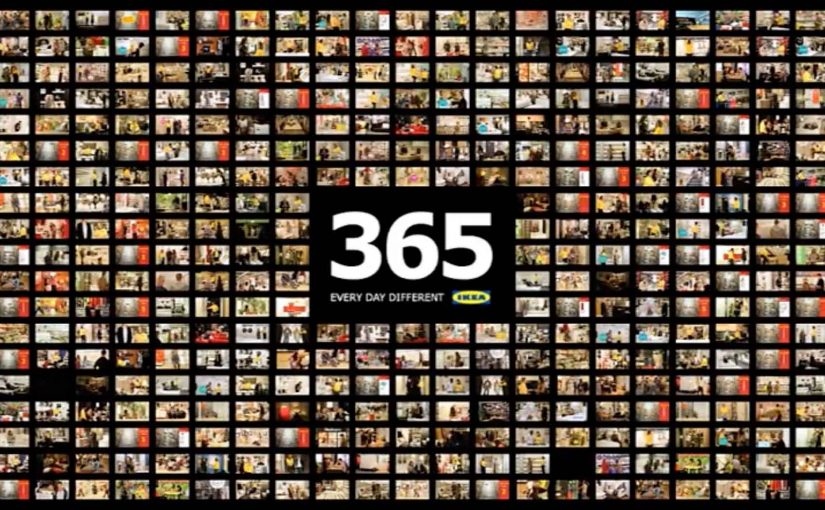
Ikea shows its versatility by doing something most brands never attempt. A different commercial every day. Lemz Amsterdam sends out a new spot daily for 365 days.

The real question is whether you can sustain proof of range at the cadence you are buying.

How they make it possible. Production volume and distribution

To keep pace, the team produces 15 commercials in a day. That buffer keeps them ahead of schedule so they can deliver daily ads that feature online and appear randomly across TV stations. That production buffer is what turns “versatility” from a claim into something viewers see again and again.

In high-frequency retail marketing, the bottleneck is repeatable production and distribution.

Why it lands. Variety you can believe

Most brands claim “we have something for everyone,” then run the same spot for weeks. Ikea flips the burden of proof. The viewer sees a steady stream of different spots, so the promise feels earned.

Extractable takeaway: If “versatility” is your claim, the only credible proof is sustained variety that shows up on a predictable cadence.

For brands that position on breadth, disciplined output beats a single “perfect” hero film.

The case study film

This is the case study film of the campaign, which continues today.

Make it stealable in your own system

  • Design for throughput. Build a production rhythm and buffer that makes daily publishing feasible.
  • Match proof to promise. If the brand claim is range, the content has to show range, not just say it.
  • Let distribution do part of the work. Rotate placements so the variety is encountered, not hidden in a playlist.

A few fast answers before you act

What is the Ikea 365 Campaign?

A campaign where Ikea runs a different commercial every day for 365 days.

Who creates it?

Lemz Amsterdam.

How do they keep up with daily output?

By producing 15 commercials in a day, creating a buffer so daily publishing stays consistent.

Where do the ads run?

Online and randomly across TV stations.

What is the core idea it proves?

Versatility, shown through relentless variety and sustained daily delivery.