

Hyundai Canada: Worst Parking Job Ever

A parked 2004 Hyundai Elantra gets crushed in a parking lot incident captured on security footage. The clip is framed as the “worst parking job ever,” and it quickly becomes the kind of viral story that spreads because the outcome is so brutally clear.

The footage is dated October 22, 2009 in Ontario, Canada, and it puts the owner, Todd Jamison, at the center of an internet pile-on he did not ask for.

Then Hyundai Canada steps into the story. Instead of treating it as someone else’s bad day, they decide to become the helpful brand in the comments section, in real life. On October 30, 2009, they surprise Jamison with a brand new 2010 Hyundai Elantra Touring and capture the handover on film.

How the brand response is engineered

The mechanism is fast, simple, and camera-friendly. A widely shared piece of user-discovered content creates attention. The brand responds with a real-world act that resolves the narrative tension, then publishes the “resolution” as a second video that is just as easy to share as the original. Because the second video closes the loop on the first, it spreads as payoff, not PR.

In automotive PR and brand storytelling, this is the cleanest form of earned media: a human problem, a timely intervention, and a documented payoff that feels generous rather than scripted.

In North American automotive marketing, these moments recur, so the only scalable advantage is showing up with a real fix fast.

The real question is whether you can resolve the tension with a meaningful action before the internet moves on.

Why it lands

Because it completes the story people were already watching. The first video triggers disbelief and sympathy. The second video rewards that emotion with a satisfying outcome. Hyundai does not try to outshout the internet. It aligns with what viewers already want to see happen next, then makes that ending real.

Extractable takeaway: When a viral moment creates an obvious “someone should help” impulse, the best brand move is to deliver a concrete fix fast, then tell the story as a continuation, not a campaign. The sequel is the strategy.

Steal the “unexpected hero” play

An “unexpected hero” play is when a brand solves a real problem for a real person in public, and lets the action carry the story.

  • Respond to the narrative, not the metrics. If the situation has a clear moral shape, your action will travel further than your media spend.
  • Make the intervention unambiguously useful. A replacement car is simple to understand. Complexity dilutes goodwill.
  • Publish the resolution, not the process. Viewers want the moment of surprise and relief, not a corporate explainer.
  • Keep the tone human. The brand should feel like it is helping a person, not exploiting an incident.

A few fast answers before you act

What is the core story arc here?

A widely shared security clip shows a parked car being crushed. Hyundai Canada follows up by replacing the car and filming the surprise, turning shock into closure.

Why is the follow-up video essential?

Because it converts attention into meaning. Without the sequel, the story is only misfortune. With it, the story becomes relief and brand goodwill.

What makes this feel authentic instead of opportunistic?

The action is tangible and directly benefits the person who suffered the loss. The brand is not adding commentary. It is changing the outcome.

How do you decide whether to engage at all?

Engage only if you can improve the outcome for the affected person in a way that is clear on first viewing. If you cannot deliver a meaningful fix, the safest move is to avoid turning someone else’s misfortune into content.

What is the biggest risk when brands copy this approach?

Performative help. If the intervention is small, conditional, or self-serving, the audience will treat it as exploitation of someone else’s bad day.
Cadbury Creme Egg: Egg-Splatting Bus Stands

Turning bus-stop boredom into a reason to play

Only available from New Year’s Day to Easter Day, the Cadbury Creme Egg is one of the best selling confections in the U.S., Canada, and the United Kingdom.

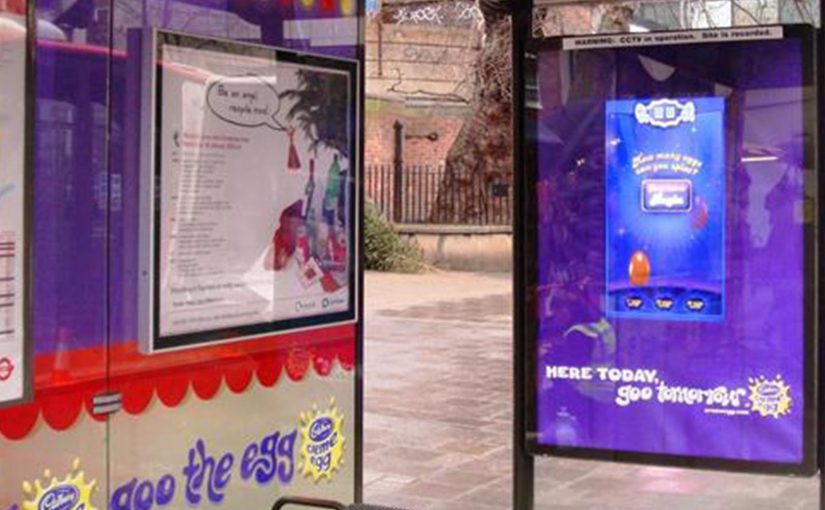
In a bid to boost Creme Egg sales in the lead-up to Easter, Cadbury’s has come up with some really unique bus shelter ideas in the UK.

Waiting for a bus is boring. Now though, you can fill this time by playing Cadbury’s first ever interactive outdoor game called Splat the Egg.

How the idea works: time, place, and a simple interaction loop

The mechanism is classic context hijack. By “context hijack”, I mean using the place’s existing purpose and dwell time as the trigger for a simple action. You take a moment with unavoidable waiting, add a clear instruction, and reward participation with a small burst of fun. The shelter becomes the interface, and the product becomes the “game object”. Because the action is legible and the payoff is immediate, people can join in without needing a long explanation.

In European FMCG launches with seasonal availability, interactive out-of-home can act as both reminder and recruiting surface, converting passive footfall into active brand experience.

Why it lands: it gives the viewer control over the medium

It works because it reframes waiting as choice. Instead of being stuck, you get something to do. And once one person starts, the social proof pulls in the next. A bus stop is already a small crowd. The game turns it into a moment people watch and talk about. The real question is whether your out-of-home placement gives people something to do, not just something to read. Interactive out-of-home should earn attention by turning waiting into play, not by piling on more claims.

Extractable takeaway: If your medium comes with unavoidable dwell time, build a two-second, self-explanatory action that rewards participation and makes spectators part of the experience.

The business intent: make seasonal scarcity feel like an event

Creme Egg’s limited availability is built for anticipation. This activation makes that anticipation physical. It pushes mental availability ahead of Easter and ties the product to a playful ritual rather than just a purchase.

A neat extension for people who cannot try it in person

Is this the future of advertising. Every lamp post and bus shelter calling out to be stroked, touched or hit?

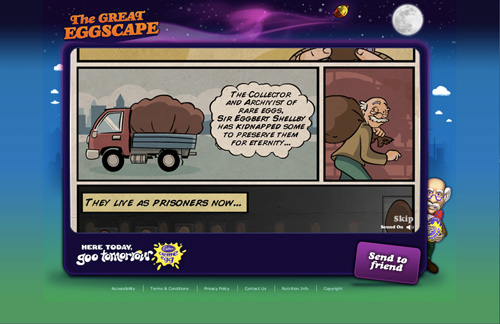
For those who won’t have the chance to experience the real thing. You can have a go at the online version at www.cremeegg.co.uk/greateggscape/.

The Great Eggscape

What to steal for interactive out-of-home without overbuilding it

  • Exploit dwell time. Bus stops, queues, and waiting areas are built-in attention pockets.
  • Keep the interaction legible in two seconds. If it takes explanation, it will not scale in the street.
  • Design for spectators as well as players. The crowd is part of the distribution.
  • Connect the physical to an accessible fallback. An online version extends reach beyond the locations.

A few fast answers before you act

What is Cadbury’s “Splat the Egg” bus shelter idea?

An interactive out-of-home activation that turns a bus shelter into a playable game, letting people waiting for a bus engage with a Creme Egg-themed experience.

Why choose bus shelters for an interactive campaign?

Because they come with natural dwell time. People are already waiting, so the activation converts idle minutes into engagement without asking for extra effort.

What is the core mechanism?

Context hijack plus a simple interaction loop. A clear instruction turns a waiting moment into a quick burst of fun, and the shelter becomes the interface.

What is the business goal behind this activation?

To build anticipation for a seasonal product and tie scarcity to a playful ritual that increases mental availability ahead of Easter.

What is the most transferable takeaway?

Build simple viewer control into the medium at moments of forced waiting, and design for spectators as well as participants so the crowd becomes distribution.

Eichborn: Flyvertising at the Frankfurt Book Fair

Jung von Matt just redefined advertising for their client Eichborn at the Frankfurt Book Fair by attaching tiny banners to 200 flies and setting them loose as miniature “sky ads” around the halls. The idea was coined Flyvertising, or “Fliegenbanner”.

A stunt that makes the logo literal

Eichborn’s brand mark is a fly. So instead of printing the fly on a poster and hoping people notice, the campaign turns the fly into the medium and lets it wander through the crowd, uninvited, and impossible to fully ignore.

The weight of the banner itself, attached with a string and some sticky stuff that allowed it to eventually fall off without harming the fly, was so that the fly could fly with it, but not very high and they kept landing on visitors.

How Flyvertising works

The execution uses ultralight banners attached with a string and a sticky material described as designed to let the banner fall off later without harming the fly. The extra weight keeps the insects from flying high, which means they repeatedly land on visitors and surfaces. In a crowded fair, that turns a wandering fly into a moving pointer that creates attention and helps people find the Eichborn stand.

In European trade-show marketing, a stunt wins when it turns wayfinding into a story people cannot ignore in a crowded hall.

Why this lands

The campaign exploits a simple truth about exhibitions. People are overloaded with signage and trained to filter it out, but an interruption that breaks the “expected media” pattern cuts through instantly. Here, the interruption also feels on-brand, because the fly is not a random prop. It is the identity asset brought to life.

Extractable takeaway: If your brand owns a distinctive symbol, find a way to make that symbol behave like media in the real environment where attention is hardest to earn, and let the medium carry the message.

What Eichborn is really buying

The real question is whether a trade-show stunt can turn a hard-to-find stand into the story people repeat across the hall. This is smart exhibition marketing because it fuses wayfinding with a brand asset people will talk about. This is not about explaining a book list. It is about generating foot traffic, conversation, and memorability around a stand number in a hall full of publishers. The flies do the work of a promoter, and the story spreads faster than any brochure.

What to steal for your next event activation

  • Let the identity asset drive the idea. The closer the stunt is to the brand symbol, the less it feels like random noise.
  • Design for physical proximity. A trade show is won at arm’s length. Make the experience land close enough to be felt.
  • Build a “tellable” moment. If a visitor can summarize it in one sentence, it travels through the venue for you.
  • Plan the ethics and the optics. If living things are involved, the “no harm” claim needs to be credible and easy to defend.

A few fast answers before you act

What is Flyvertising?

Flyvertising is an ambient trade-show stunt where Eichborn released flies carrying ultralight mini-banners, turning the insects into moving ads that drew attention and guided visitors toward the publisher’s stand.

Why does this kind of “living media” cut through at exhibitions?

Because visitors are conditioned to ignore static signage. A moving, unpredictable interruption breaks that filter, especially when it happens in personal space.

What makes it feel on-brand rather than a generic stunt?

Eichborn’s identity includes a fly, so the medium directly expresses the brand symbol. That alignment makes the execution easier to remember and retell.

What is the transferable principle behind Flyvertising?

The transferable move is to turn a brand-owned symbol into the delivery system for attention in the exact environment where people normally ignore messages.

What are the risks with this pattern?

Ethics, hygiene perception, and venue rules. If people feel the stunt is harmful or unhygienic, the attention flips from curiosity to backlash.