
Sony: Headphone Music Festival AR posters

Sony: Headphone Music Festival AR posters

People in Tokyo who wear headphones, or simply want to try new ones, were treated to an augmented reality music festival from Sony Japan. Four popular local rock groups were turned into original AR performances, then “played” through band tour posters placed in busy locations. Sony-branded headphone trial stations were set up nearby so anyone could join in.

The loop is clean. Spot the poster. Scan it. Get a performance that feels like it is happening in your surroundings. Then step over and compare that moment on Sony headphones.

What makes this feel like a festival, not a tech demo

The execution is essentially a pop-up concert system distributed across the city. The posters act as stages. The phone acts as the ticket. The headphone stand acts as the product trial. That chain of touchpoints is why the experience reads as “festival” rather than “app feature.”

The mechanism: posters as portals

Instead of forcing people into a microsite or a branded app maze, Sony uses a familiar object. The tour poster. The poster becomes the launch surface for AR content. That matters because it removes the biggest friction in mobile AR. The “what do I point my camera at” question.

In supporting materials, the technology is described as Sony’s SmartAR and a smartphone app that recognises the posters and overlays 3D performance content into the live camera view. The mechanics stay invisible to the audience. They just see the band appear.

In dense urban retail markets, AR works best when it turns everyday street media into an immediate try-before-you-buy demo.

The real question is whether your AR trigger reduces friction enough that product trial becomes the next obvious step.

Why it lands for headphone marketing

Headphones are hard to sell with words. Most people cannot translate driver specs into feeling. This activation sells through a direct comparison. You hear a performance, then you hear it again through the product the brand wants you to try.

Extractable takeaway: A retail AR activation lands when the trigger is already in public view, the payoff is instant, and the path from wow-moment to product trial is one physical step away.

It also frames Sony as the host of the music moment, not just the logo next to it. That is a stronger association than “better sound.” It is “better access to the thing you love.”

The business intent behind the street setup

The intent is not just awareness. It is footfall and trial. The AR content pulls people in, but the trial stations convert curiosity into a product experience. If you can get someone to listen for 30 seconds, you can start building preference.

Steal this for poster-triggered AR trials

  • Anchor AR to a physical trigger people already understand. Posters, packaging, signage, tickets.
  • Make the payoff immediate. The first five seconds decide whether AR feels magical or annoying.
  • Keep the bridge to trial short. If you sell hardware, put the demo within sightline of the trigger.
  • Use content that earns replays. Music clips, reveals, limited drops, rotating “sets” work better than static overlays.
  • Design for scanning in real conditions. Glare, crowds, bad signal, rushed users. Make recognition forgiving.

A few fast answers before you act

What is the Sony “Headphone Music Festival” idea?

It is a street-based AR activation where tour posters trigger AR music performances on a phone. Sony pairs that content with nearby headphone trial stations so people can immediately test the product while they are engaged.

Why use posters instead of geofencing or QR codes?

Posters provide a clear camera target and an obvious reason to scan. They also carry cultural meaning. A tour poster already signals music and discovery, so the AR layer feels natural.

What makes AR effective for selling headphones?

It creates a controlled listening moment in an uncontrolled environment. The activation gives you a reason to put headphones on right now and compare the experience immediately.

What is the biggest pitfall in poster-triggered AR campaigns?

Recognition friction. If the scan fails or the experience takes too long to load, people abandon it. The trigger must be reliable and the content must appear quickly.

How do you measure success for this kind of activation?

Track scans per poster location, completion rates for the AR experience, and trial-station interactions. If possible, connect trial interactions to store visits or product interest signals.
Fiat 500 America: TwitBid Twitter Auction

Fiat 500 America: TwitBid Twitter Auction

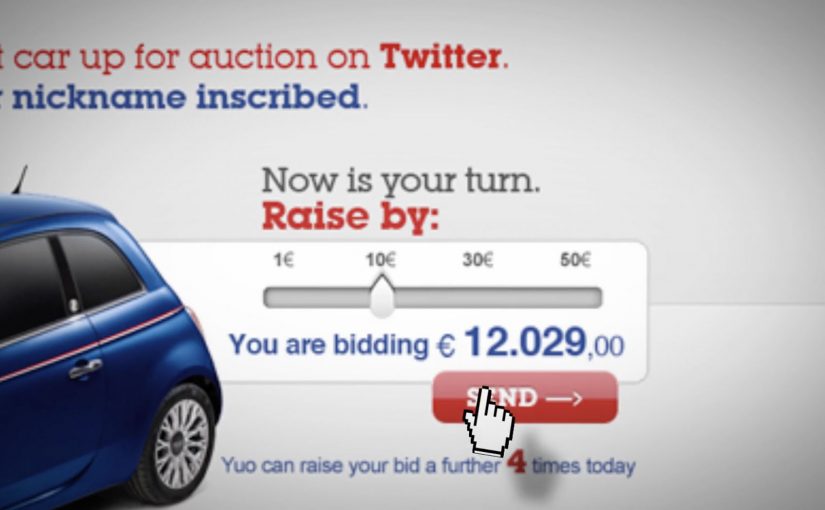
Fiat unveiled an exclusive limited edition run of 500 cars inspired by U.S. style at the Geneva Motor Show. Then, through a Twitter based auction, they made it possible to win the “number one” car (distinguished by a badge on the external pillar bearing the serial number 1/500 and the winner’s Twitter nickname) starting from a bid of €1.

To win the Fiat, participants were directed to follow @fiatontheweb on Twitter and then place a bid at www.500America.fiat500.com using their Twitter account. As a result, Fiat received 700 bids from 293 users, across 11 countries. A Twitter follower with a bid of €15,165 was declared the winner of the limited edition Fiat 500 America.

TwitBid turns a car launch into a public scoreboard

TwitBid is a Twitter-linked auction mechanic where each bid is tied to a visible handle. The smartest part is not the auction itself. It is the visibility layer. A bid is not a private transaction step. It becomes a social signal tied to an identity, which encourages escalation and turns the bidding ladder into content other people can watch unfold.

In brand launches with collector energy, mechanics that let fans compete in public create more momentum than mechanics that keep participation hidden.

What the mechanism is really doing

  • Make entry frictionless. The opening bid starts at €1, which makes “having a go” feel low risk.
  • Use identity as fuel. Bids are placed via Twitter, so the participant’s handle becomes part of the story.
  • Turn the object into proof. The “number one” car carries a visible 1/500 marker and the winner’s nickname, which makes the win feel permanent and collectible.

In global consumer launches where scarcity is real, a public scoreboard can turn a product drop into shared entertainment.

Why it lands

The real question is whether your launch mechanic turns every participant move into something other people can see. Most automotive launches ask people to admire. This one asks people to compete. The auction format creates scarcity pressure, and the Twitter layer adds social proof. Even if you do not bid, you can still follow the narrative of who is winning and how high it goes.

Extractable takeaway: If you want real participation, attach identity to action and make progress public. People engage longer when their move is visible, comparable, and tied to status.

What Fiat is really buying with this

The obvious outcome is a high price for the first car. The deeper outcome is attention that behaves like earned media. Each bid acts like a micro-broadcast, and the “number one” badge ties the online moment back to a physical artifact. That is a clean bridge between social platforms and product storytelling.

Launch moves to copy from TwitBid

  • Pick one scarce artifact. A single “first off the line” item is easier to explain than multiple prizes.
  • Make the ladder visible. Competition needs a scoreboard, not a form.
  • Build identity into the reward. A name, handle, or serialisation marker increases perceived ownership value.
  • Engineer the minimum increment. Small step sizes keep the contest active and make it feel winnable.

A few fast answers before you act

What is TwitBid in plain terms?

It is a Twitter-linked online auction where people place bids using their Twitter account to compete for a specific limited-edition item.

Why tie bidding to Twitter instead of a normal auction site?

Because every bid is tied to an identity and can become visible in the social stream, which increases reach and reinforces the competition dynamic.

What makes the “number one” car feel more valuable than the other 499?

It is positioned as the first unit off the line and visibly marked with serial number 1/500 plus the winner’s nickname, which makes it a one-off collectible.

What is the biggest risk with social auctions?

Friction and trust. If sign-in, bidding, or confirmation steps are unclear, participation drops. If rules feel opaque, the brand takes reputational damage.

What should you measure if you run a similar mechanic?

Unique bidders, bids per bidder, bid velocity over time, conversion from followers to registrants, and how much incremental reach the bidding activity creates versus paid media.

Secret Diary of a Call Girl: Radio Stunt

Secret Diary of a Call Girl: Radio Stunt

A window performance built for radio

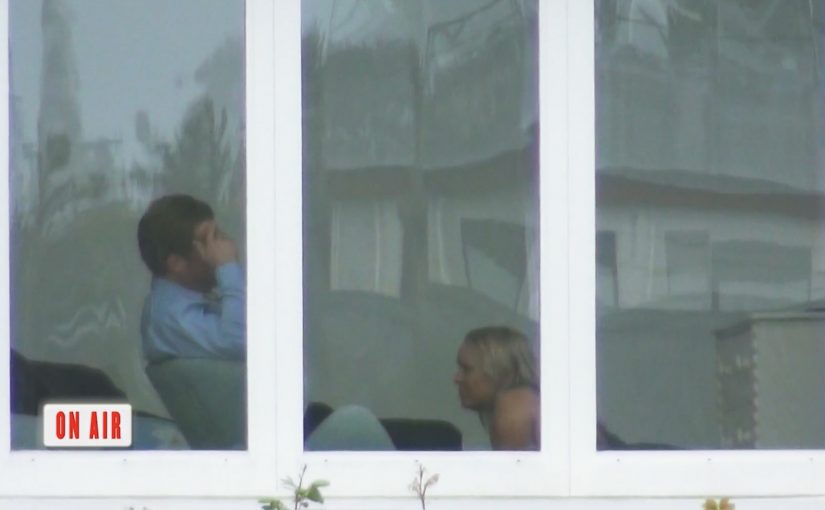
To launch the British TV drama Secret Diary of a Call Girl in New Zealand, DraftFCB staged a simple provocation. An “actress” displayed call girl-like behavior in a house window directly opposite a top radio station for three successive nights.

As expected, the scene caught the attention of the local DJ, who began broadcasting his observations on air. Other DJs around the country reportedly picked up the story, keeping it in circulation for roughly 72 hours. On the final night, with public interest at its peak, the actress closed the blinds to reveal the show message and the reason for the spectacle.

The mechanic: hijacking live commentary as distribution

The campaign is engineered to be “irresistible to narrate.” Put a curiosity trigger within line-of-sight of people whose job is filling airtime with observations, then let their real-time commentary do the heavy lifting. The multi-night schedule matters because it turns a one-off sighting into an unfolding story that listeners can return to, and that other shows can reference without needing new material.

In entertainment launches, live conversation often outperforms polished promos because the audience feels like they are overhearing something that is happening, not being sold something.

In broadcast-led markets, earned attention compounds fastest when the story is physically proximate to a microphone and structured to renew itself across multiple days.

Why it lands

It uses a classic public curiosity loop. People see something ambiguous, hear someone validate it on air, then share it socially to compare interpretations. Because the DJs are reacting in the moment, the “is this real?” tension stays alive long enough to travel, and the final-night reveal provides closure that feels like a payoff rather than a disclosure.

Extractable takeaway: If you want sustained buzz, design a repeatable public trigger that creates daily new angles for commentators, then hold the brand reveal until attention has clearly peaked.

What the launch is really optimizing for

The goal is not just reach. It is talk time, repetition, and social spillover. A premiere wins when it becomes the thing people reference without being prompted, and when the message arrives as the resolution of a story people have already been following.

The real question is whether the setup can turn observation into repeated on-air narration before the reveal arrives.

What to steal from this radio-first stunt

  • Choose a “natural broadcaster.” Put the trigger near people whose incentive is to describe what they see.
  • Make it episodic. Multi-night structure creates freshness and gives people a reason to check back.
  • Design ambiguity, then control the release. Let curiosity build, but ensure the reveal is clean and unmistakable.
  • Plan the social overflow. Seed a format that is easy to retell in one line, so listeners can amplify it without context.

A few fast answers before you act

What did DraftFCB do to promote Secret Diary of a Call Girl in New Zealand?

They staged an actress behaving like a call girl in a bedroom window opposite a radio station for three nights, prompting DJs to discuss it on air until a final-night reveal connected it to the TV premiere.

Why does placing the stunt opposite a radio studio matter?

Because DJs are paid to narrate interesting observations. Physical proximity to the studio turns the environment into live content.

What is the core distribution mechanic?

Earned media through live commentary. The stunt creates something discussable, and the on-air conversation becomes the ad.

Why run it across multiple nights?

Repeat nights transform a sighting into a story arc, increase the chance of pickup across stations, and create a natural moment for a final reveal.

What is the biggest risk with this kind of tactic?

If the reveal is unclear or the tone feels exploitative, the conversation can flip. The payoff must land cleanly and fast.