

Eterna Cadencia: The Book That Cannot Wait

Eterna Cadencia: The Book That Cannot Wait

Last month I wrote about Austria Solar’s annual report, whose pages became visible only when exposed to sunlight.

Now Buenos Aires based bookshop and publisher Eterna Cadencia has released “El libro que no puede esperar”, “The book that cannot wait”. It is an anthology of new fiction printed in ink that disappears after two months of opening the book.

The mechanic: ink that fades once you open the seal

How is that possible. Here, the mechanic is a built-in physical rule: the books are described as being silk-screened using a special ink, then sealed in air-tight packaging. Once opened, the printed material reacts with the atmosphere and starts to fade. The result is that, after roughly two months, the text vanishes.

In global publishing markets where e-books change reading habits, physical formats regain attention when they add a constraint that digital cannot replicate.

Why it lands: urgency turns reading into an action, not an intention

The idea does not compete with e-readers on convenience. It competes on psychology. A normal book is patient. This one is not. It creates a deadline, and deadlines change behavior. Because the fading is irreversible, the deadline feels real rather than promotional.

Extractable takeaway: If you want people to stop postponing a behavior, make the cost of waiting tangible and irreversible. Scarcity works best when it is built into the product, not added as a marketing slogan.

What it is really doing for new authors

The real question is whether a physical constraint can turn passive interest into immediate reading.

This is smart publishing design, not a gimmick for its own sake.

At face value, this is a publishing gimmick. Underneath, it is an argument for momentum. New fiction struggles when it sits unread on a shelf, because “I’ll get to it” often becomes “never”. A time-limited book reframes the purchase as a commitment to read now, which is exactly what emerging authors need.

The project is also widely described as being developed with DraftFCB, which helps explain why the execution feels like an idea engineered for cultural pickup, not just for bookstore shelves.

What to steal if you are marketing anything physical

  • Build the message into the object: the product itself should carry the story, even without a campaign.
  • Make the constraint legible: people should understand the rule in one sentence.
  • Turn delay into loss: urgency works when waiting has a real consequence.
  • Use packaging as a trigger: opening the seal is a clear “start” moment, and that matters for behavior.
  • Design for retellability: “a book that disappears if you do not read it” spreads on its own.

A few fast answers before you act

What is “The Book That Cannot Wait”?

It is a print book sealed in packaging where the text is printed with ink that starts fading once the seal is opened, so the content disappears after around two months.

Why would a publisher want ink that disappears?

To create urgency. The mechanic nudges readers to start and finish the book quickly, which can help emerging authors get read instead of getting postponed.

Is this a product innovation or a marketing campaign?

It is both. The object is the media. The disappearing ink turns the product into the message, which then earns coverage and conversation.

What is the biggest risk of copying this idea?

Trust. If people feel tricked or if the fade behavior is inconsistent, the stunt becomes resentment. The rules need to be clearly communicated and reliably delivered.

Where else does “built-in urgency” work?

It can work in limited editions, time-bound access, perishability, or experiences that change after first use. It is strongest when the constraint feels meaningful, not arbitrary.

NAB: The Honesty Experiments

NAB: The Honesty Experiments

Australian bank NAB positions Australians as an honest lot, and argues they deserve honest credit cards to match. To bring that promise to life, they conducted a series of “honesty experiments” and published the results on YouTube.

Incorrect Change

Lost Wallet

Leaky Pockets

From a product claim to a public proof loop

The mechanism is a classic credibility builder. A “public proof loop” means turning a claim into a repeatable test, then publishing the outcome so the audience can judge it. Run simple real-world tests where people can choose honesty, film the outcome, then let the audience do the judging rather than the brand doing the telling.

In retail banking categories, trust is built faster through observable behaviour than through promises and price claims.

The real question is whether a trust claim can be converted into something people can judge for themselves.

For trust-starved categories, this is a stronger play than another round of product-feature messaging.

Why it lands

These films work because they invite a low-friction emotional conclusion. People want to believe the best of others, and the experiments are structured to deliver that relief, then attach it to the brand stance. The content is also inherently shareable because it is about character, not about banking mechanics.

Extractable takeaway: If you want to own “trust,” do not describe it. Show a behaviour that audiences can recognise as trust in action, then connect it back to the product promise in one simple line.

Then NAB escalates to “thank you” in real time

To say thanks in the biggest possible way, NAB followed the experiments with a real-time stunt that thanked honest passers-by immediately after they returned lost objects.

What the second phase adds that video alone cannot

  • Immediate reciprocity. Honesty is met with an instant reward, not abstract praise.
  • A bigger emotional beat. Surprise gratitude creates a stronger memory than “you did the right thing.”
  • Proof at street level. The brand shows up in the moment of integrity, not after the fact.

What to replicate from NAB’s honesty experiments

  • Pick one human truth. “Most people are honest” is clearer than a bundle of values.
  • Design the choice point. The story lives in a single decision. Keep it simple and legible.
  • Let people self-identify. The viewer should be able to imagine themselves in the situation.
  • Add a second act. If phase one proves the belief, phase two can reward it and deepen the brand role.
  • Protect credibility. Be transparent about rules and ensure the reward does not feel staged or selective.

A few fast answers before you act

What are the “honesty experiments” in one sentence?

A set of filmed, real-world tests where strangers can choose to act honestly, used to support NAB’s “honest credit cards” positioning.

Why do social experiments work for trust-based brands?

They replace claims with observable behaviour. Viewers decide what the outcome means, which feels more credible than advertising language.

What does the real-time thank-you stunt add?

It turns the brand from narrator into participant, rewarding honesty immediately and creating a stronger emotional memory.

What is the biggest risk with this format?

Credibility erosion. If viewers suspect manipulation, selective editing, or unclear rules, the trust message can backfire.

What should you measure beyond views?

Brand trust lift, message association with the product, sentiment, share rate, and whether the work changes consideration versus competitors in the same period.

MCSC: World’s Most Valuable Social Network

MCSC: World’s Most Valuable Social Network

When a child goes missing, the first hours matter. The problem is that the people who could help are often nearby, busy, and scrolling.

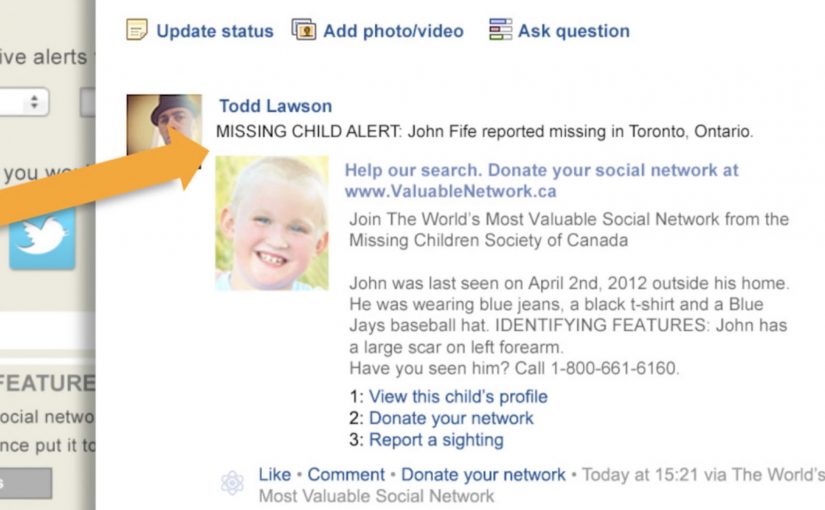
The Missing Children Society of Canada, with Grey Canada, asks people to “donate” their Facebook and Twitter news feeds. By opting in, a person allows missing-child alerts to be posted directly into their feed, turning everyday social reach into a public-safety broadcast layer.

The distribution logic is local. Alerts are geographically coded, so someone in Toronto sees posts about missing children in their area, not a national firehose.

Turning social feeds into an emergency surface

The mechanism is permissioned publishing. Here, “permissioned” means people explicitly opt in to let the program post on their behalf. Instead of asking people to remember to share posters or retweet at the right moment, the campaign uses opt-in account access to place alerts where attention already lives. Because the alert is published automatically into feeds people already check, it moves faster than a request that depends on manual sharing.

In Canadian public-safety communications, speed and local relevance determine whether a message gets acted on or ignored.

Why this lands better than a generic awareness push

Most “support the cause” messaging competes with everything else in the feed. This flips the frame. The feed itself becomes the tool, and the content is time-sensitive and action-oriented. This is a stronger model than a generic awareness push because it routes attention into action without extra steps.

Extractable takeaway: If the mission depends on time, do not optimize for “awareness.” Optimize for distribution mechanics that reduce steps at the moment of need, and constrain the message to the people who can realistically act.

Geo-coding is the quiet hero here. Locality reduces fatigue, increases perceived responsibility, and makes the alert feel like a neighborhood problem, not distant tragedy content.

What the campaign is really building

Beyond any single case, this creates a repeatable digital volunteer layer. Every donated feed is a standing commitment, and every local alert becomes a test of whether the network can mobilize attention fast enough to matter.

The real question is whether you can convert passive sympathy into permissioned, local distribution during the first hours.

Design moves worth borrowing

  • Make opt-in feel like “donation.” People understand giving reach the way they understand giving money.
  • Automate the share. Remove the “I should post this” friction.
  • Localize by default. Relevance is the difference between help and noise.
  • Keep the message actionable. Clear identifiers and a next step beat emotional copy in urgent scenarios.

A few fast answers before you act

What does it mean to “donate” your social media feed in this campaign?

You opt in so missing-child alerts can be posted directly to your Facebook or Twitter feed, using your reach to distribute time-sensitive information.

Why use geo-coded alerts?

It keeps the feed relevant and increases the chance someone nearby recognizes the child or has useful information, while avoiding national alert fatigue.

What problem is this solving compared to posters or standard PSAs?

Speed and placement. It puts alerts into a high-attention channel immediately, without relying on people to take an extra step to share.

What should a program like this measure?

Opt-in volume, local reach per alert, time-to-first-distribution, engagement actions that indicate reading, and downstream reporting behavior where available.

What’s the smallest version you can pilot?

Start with a single opt-in flow, a clear local targeting rule, an approval workflow for posting, and one simple call to action that tells people exactly what to do if they have information.