Ford C-Max Augmented Reality

Ford C-Max Augmented Reality

A shopper walks past a JCDecaux Innovate mall “six-sheet” screen (poster-format) and stops. Instead of watching a looped video, they raise their hands and the Ford Grand C-MAX responds. They spin the car 360 degrees, open the doors, fold the seats flat, and flip through feature demos like Active Park Assist. No printed marker. No “scan this” prompt. Just gesture and immediate feedback.

What makes this outdoor AR execution different

This is where augmented reality in advertising moves from a cool, branded desktop experience to a marker-less, educational interaction in public space. Marker-less here means the experience does not need a printed marker or “scan this” prompt to start. The campaign, created by Ogilvy & Mather with London production partner Grand Visual, runs on JCDecaux Innovate’s mall digital screens in UK shopping centres and invites passers-by to explore the product, not just admire it.

The interaction model, in plain terms

Instead of asking people to download an app or scan a code, the screen behaves like a “walk-up showroom.”

  • Hands up. The interface recognises the user and their gestures.
  • Virtual buttons. On-screen controls let people change colour, open doors, fold seats, rotate the car, and trigger feature demos.
  • Learning by doing. The experience is less about spectacle and more about understanding what the 7-seat Grand C-MAX offers in a few seconds.

How the marker-less AR works here

The technical leap is the move away from printed markers or symbols as the anchor for interaction. The interface is based on natural movement and hand gestures, so any passer-by can start immediately without instructions.

Under the hood, a Panasonic D-Imager camera measures real-time spatial depth, and Inition’s augmented reality software merges the live footage with a 3D, photo-real model of the Grand C-MAX on screen.

Because the interface responds to natural hand movement, the interaction starts without instruction and keeps the focus on learning the product, not learning the UI.

In retail and out-of-home environments, interactive screens win when they eliminate setup friction and teach the product in seconds.

The real question is whether your outdoor screen is a passive impression machine or a walk-up product experience that teaches in under 30 seconds.

Why this matters for outdoor digital

If you care about outdoor and retail-media screens as more than “digital posters,” this is a strong pattern. This pattern is worth copying: design for viewer control and fast product education, not just looping impressions.

Extractable takeaway: Remove setup friction first, then use a small set of high-value interactions to teach one product truth quickly.

  • Lower friction beats novelty. The magic is not AR itself. The magic is that the user does not need to learn anything first.
  • Gesture makes the screen feel “alive.” The moment the passer-by sees the car respond, the display stops being media and becomes a product interface.
  • Education scales in public space. Showing how seats fold, how doors open, or what a feature demo looks like is hard to compress into a static ad. Interaction solves that.

Practical takeaways if you want to build something like this

  • Design for instant comprehension. Assume 3 seconds of attention before you earn more. Lead with one obvious gesture and one obvious payoff.
  • Keep the control set small. Colour, rotate, open, fold. A few high-value actions beat a deep menu.
  • Treat it like product UX, not campaign UX. The success metric is “did I understand the car better,” not “did I watch longer.”
  • Instrument it. Track starts, completions, feature selections, and drop-offs. Outdoor can behave like a funnel if you design it that way.

A few fast answers before you act

What is the core innovation here?

Marker-less, gesture-driven AR on mall digital screens that lets passers-by explore product features without scanning a code or using a printed marker.

What does the user actually do?

They raise their hands to start, then use on-screen controls to change colour, open doors, fold seats, rotate the car, and trigger feature demos like Active Park Assist.

What technology enables it?

A depth-imaging camera measures real-time spatial depth, and AR software merges live footage with a 3D model of the vehicle.

Why does “marker-less” matter in public spaces?

Because it removes setup friction. Anyone walking by can immediately interact through natural movement and gestures.

What should you measure to know it worked?

Track starts, completions, feature selections, and drop-offs so you can see which interactions people choose and where they bail out.

Liaison Dangereuse: Striptease Shopping

Liaison Dangereuse: Striptease Shopping

Valentine’s lingerie shopping, turned into a show

Liaison Dangereuse, a German lingerie brand, gave Serviceplan a creative challenge: increase lingerie sales around Valentine’s Day.

Seduction always works. So what about making the buying experience attractive and unique for men by giving them the opportunity of buying lingerie directly from the body of beautiful models, and pairing that with a memorable striptease? Thus a new way to sell online lingerie was created.

The mechanism that changes behavior

The idea reframes checkout as participation. Instead of browsing product grids, the customer “shops” from the model, which makes selection feel more like discovery than transaction, and reduces hesitation at the moment of choice.

In European ecommerce and performance marketing, the fastest lever is reducing hesitation by making the path to purchase feel emotionally easy and socially tellable.

The real question is whether you can turn your highest-friction step into a guided, retellable moment without breaking brand trust.

This kind of mechanic is worth copying only when it fits your brand voice and clear consent boundaries.

Why it lands with the intended buyer

This is built for a very specific Valentine’s reality: many male buyers want help choosing, and they want the moment to feel confident, not awkward. A guided, theatrical experience removes indecision and makes the purchase feel like part of the gift.

Extractable takeaway: When the buyer feels unsure about choice, redesign selection so confidence is the default and the mechanic becomes the story.

Earned media as a built-in distribution layer

Serviceplan not only generated free media coverage from major websites, newspapers and magazines in Germany, it also reported additional traffic of 155% to the Liaison Dangereuse website. Reported sales went up by 50% during the promotion.

Click here to watch the video on Ads of the World website.

Steal this conversion mechanic

  • Design for the buyer’s emotion. Remove embarrassment and decision anxiety. Add guided confidence.
  • Make the shopping path the story. If the mechanic is inherently retellable, distribution comes with it.
  • Focus the experience on the highest-friction moment. Choice, not payment, is often the real dropout point.
  • Measure what matters. Track uplift in qualified traffic, add-to-cart rate, and conversion, not just press mentions.

A few fast answers before you act

What is “Striptease Shopping” for Liaison Dangereuse?

It is a Valentine’s-focused ecommerce activation that lets shoppers buy lingerie through a model-led, striptease-style interface, turning product selection into a playful, guided experience.

Who is the experience designed for?

It targets gift-buyers who feel unsure about lingerie choices. The mechanic reduces awkwardness and indecision by making selection feel assisted rather than self-directed.

What is the behavioral mechanism that improves conversion?

It reframes checkout as participation. By turning browsing into a simple, story-like interaction, it reduces hesitation and makes the purchase feel emotionally easy.

Why did it generate strong earned media?

The buying mechanic is unusual and instantly demonstrable. That makes it easy to describe, easy to show, and inherently shareable across press and social channels.

What results were reported from the promotion?

Campaign summaries reported +155% website traffic and +50% sales during the promotion period.

What is the key risk to manage with “seduction” mechanics?

Brand fit and boundaries. If the experience feels exploitative or off-brand, the attention can backfire. The idea needs clear intent, consent, and tone discipline.

Superette: Short Shorts

Superette: Short Shorts

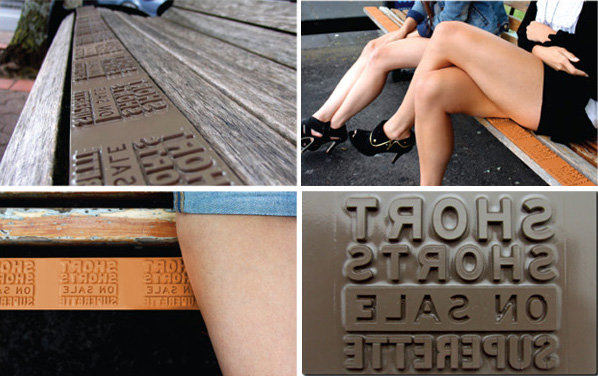
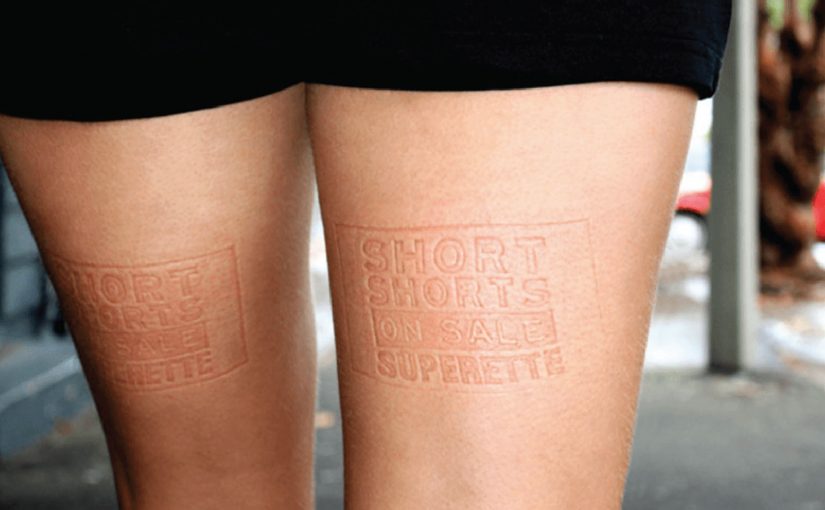
In the inner city, someone stands up from a bus-stop bench and notices a message pressed into their thigh. It reads like a sale reminder, and it travels with them for the next hour.

That is the execution DDB Auckland creates for Superette’s short shorts sale. Indented plates are fitted across bus stops, mall seats, and park benches in the fashion district, so when people sit down, the message is imprinted on the bare skin exposed by the trend. The result, as described, is branded seating plus a moving wave of free media: thousands of temporary imprints that last up to an hour, and show up most visibly on exactly the style-setters the retailer wants.

Superette’s short shorts sale campaign.

How the imprint works

This is body imprint advertising: a physical surface transfers a readable message onto skin through pressure, like a temporary stamp without ink. The media buy is the furniture people already use. The “placement” is the moment the audience sits down.

In fashion retail, the fastest way to make a promotion feel native is to attach it to the lived behavior and the exposed product context, not a separate media channel.

Why it lands in the street

The idea carries its own proof. The imprint is not a claim you read; it is a thing that happens to you, and that makes it unusually hard to ignore or forget. It also creates a social moment. People compare marks, laugh, take photos, and inadvertently become distribution. The targeting is embedded in the location strategy: benches in inner-city and fashion-district zones bias the audience toward the “hippest young cats” already dressed for visibility.

Extractable takeaway: When your offer is simple and time-bound, design a mechanic where the audience physically carries the message for a short period, then place that mechanic where the right crowd naturally gathers.

What Superette is really buying

Not just awareness. The campaign buys cultural permission. It signals that the sale belongs to a specific scene and that the brand understands how that scene moves, sits, and shows skin. The imprint is a cheap, repeatable proof-point of “this is for you” without ever saying it directly.

The real question is whether the sale message can travel through the scene as social proof instead of behaving like an ad bolted onto it.

What retail teams can steal from this

  • Turn existing infrastructure into media. Find the surfaces your audience already uses, then engineer the message into the touchpoint.
  • Make the ad portable. If people carry the message with them, your reach compounds without extra placements.
  • Target by behavior, not demographics. Location and context can do the filtering when the creative is inseparable from the setting.
  • Keep the message legible and short. Physical imprint media rewards minimal copy and a single, clear action.

A few fast answers before you act

What is “body imprint advertising” in this campaign?

A message is created as a temporary impression on skin by sitting on seats fitted with indented plates. No ink is needed. Pressure creates the readable mark.

Why does putting the ad on benches make sense for a shorts sale?

The trend exposes bare thighs, so the sale message can live on the same body area the product is designed to reveal. The medium and the product context reinforce each other.

What makes this feel like “free media” after the placement?

Once a person stands up, the imprint travels with them for a while. Every subsequent encounter becomes an additional impression without buying another seat or poster.

What is the main risk with this approach?

If the imprint feels intrusive or uncomfortable, the novelty can flip into backlash. The mechanic depends on perceived playfulness, not coercion.

When should a brand use a tactic like this?

When the message is ultra-short, the audience is location-clustered, and the idea can be experienced instantly in a way that people will talk about and show others.