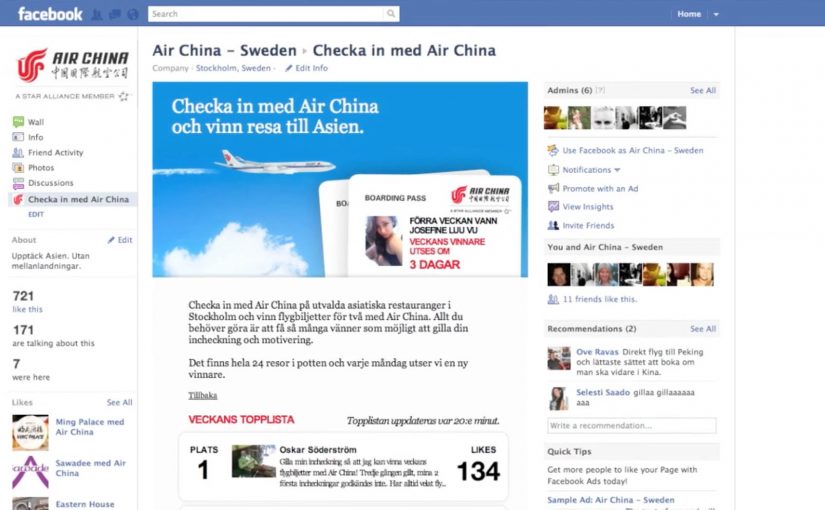
You visit a popular Asian restaurant in Sweden, check in with Air China on Facebook, and instantly become part of a live leaderboard. The more you check in, the higher you climb. Each week, the top check-in users earn two complimentary tickets to Asia.
Air China flies not only to China but also throughout Asia. The challenge is how Air China raises Swedish consumers’ awareness about this fact. In response, their ad agency Rodolfo creates a Facebook check-ins campaign.
How the campaign works in the real world
A select number of popular Asian restaurants in Sweden are transformed into ambassadors for Air China. At the restaurants, guests are encouraged to check in with Air China on Facebook.
What makes it competitive and shareable
The check-ins are aggregated on the Air China Facebook page, and a complete leader board of the highest number of check-ins and the most popular restaurants is displayed. Each week, the users with the highest number of check-ins are awarded two complimentary tickets to Asia.
In market categories where route awareness is broader than one destination, brands need a way to move from static claims to lived proof in everyday settings.
Why this format fits airline awareness
The activation connects everyday behaviour to a clear brand message. Because the action happens in Asian restaurants and the leaderboard makes repeat visits visible, the idea of “Asia access”, meaning one airline that can take you to multiple destinations across Asia, feels immediate, social, and measurable without needing a hard sell in the moment.
Extractable takeaway: When a brand promise is broader than what people currently remember, attach it to a repeatable action in a context that already signals the message.
The real question is whether the brand can turn ordinary social behaviour into repeated proof of a broader route network. The business intent is to expand Air China’s mental availability beyond China and into Asia as a travel network. This is a smart awareness play because the reward, venue, and social mechanic all reinforce the same message.
What to steal from this airline check-in mechanic
- Use context as your media: Turn partner venues into “brand ambassadors” when the venue naturally signals your message, here Asian restaurants reinforcing broader Asia access.
- Design for 10-second participation: Use a repeatable, low-friction action, check-in, that people can do in seconds, in a context where sharing already feels normal.
- Add a progress mechanic: Include a visible scoreboard, leaderboard, so the behaviour has a reason to repeat, not just a reason to start.
- Run on a clear cadence: Weekly winners keep urgency high and create multiple chances to participate without complexity.
- Make the reward reinforce the promise: Align incentives tightly to the brand claim, tickets to Asia, so every mention strengthens recall.
A few fast answers before you act
What is the core idea of this campaign?
Turn physical venues into social triggers. Restaurants prompt people to check in with Air China, and the accumulated check-ins become the campaign scoreboard.
Why use restaurants as campaign ambassadors?
They are culturally relevant touchpoints for Asia in Sweden, with built-in footfall and a natural reason for people to share where they are.
What role does the leaderboard play?
It creates a simple competition loop. People see progress, compare against others, and repeat the behaviour to climb. That repetition drives reach and recall.
What is the incentive design lesson here?
Make the reward perfectly aligned with the promise. Tickets to Asia are a direct reinforcement of Air China’s broader Asian network, not a generic prize.
What should a brand copy first from this format?
Start with the triad, not the platform: a relevant venue, a low-friction repeat action, and a reward that proves the brand promise. That is the reusable structure.