
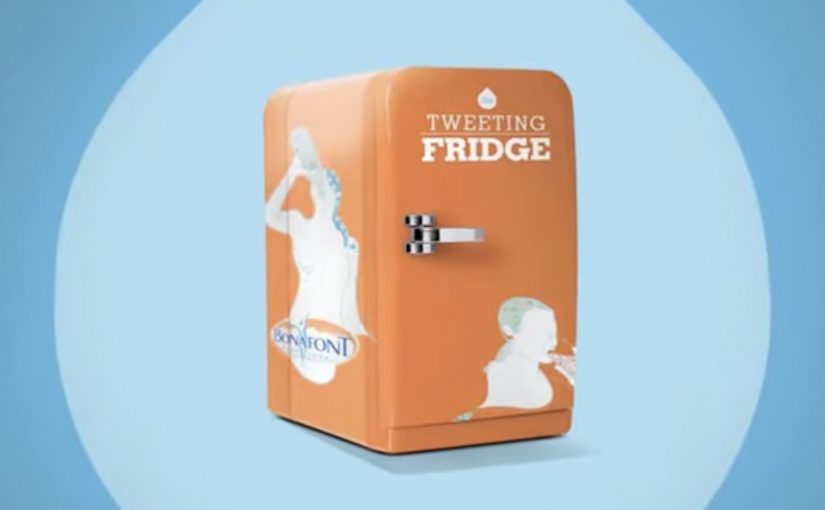
Bonafont: The Tweeting Fridge

The campaign starts with a simple gift. Bonafont sent a mini fridge stocked with 2 liters of bottled water to an influential Twitter personality in Brazil.

The twist was inside the door. The fridge was wired so every time it was opened, a tweet was automatically posted on the celebrity’s account, signaling to thousands of followers that they were drinking water. With a library of pre-written messages, the feed stayed fresh while the behavior stayed consistent.

In other words, hydration became a public ritual, and the act of opening the fridge became the publishing trigger, meaning the moment that automatically creates the post.

The most effective reminders are the ones that piggyback on social proof from people an audience already pays attention to.

A social reminder disguised as a connected object

The mechanism is straightforward. A door-open event triggers a social post. The creative leap is turning a private habit into a visible cue, so the audience gets a repeated prompt without ever being directly targeted by an ad. It is an Internet-of-things demo used as a behavioral nudge.

In global consumer health and FMCG marketing, habit cues scale best when they ride on routines people already perform and signals people already notice.

Why it lands

People rarely fail to drink water because they disagree with the idea. They fail because they forget, especially during work hours. This execution attacks the memory problem, not the belief problem. It also makes the reminder feel lighter. You are not being lectured by a brand. You are seeing someone you follow take a sip.

Extractable takeaway: When the behavior you want is repetitive and easy to forget, attach the reminder to a reliable physical trigger and let social proof do the distribution, so the message spreads as a habit signal, not a campaign slogan.

The real question is whether your reminder can show up as a lightweight cue at the moment of action, rather than as persuasion delivered in advance.

This is a pattern worth copying when “forgetting” is the main barrier and the trigger can be made automatic.

Stealable moves for your next behavior-change activation

  • Choose a trigger that is automatic. Door opens, post happens. No extra step means no drop-off.
  • Borrow credibility from the right messenger. The influencer is not decoration. They are the proof carrier.
  • Keep content variation ready. Repetition builds habit, but repetition with identical copy feels spammy.
  • Make the action visible, not the persuasion. Showing the behavior is often more powerful than explaining it.
  • Scale through a simple rotation model. Passing the object to new personalities keeps attention without redesigning the system.

A few fast answers before you act

What is “The Tweeting Fridge” in one sentence?

A connected mini fridge that automatically tweets when the door is opened, using social proof to remind followers to drink water.

Why is the fridge better than a normal “drink water” campaign?

Because the reminder is tied to a real-world trigger and delivered through a trusted voice, so it feels like a habit cue rather than an ad.

What problem does it solve for the brand?

It increases consumption by turning “forgetting” into “remembering,” using repeated prompts that keep the brand present at the moment of use.

What is the biggest risk if a brand copies this idea?

Over-automation. If the posting feels spammy or deceptive, audiences can turn against the brand and the influencer at the same time.

How do you keep an automated post from feeling spammy?

Use a small rotation of natural messages and avoid excessive frequency, so the automation reads like a habit signal instead of a bot loop.
Miami Ad School: Three Student Concepts

Three student concepts that show their thinking in one move

This year Miami Ad School has produced a run of strong conceptual projects from current students. Here are three that stand out because each one has a clear mechanic and a crisp “why this brand” fit. Here, the mechanic means the one user action and system response that make the concept work.

What makes these concepts travel

Each idea takes a familiar behavior. Choosing food, correcting spelling, inviting friends. Then it adds a single interaction rule that turns the behavior into a branded moment. It is not “advertising about a thing”. It is an experience that demonstrates the thing.

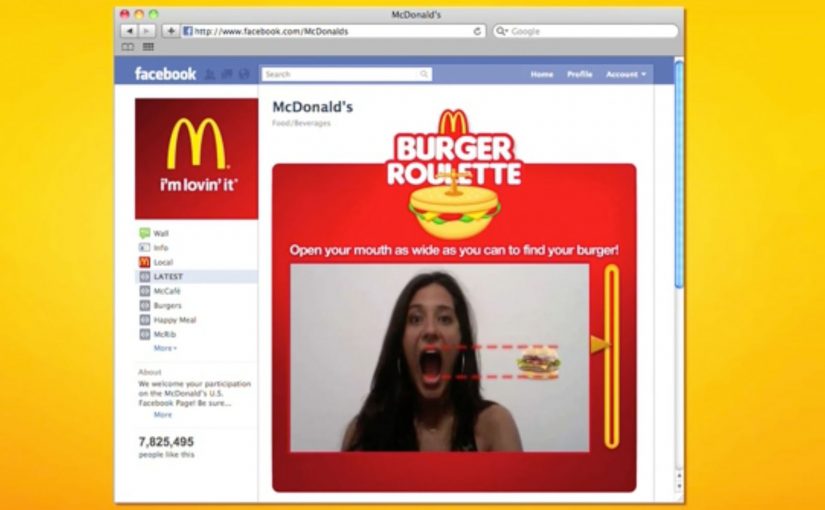
McDonald’s Burger Roulette App

This student concept is designed as a Facebook app that helps you find the “perfect” McDonald’s burger for your mouth. The premise is playful decision support. You answer a few prompts, the system narrows your choice, and the brand becomes the helpful guide instead of a menu you skim and forget.

UNICEF Donate A Word

This student concept proposes a new way to donate for child education by using the spelling feature inside Google Chrome. When a misspelled word is flagged, the prompt becomes a donation trigger, turning a small everyday friction into a small everyday contribution.

In portfolio-driven creative education, concepts like these matter because they show whether a student can turn brand strategy into a usable interaction, not just a line of copy.

Heineken Invite

This student concept uses a social-media-connected bottle opener that invites friends over for a beer. The social mechanic is competitive. Whoever has the most friends attending earns a free case of Heineken, turning “opening a beer” into an invitation ritual and a reason to gather.

Why it lands

All three ideas share the same advantage. They make the brand useful inside a moment people already have, rather than interrupting people to talk about the brand. The mechanic is the message, and the interaction is simple enough that you can explain it in one sentence without killing the effect. That works because a visible rule lets people grasp the idea instantly and connect the payoff to the brand.

Extractable takeaway: Build concepts around one native behavior and one immediate response. If the “rule” is explainable in a sentence and demonstrable in a clip, the idea will be remembered, and repeated.

The real question is whether the interaction makes the brand promise visible without extra explanation. The strongest student concepts are the ones where the interaction itself carries the branding work.

What brand builders can take from these student concepts

  • One behavior, one rule. Keep the mechanic tight. Complexity kills concept believability.
  • Make the brand the enabler. The best student concepts position the brand as the thing that makes the moment better, not the logo that arrives at the end.
  • Design for quick demonstration. If you cannot show it in 10 seconds, it will not spread beyond the pitch.
  • Payoff matters. Personal recommendation, effortless giving, or a social reward. The user needs a reason to do the action.

A few fast answers before you act

What is the common pattern across these three concepts?

Each turns a familiar action into a branded interaction rule with an immediate payoff, making the experience feel like proof rather than promotion.

Why are student concepts often framed around apps or gadgets?

Because interfaces make mechanics visible. You can show input, response, and reward quickly, which makes the idea easy to understand and easy to share.

What makes a concept like “Donate a Word” compelling?

It piggybacks on an existing habit and converts a tiny, repeated behavior into a tiny, repeated donation moment, which feels effortless and scalable.

What is the main risk when brands try to build ideas like this for real?

Friction. If the mechanic is not instant and obvious, people will not complete it in the real world, even if it looks great in a concept film.

What’s the single best takeaway for marketers reviewing student work?

Look for concepts where the mechanic expresses the brand promise without extra explanation. If the interaction itself makes the point, the idea is strong.

Turkcell: #Turkcelltweet Live Unboxing

Turkcell was launching new smartphones bundled with mobile internet and wanted to build awareness among heavy internet users. So Turkcell’s agency, Rabarba from Istanbul, created a live Twitter competition designed to pull exactly those people in.

A Twitter game that literally unwraps the prize

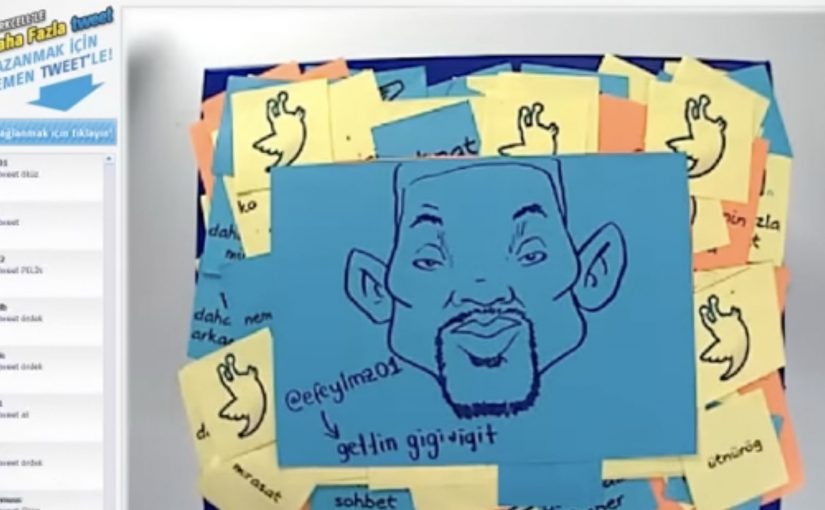
The smartphone was packed in gift boxes and covered with Post-it notes. Players had to tweet what was written on the Post-its to “unwrap” the boxes, using the hashtag #Turkcelltweet. Along the way, contestants joined quick games that won them free minutes and mobile data. The final challenge was to get a celebrity to retweet the message, which won the successful Twitter user a smartphone.

In mobile-first consumer markets, live social mechanics can turn a product launch into a participatory event that spreads through existing networks.

Why it lands

This works because it converts passive watching into a simple, fast action. Read. Tweet. Progress. It also creates a public scoreboard effect. Everyone can see the stream, feel the speed pressure, and understand why a specific player is moving closer to the prize.

Extractable takeaway: When you need attention from people who tune out advertising, design a live loop where participation creates visible progress and the reward feels plausibly “earned” in public. By “live loop” I mean a repeatable action-reward cycle that updates in real time.

What the brand is really buying

The real question is whether you are buying a one-off spike or a repeatable participation habit you can trigger again.

On the surface, it is a giveaway. Underneath, it is audience training. The campaign teaches people to watch Turkcell’s channel closely, to act quickly, and to associate the bundle with active internet culture rather than with standard telecom promotion.

If you cannot guarantee fair rules and real-time moderation, do not run a live social competition like this.

Steal this live unboxing loop

  • Build a single clear verb. “Tweet this to unwrap” is easier than any multi-step entry mechanic.
  • Make progress visible. The crowd should be able to understand what is happening in seconds.
  • Use micro-rewards. Minutes and data keep non-winners engaged, not just the front-runner.
  • Reserve one high-status finish. A celebrity retweet creates a final boss moment that feels bigger than “random draw”.
  • Design for throughput. Live contests die if the pace slows or the rules feel inconsistent.

A few fast answers before you act

What is #Turkcelltweet in one sentence?

It is a live Twitter competition where people tweet Post-it clues to unwrap a boxed smartphone, win small rewards on the way, and compete for a phone as the final prize.

Why does “unwrapping in public” work as a mechanic?

Because it creates visible progress that spectators can follow, and it turns every participant action into content the network can see.

What role do the small prizes play?

They keep the wider crowd engaged. Even if you do not win the phone, you can still gain minutes or data and feel the game is worth playing.

What is the biggest risk with live social competitions?

Fairness and reliability. If timing, moderation, or rule enforcement looks inconsistent, sentiment can flip fast.

What should you measure beyond hashtag volume?

Unique participants, repeat participation, completion rates across stages, sentiment, and whether the campaign lifts bundle consideration and store inquiries in the launch window.