
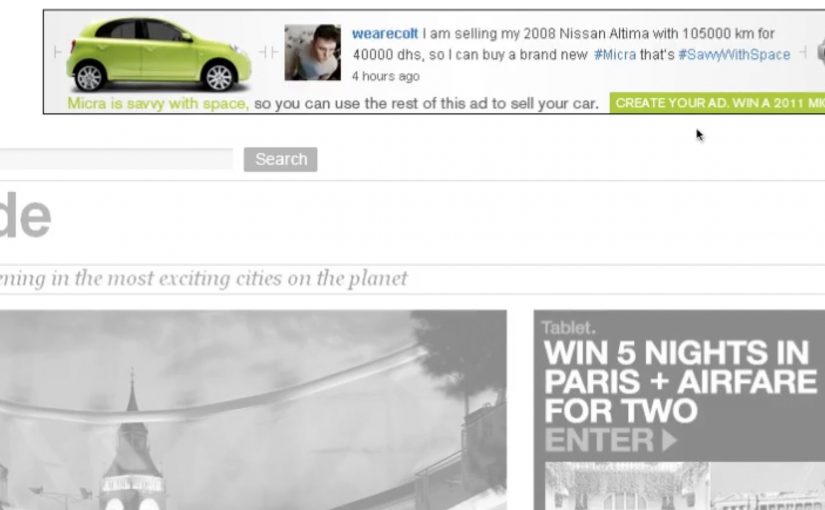
Nissan Micra: Savvy With Space Banner

Nissan Micra: Savvy With Space Banner

From an under-the-seat shoe drawer to an extra-large glovebox, the 2011 Nissan Micra makes the most out of what it has. Here, “space-savvy” means fitting more useful function into a small footprint without making the car feel cramped. To reach drivers who value space-savvy functionality, TBWA\RAAD Dubai takes the same idea into media and builds a banner ad that “packs in” more utility than you would expect.

The punchline is simple. The banner is so clever with space that you can even use the ad itself to help sell your car.

When the format becomes the message

Instead of talking about storage compartments and smart design in a conventional way, the campaign uses the banner’s own layout as the demonstration. The ad behaves like the Micra. Compact, efficient, and surprisingly capable inside a tight footprint.

In automotive marketing, proving practical value often works best when the proof is baked into the experience format, not layered on as copy.

Why this lands

This works because it turns “space-savvy” from a feature claim into something you can feel. The audience is not asked to believe a list of compartments. They experience a compact unit that still does more than expected, which mirrors the product promise in a way that reads instantly.

Extractable takeaway: If your product advantage is “smart use of limited resources,” make the media unit demonstrate that constraint directly, so the format itself becomes the proof.

What the campaign is really optimizing for

The real question is whether the media can make clever functionality feel obvious before the audience has to read a feature list.

This is a strong fit for the Micra because the format does the selling work before the copy has to. The target is not everyone who wants a car. It is drivers who prioritise clever functionality and everyday usefulness. The banner’s “utility-first” design signals that the Micra is designed for people who like practical wins, not flashy theatre.

What functional brands can borrow

  • Let the container prove the claim. Build the story into the experience mechanics.
  • Design for instant comprehension. The idea should land before someone reads supporting text.
  • Match the medium to the benefit. Functional products benefit from functional media behaviors.
  • Keep it user-relevant. If the execution helps someone do something, attention comes easier.

A few fast answers before you act

What is “Savvy With Space” in this Nissan Micra campaign?

It’s a banner-led idea that uses the ad unit’s compact, space-efficient design to mirror the 2011 Nissan Micra’s “smart storage and functionality” positioning.

What makes this different from a normal feature ad?

The format demonstrates the benefit. Instead of only describing clever storage, the banner’s behavior and layout are designed to feel space-smart.

Who is the campaign aimed at?

Drivers who value practical, space-savvy functionality and small design decisions that make daily use easier.

What’s the reusable pattern here?

Make the medium behave like the product benefit, so the audience experiences the claim rather than just reading it.

What could go wrong if you copy this approach?

If the “cleverness” is not immediately obvious, it can look like gimmickry. The functional proof has to be legible fast.
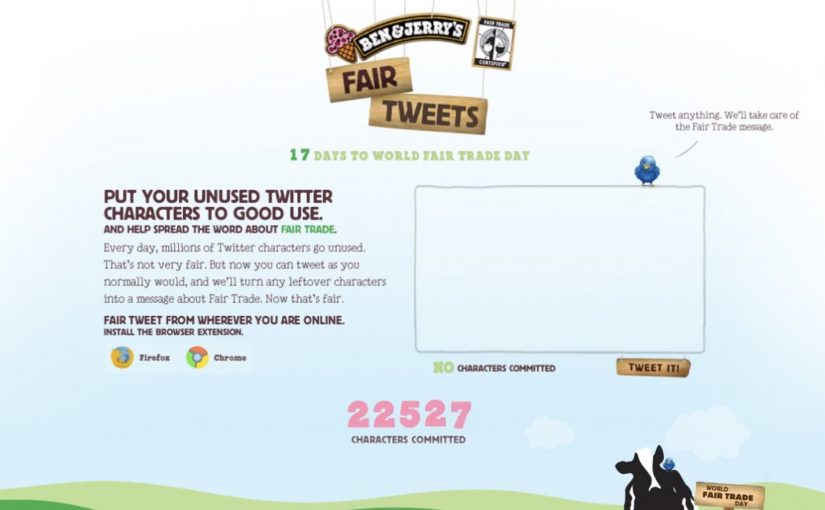
Ben & Jerry’s: Fair Tweets

Ben & Jerry’s: Fair Tweets

How can an ice cream maker use social media to help provide farmers a fair income across the globe. Ben & Jerry’s positions itself as a Fairtrade-first mover in ice cream, then takes on the challenge with a deceptively simple Twitter utility called Fair Tweets.

The idea is to let followers donate their unused tweet space to the cause. “Unused social media space” here means the leftover characters inside a tweet that does not hit the then-standard 140 character limit. Fair Tweets fills those remaining characters with an advocacy message that promotes World Fair Trade Day (May 14) and Fair Trade issues more broadly.

Turning leftover characters into a donation mechanic

The mechanism is a lightweight interface that behaves like a plug-in for your behavior. You tweet as normal. The system automatically appends a Fair Trade message into the empty character space you did not use. It is a small “opt-in constraint” that converts millions of tiny, personal broadcasts into consistent campaign impressions. By “opt-in constraint,” I mean a voluntary limit the user accepts, so the campaign can add a message without hijacking their voice.

In global consumer brands with always-on social channels, this pattern scales because it turns everyday posting into distributed, opt-in media inventory.

The real question is whether you can piggyback on an existing habit without hijacking what people meant to say.

In brand-led cause marketing, the fastest way to earn participation is to reduce effort to one familiar action inside a channel people already use daily.

Why it lands

It does not ask people to change who they are on Twitter. It asks them to keep tweeting, while quietly upgrading the payload. This pattern is worth copying only when the appended message stays clearly secondary to the user’s own voice. The constraint is the hook. It makes the act feel clever rather than preachy, and it turns participation into a visible badge that friends can copy in seconds.

Extractable takeaway: If you want a cause message to spread without feeling like an ad, attach it to a behavior users already repeat, then “tax” only the slack in that behavior. The slack is where adoption hides.

What to steal for your next social utility

  • Exploit a real constraint. The character limit is not a creative brief. It is a platform rule that makes the idea instantly understandable.
  • Make the value exchange obvious. Users give you what they were going to waste anyway, then they get an identity signal for supporting the cause.
  • Keep the activation single-step. One click, one tweet, done. Every additional step kills the multiplier.
  • Design for imitation. The best proof is not a campaign site. It is seeing friends do it in-feed.

A few fast answers before you act

What is the Fair Tweets idea in one line?

It automatically fills the unused characters in a tweet with a Fair Trade message, so normal tweeting becomes lightweight cause promotion.

Why does “unused characters” work as a donation model?

Because it feels free. Users are not giving money or time. They are donating spare capacity inside something they were already doing.

What makes this approach different from a hashtag campaign?

A hashtag asks users to change their message. Fair Tweets rides along with any message, which increases participation without forcing people into campaign language.

What is the biggest risk when brands copy this pattern?

Over-automation. If the appended message feels spammy, repetitive, or hijacks the user’s voice, people will stop using it and may resent the brand.

How do you write the appended message so it feels shareable?

Keep it short, clearly optional, and visibly additive to the user’s tweet. If it reads like a branded footer or repeats too aggressively, it stops feeling like a badge and starts feeling like spam.