
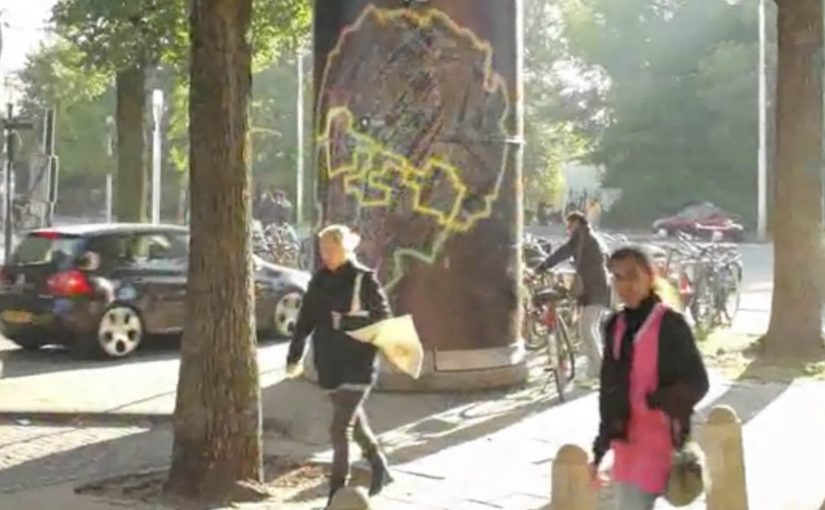
Nike Take Mokum: graffiti you paint by running

Boondoggle Amsterdam came up with a campaign for Nike that made running less serious. They distracted youngsters from their boring running schedules and challenged them to release their creativity on Amsterdam by using their feet as paint instead.

A Facebook app called “Take Mokum” (Amsterdam’s local nickname) was developed that allowed runners to make digital graffiti on the map of Amsterdam. All they had to do was actually run the route and upload their KMs with Nike+. In this context, Nike+ is simply the upload that validates the kilometres. The app would then paint the graffiti for them. These graffiti pieces could then be shared, and liked fanatically.

Running as a creative tool, not a discipline

The mechanism is beautifully simple: convert effort into expression. The runner designs a “tag” by choosing a route. Here, a “tag” is the graffiti-style signature you draw with your route. The city becomes the canvas. Nike+ becomes the proof that the route was actually run. Then the app visualises the path as graffiti, so the output feels like art rather than exercise data.

That flips the motivation model. Because the route becomes a visible mark, every kilometre contributes to something you can show, not just a number you log. You are not running to hit a number. You are running to create something worth showing. The real question is whether you can turn a fitness discipline into a culture-native act of self-expression.

In youth-facing, city-based campaigns, adoption often follows social signalling, not self-optimisation.

Why it lands with youngsters

This campaign taps into identity and visibility. Graffiti culture is about leaving a mark. Take Mokum lets people do that in a digital layer without vandalising anything. The “like” loop adds social reward. The route becomes content, not just a workout.

Extractable takeaway: If you want people to stick with effort, make the output look like identity and let the community reward it.

It also removes the seriousness that can make running feel like punishment. The challenge is playful. The accomplishment is shareable.

The intent: make Nike’s running promise felt, not claimed

The business intent is aligned with Nike’s broader mission to change running. Instead of telling young people that running is cool, the campaign makes running a means to do something else: create, compete for attention, and express style. The product story is embedded in the behaviour.

Behaviour-change work should treat data as validation and culture as the incentive.

The result, as described: young Amsterdam started running, and Nike’s mission to change running was actually experienced by youngsters.

What to steal from Take Mokum

  • Turn effort into an artefact. People stick with habits when the output feels worth keeping or sharing.
  • Let users design the challenge. The route is the creative input. That increases ownership.
  • Use data as validation, not as the headline. Nike+ proves the run. The graffiti is the reward.
  • Build a social loop. Sharing and liking are not add-ons. They are the motivation engine.
  • Match the culture. The campaign borrows from street expression rather than “fitness discipline”.

A few fast answers before you act

What is Nike Take Mokum?

It is a Facebook app that lets runners create digital graffiti on an Amsterdam map by running a route and uploading the kilometres through Nike+.

How does the app turn a run into graffiti?

The runner’s route becomes the “drawing”. After the Nike+ upload, the app visualises the path as a graffiti-like mark on the city map.

Why is this motivating compared to a normal running plan?

Because the reward is creative and social. You produce something you can share and get reactions to, not just a time and distance record.

What audience behaviour did this campaign aim to create?

To get young people running by making the activity feel playful, expressive, and socially visible, rather than structured and serious.

What is the key takeaway for behaviour-change campaigns?

Motivation improves when you convert effort into identity. Give people a way to express themselves, then let the community reinforce it.
Sea Life: Rain Ads That Appear When It Rains

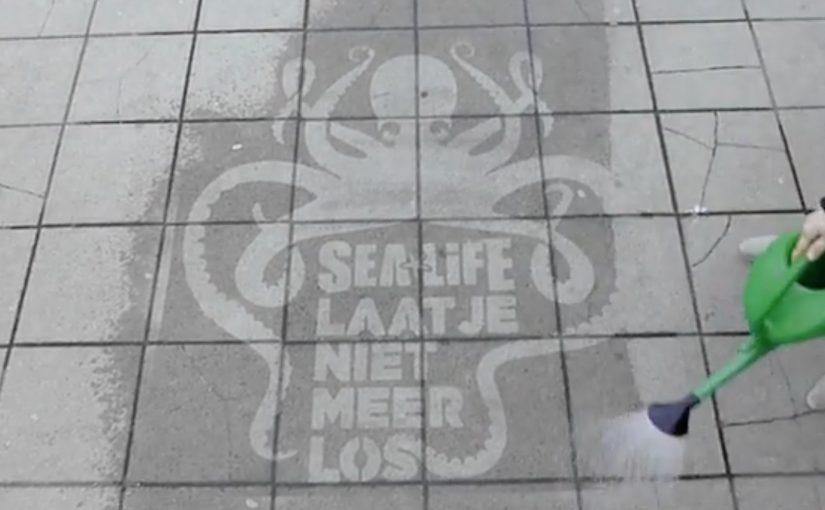
An octopus that only shows up in the rain

Fresh Green Ads is a green media agency from Amsterdam that developed a Rain Campaign, a street-message activation that appears only when pavement is wet, for Sea Life Scheveningen.

Every time it rains the octopus of Sea Life Scheveningen appears on the streets with its tentacles holding the text: “Sea Life laat je niet meer los” (Sea Life never lets you go). When the streets dry up the Rain Campaign disappears. The striking and environmentally friendly message remains visible for up to eight weeks.

The weather trigger is the headline

The campaign is not just placed outdoors. It is activated by the outdoors. Rain becomes the on-switch, which makes the appearance feel like a small surprise rather than an imposed ad.

In outdoor and ambient media, context-triggered visibility works best when the environment itself becomes the activation switch.

Why it fits Sea Life perfectly

Water is not a backdrop here. It is the medium. The octopus “arrives” with rain and disappears when the street dries. That behavior mirrors the theme and makes the line “never lets you go” feel playful instead of pushy.

Extractable takeaway: When your activation trigger is the same element your brand is about, the visibility feels earned and the message can stay playful instead of pushy.

The quiet business logic

The real question is whether your activation can earn repeated attention by showing up only when conditions are right.

Create repeated moments of attention without constant visual clutter. You get spikes of visibility exactly when conditions are right, and then the street returns to normal.

This is the better pattern when you want outdoor attention without turning every day into an ad.

Tactics to borrow from rain-triggered OOH

  • Use context as a trigger. Weather can be a switch, not just a backdrop.
  • Let the idea control visibility. Appear. Disappear. Create surprise.
  • Build sustainability into the execution. Make sure the cleverness is not wasteful.

A few fast answers before you act

What is the Sea Life Scheveningen Rain Campaign?

A street-message activation that appears when it rains, showing a Sea Life octopus and the line “Sea Life laat je niet meer los” (Sea Life never lets you go).

Who developed it?

The post credits Fresh Green Ads, a green media agency from Amsterdam.

What happens when the streets dry?

The rain-activated message disappears as the street dries.

Why does weather-triggered visibility feel less intrusive?

Because rain acts as the on-switch, the message arrives as a surprise rather than a constant presence.

How long can the message remain visible overall?

The post says the environmentally friendly message can remain visible for up to eight weeks.

Volkswagen LinkedUit: A LinkedIn API Campaign

Volkswagen has released a LinkedIn-based campaign which takes full advantage of the new LinkedIn API. Here, “LinkedIn API” simply means the permissioned interface that lets an app read profile information after you sign in.

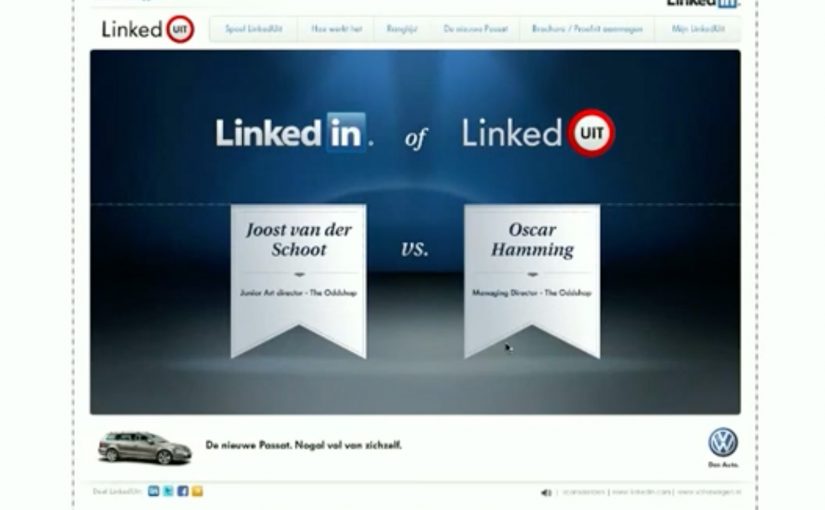
The campaign is called “LinkedUit” (LinkedOut) and gives anyone who challenges a friend on LinkedIn a chance to win a Volkswagen Passat.

The game is really simple. After signing in using your LinkedIn profile, the app lets you choose others in your network to challenge. A LinkedIn victor and a LinkedOut loser is then chosen based on education, experience, recommendations and connections.

Mechanically, the app pulls profile fields after sign-in and turns them into a score you can compare against someone in your network. This pattern is worth copying when you can explain the scoring in plain language and keep participation clearly opt-in. Because the inputs are already curated, the result feels personal with almost no extra work.

In European automotive marketing, platform-native games like this only stay credible when the data use is explicit and the scoring feels fair.

The real question is whether the value of the interaction outweighs the discomfort of being compared.

Why this is a smart use of platform data

This campaign uses something people already curate and care about. Their professional identity. Instead of asking for attention, it uses existing LinkedIn data as the raw material for the experience.

Extractable takeaway: If you can make a platform’s identity data the mechanic, you lower friction and raise relevance. But you only earn repeat use when people can predict why they won or lost.

  • Low input for users. The profile is already built. The game simply reads it.
  • High personal relevance. Comparisons feel personal because they are based on your own history.
  • Built-in social spread. Challenges create a natural loop through networks.

The Passat benefit: “feature-rich” as a metaphor

The creative link is straightforward. Passat equals feature-rich. LinkedIn profile equals information-rich. The experience makes the metaphor tangible by turning profile depth into a competitive score.

That kind of metaphor works when it is easy to explain in one sentence and easy to experience in one click.

What makes this type of social game succeed or fail

  1. Fair scoring logic. If the rules feel arbitrary, people reject the result.
  2. Fast time-to-result. The payoff must arrive quickly after sign-in.
  3. Friendly rivalry. Challenges should feel playful, not judgmental.
  4. Clear reward. A chance to win a Passat is a simple, memorable incentive.

What to take from this if you are building platform-native campaigns

  • Use the platform’s native data as the experience. The more you rely on what already exists, the lower the friction.
  • Make the mechanic social by default. Challenges, invites, and comparisons drive distribution.
  • Keep the brand connection clean. One strong metaphor beats multiple weak links.
  • Design for credibility. When you use personal data, transparency and perceived fairness matter.

A few fast answers before you act

What is Volkswagen “LinkedUit”?

It is a LinkedIn-based campaign that uses LinkedIn profile data to create a challenge game, giving participants a chance to win a Volkswagen Passat.

How does the game determine a winner?

The app compares elements such as education, experience, recommendations, and connections to choose a “LinkedIn victor” and a “LinkedOut” loser.

Why is the LinkedIn API important here?

Because it enables the experience to pull in profile information automatically, making the game quick to start and personally relevant without extra data entry.

What is the creative link to the Passat?

The campaign uses the idea that the new Passat is full of features, just like a LinkedIn profile is full of information, then turns that into a competitive mechanic.

What is the main lesson for social platform campaigns?

If you build around native identity and data, and make the interaction social by default, you can create an experience that spreads through the network naturally.