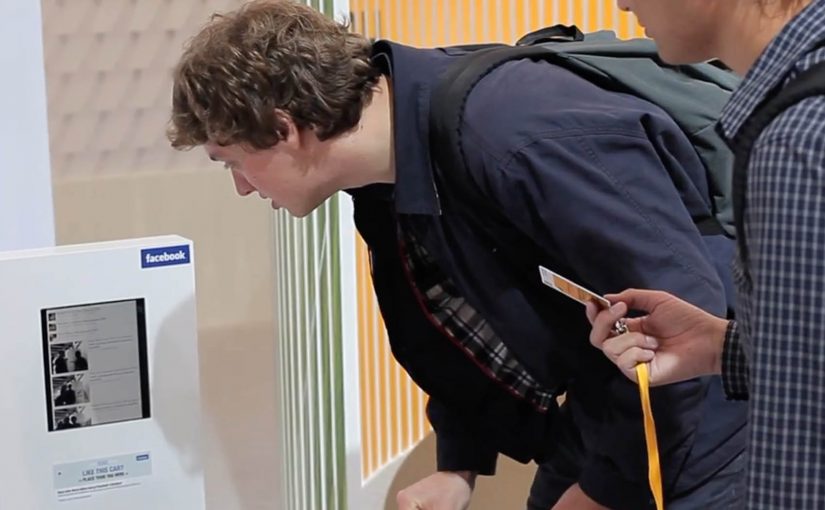
For the Amsterdam Motorshow, Renault introduced the possibility of “liking” real objects offline and immediately sharing them online via the Facebook wall. They created this innovative and real-time social sharing experience with the help of a RFID Facebook card.
Specially made Facebook pillars were placed in front of the Renault cars. All the visitors had to do was hold their pass in front of these pillars and an automatic connection would be made to their Facebook profile, with the car being “shared” on their wall. This way their offline car experience was instantly shared with their online friends.
Renault got the mechanics right, but last year Coca-Cola used the same technology in a more engaging manner at their Coca Cola Village event in Israel.
Why this felt new at the time
The breakthrough is not the “like” itself. It is the bridge. A physical moment becomes social output, meaning a post on the visitor’s Facebook wall, in seconds, without asking the visitor to take out a phone, search, type, or upload. Because the share action is reduced to a single tap, more people complete it before attention moves on.
Extractable takeaway: If you want physical experiences to generate social reach, remove every extra step between the moment and the share.
- One gesture. Tap the card, and the content posts.
- Identity linked once. The RFID card connects the visitor to their profile without repeated logins.
- Social proof at scale. Each tap becomes a public signal to friends, extending the showroom beyond the venue.
In event marketing and showroom environments, the scalable advantage is not the technology itself but how quickly it turns attention into a visible social signal.
The real question is how to turn a live brand encounter into an online share before the visitor’s attention shifts.
What to copy for live-share activations
If you want real-time sharing from physical spaces, reduce the share action to a single motion and make the output predictable.
- Cut the action to one move. The participant should only need to tap, not search, type, or upload.
- Make the output clear. The visitor should know exactly what will appear on their wall before acting.
- Keep the share native to the moment. The social post should feel like a continuation of the offline interaction, not a separate task.
A few fast answers before you act
What did Renault do at the Amsterdam Motorshow?
Renault created an RFID-based activation that let visitors “like” cars offline by tapping a Facebook RFID card at branded pillars, which then posted the car to their Facebook wall.
Why use RFID instead of asking people to share on their phones?
RFID reduces friction. It removes typing, app switching, and upload steps, which increases participation and makes sharing feel effortless in the moment.
What is the main benefit of connecting offline experiences to social in real time?
It turns a physical event into an online distribution channel, where each participant becomes a broadcaster to their own network.
What makes this more scalable than asking staff to help visitors post manually?
The action is standardized and immediate. Each visitor can generate the same type of share without depending on staff, which makes the activation easier to repeat at scale.
What should you be careful about with automated social posting?
Make the action intentional and the output transparent. People need to understand what will be posted before they tap.