
Esquire’s Augmented Reality Issue

Esquire’s Augmented Reality Issue

You open a print issue of Esquire and the pages do not stop at ink. You point a webcam or phone at a marked page and the magazine layer expands. Here, “marked” means the page includes a printed visual marker the AR software can recognize. Video clips play, 3D objects appear, and extra content sits directly on top of the printed layout. The issue behaves like a portal, not a publication.

The move. Extending print with augmented reality

Esquire experiments with an augmented reality-enabled issue that connects physical pages to digital experiences. The print product becomes the trigger, and the digital layer becomes the reward for curiosity.

How it works. Markers plus a camera

  • Selected pages include visual markers designed to be recognized by software.
  • The reader opens the AR experience on a computer webcam or mobile device.
  • When the camera recognizes the page, digital content overlays the magazine.
  • The overlays can include video, interactive elements, and 3D objects tied to the editorial content.

In publishing and brand media, augmented reality works best when the page itself becomes the interface rather than a detour to a separate destination. Because the camera locks onto the page itself, the overlay feels anchored to the layout, which makes the payoff arrive without a context switch.

In consumer publishing and brand media, the most repeatable AR pattern is to let the page be the trigger and the camera be the lens.

Why it matters. A magazine that behaves like a medium

This is not a banner ad placed on paper. It is a format shift. The real question is whether you are using AR to deepen the editorial moment or to bolt on a gimmick. The reader keeps control, but the magazine now has depth. Print becomes interface, and “extra content” becomes spatial and contextual rather than hidden behind a URL. If the overlay does not deepen the page you are already reading, it should not ship.

Extractable takeaway: Use AR to deepen the page the reader is already in, with a fast first reveal anchored to the layout, so the extra layer feels earned instead of tacked on.

What to take from it. Designing for the moment of discovery

  • Use print as the entry point. A physical artifact can still be the strongest trigger for attention.
  • Reward curiosity quickly. The first overlay has to land fast to justify the setup.
  • Keep the experience editorial. AR works best when it extends the story, not when it interrupts it.
  • Plan for repeatable templates. Once the pipeline exists, AR pages become a scalable content format.

A few fast answers before you act

What is Esquire’s augmented reality issue?

A print magazine issue that unlocks digital overlays like video, interactive elements, and 3D objects when a camera recognizes marked pages.

What do readers need to experience it?

A webcam or phone camera, plus the AR experience that recognizes the markers in the issue.

What kind of content can appear?

Video clips, interactive elements, and 3D overlays tied to the editorial pages.

Why is this different from typical digital add-ons?

The print page becomes the interface, so the digital layer is contextual and anchored to the physical layout.

What is the transferable lesson?

Treat physical media as an activation surface, then design a fast, editorially relevant reveal that makes the extra layer feel earned.

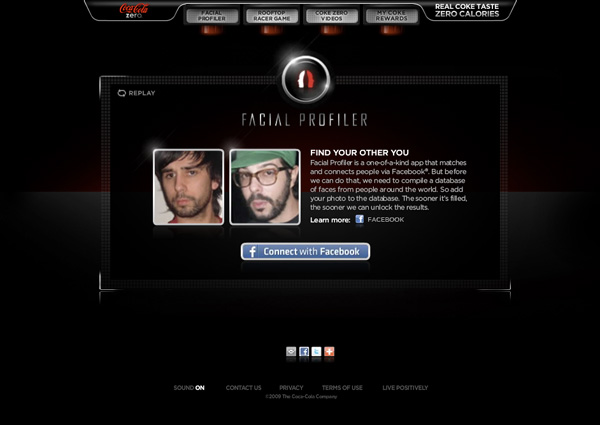
Coke Zero: Find Your Online Lookalike

Coke Zero: Find Your Online Lookalike

A social experiment built on the “evil twin” feeling

If you have ever reckoned you have an evil twin somewhere else in the world, or that you were separated at birth but no one has got round to telling you, Coke Zero’s “worldwide social networking experiment” plays directly into that curiosity.

Coke Zero created a Facebook app called the “Facial Profiler” with one clear aim: find your online lookalike.

Coke Zero Facial Profiler App

The mechanic is simple and self-explanatory. You upload a photo to the database. Coke analyses the facial characteristics and attempts to find the nearest match from other uploaded images.

In global FMCG marketing, lightweight social utilities can turn personal identity-curiosity into mass participation with minimal friction.

Why it spreads without feeling like an ad

This works because the “reward” is social, not transactional. People want to see the result, they want to show friends, and they want friends to try it back, which increases the pool of uploaded images and improves the matching for everyone.

Extractable takeaway: If the output stays debatable instead of perfectly final, people replay, compare, and recruit others, which keeps the loop moving without needing incentives.

Where the brand message sits in the experience

The campaign does not argue product attributes head-on. Instead, it borrows the logic of the product proposition and turns it into a human metaphor: “close enough” can still be compelling.

The real question is whether your experience makes the proposition felt through participation, not explained through claims.

When the promise is hard to prove in the moment, translating it into an experience like this is a smarter route than piling on more copy.

The idea behind the campaign is: ‘If Coke Zero has the taste of Coke…is it possible that someone out there has your face?’.

Steal this loop for your next participation mechanic

A participation mechanic is the simple action-and-reward loop that gets people to join, share, and bring in others.

  • Start with a universal itch. Identity, comparison, and “who do I look like” is instantly legible in any market.
  • Make the first step frictionless. One upload, one result, immediate payoff.
  • Let the community improve the product. Every participant makes the experience better for the next one.
  • Encode the proposition in the mechanic. The “same taste” claim becomes a story people can experience, not just hear.

A few fast answers before you act

What is Coke Zero’s Facial Profiler?

It is a Facebook application that invites people to upload a photo and then returns the closest lookalike match from other uploaded images in the database.

How does the campaign mechanic work?

Participation creates the asset. Users contribute photos, the system compares facial characteristics, and the database grows with every upload, which increases the chance of finding a “near match”.

Why does this kind of idea get shared?

Because the output is personal and social. The result is fun to show, fun to debate, and it prompts friends to try it too, which naturally amplifies reach.

What is the business intent behind the experience?

To make the Coke Zero proposition memorable by translating “close enough to Coke” into a human analogy, so the brand message is felt through participation rather than explained through claims.

What is the most transferable lesson for digital campaigns?

Build a simple loop where the audience action creates the content, the content creates conversation, and the conversation recruits the next participant.