
McDonald’s: Adult Playland in Sydney

A Playland built for adults, not kids

In order to awaken the inner child in McDonald’s adult consumers, McDonald’s and DDB Sydney built an adult sized Playland in the middle of Sydney.

Supersizing the familiar to make it feel new again

The mechanism is physical and immediate. Take an icon people associate with childhood, then rebuild it at adult scale and put it directly in the path of commuters. It is not a message about fun. It is fun, placed in public, with no explanation required.

In Australian CBD (central business district) commuter culture, a surprising public installation can interrupt routine and create instant permission to behave differently for a moment.

The real question is whether you can give adults permission to participate without making them feel childish.

Why it lands: it removes the awkwardness of “acting like a kid”

Adults do not need to be convinced that play is enjoyable. They need permission. By making the Playland explicitly adult-sized and placing it in the city centre, the brand turns nostalgia into a socially acceptable break from routine.

Extractable takeaway: When adults hesitate, design the environment so participation feels socially legitimate, not self-conscious.

The business intent: rebuild emotional closeness through participation

This is a reconnection play, meaning it is designed to rebuild emotional closeness through participation rather than persuasion. This is the better move than a nostalgia message when you need adults to act in public. Instead of asking adults to remember McDonald’s, it gives them a shared experience they can literally step into, then ties that memory back to the brand.

Since the time of the launch in March, McDonald’s reported that more than 300 people have taken advantage of this playground on a daily basis and engaged with McDonald’s in a way they had not for years.

Design moves that get adults to play in public

  • Use a recognisable icon. Familiarity lowers the barrier to participation.
  • Change scale to change behaviour. Adult-sizing makes the experience feel legitimate, not childish.
  • Place it where routine is strongest. The contrast is what creates attention and talk value.
  • Make the experience the proof. Participation creates memory faster than any claim can.

A few fast answers before you act

What did McDonald’s build here?

An adult-sized Playland installation in central Sydney, designed to let adults play in a familiar McDonald’s-style playground environment.

What is the core mechanism?

Rebuild a childhood icon at adult scale and place it directly in the path of commuters. The experience is the message, with no explanation required.

Why does it work psychologically?

Adults do not need to be convinced that play is fun. They need permission. Adult-sizing plus public placement makes participation socially acceptable.

What business intent does it serve?

Rebuild emotional closeness through participation. A shared, physical experience creates memory and talk value that a standard campaign claim cannot.

What is the most transferable takeaway?

If you want real engagement, put a recognisable, low-friction action in a high-routine place, and let participation do the persuasion.
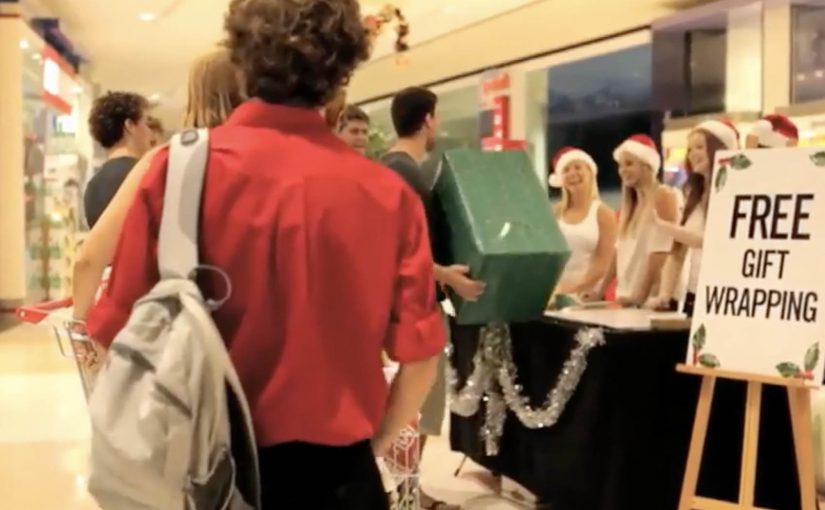
Hyundai A-League: Gift Wrapping Swindle

Getting people into a stadium rarely starts with sport. It starts with habit. Lowe in Sydney uses the pre-Christmas rush to put a match invitation into a moment people already care about, without needing another ticket ad.

A Christmas “service” that flips into promotion

The activation doesn’t fight for attention in a new media slot. It borrows an existing ritual, getting gifts ready, when people are already in a generous, social mindset and open to small surprises.

The smart part is the order of operations. It feels like help first, marketing second, which lowers resistance and makes the message easier to carry into conversation afterwards.

The reveal is the media

Once people opt in, the experience pivots. What looks like a straightforward offer becomes a playful con, and that pivot is the part people remember and retell.

That retelling is the distribution engine. It converts passive reach into a personal anecdote, and personal anecdotes are what move a friend group from “I saw something” to “we should go.”

In crowded sports and entertainment markets, attendance is often won at the everyday decision points where people choose what they will do with their next free evening.

The real question is whether you can turn an attendance ask into a story people want to retell, not just a message they notice.

Why the idea lands so well

The “swindle” framing does two jobs at once. Here, “swindle” simply means a playful bait-and-switch, the wrapping offer flips into a match invite. It creates tension and emotion in the moment, and it makes the participant feel involved, not targeted. The reaction is the content, and the retelling is the distribution.

Extractable takeaway: If you can attach your message to a real-world ritual that people already care about, you don’t need to “earn attention” from scratch. You simply redirect it, then give people a story they can repeat without you.

This is also listed in Effie Awards Australia reporting as a winner in the “Most Original Thinking” category, which fits the design: a small behavioural hack, not a big media buy.

What the league is really buying

The hidden win is not just awareness. It’s habit disruption. You take a non-football moment and reframe it as football-adjacent, then you push the idea of attending into a context where people are already planning social time around the holidays.

A ritual-first activation like this beats incremental ticket messaging because it recruits people’s social planning habits, not just their attention.

That’s how you move from “I saw an ad” to “we should go”. The campaign manufactures a nudge that feels organic because it is embedded inside a familiar activity.

Ritual-based attendance nudges to copy

  • Pick a ritual with built-in foot traffic: shopping, commuting, queues, checkouts, waiting rooms.
  • Make the reveal the message: the twist should be the reason people talk, not an extra layer you explain after.
  • Design for retelling: if the story can be repeated in one sentence, it will travel further than the experience itself.
  • Keep the CTA implicit: the best outcome is that people decide to act while they are still talking about what happened.

A few fast answers before you act

What is “The Great Christmas Gift Wrapping Swindle”?

It’s a holiday-season activation that turns gift wrapping into a surprise promotional stunt, engineered to spark conversation and drive attendance.

Why is gift wrapping a smart channel for sports marketing?

Because it’s a ritual people willingly engage with. The message travels physically with the gift, and the moment is social by default.

What makes this more effective than a standard ticket ad?

The participant becomes the messenger. A prank-style reveal produces a story, and stories outperform slogans when it comes to getting people to act.

What’s the main risk with prank mechanics?

If the reveal feels mean-spirited or wastes people’s time, you get backlash without benefit. The tone has to stay playful, and the participant has to feel “in on it” quickly.

How do you adapt the pattern outside sports?

Attach your offer to a real-world ritual in your category. Then design one clear twist that transforms the ritual into a story people want to repeat.