Honda – The Other Side

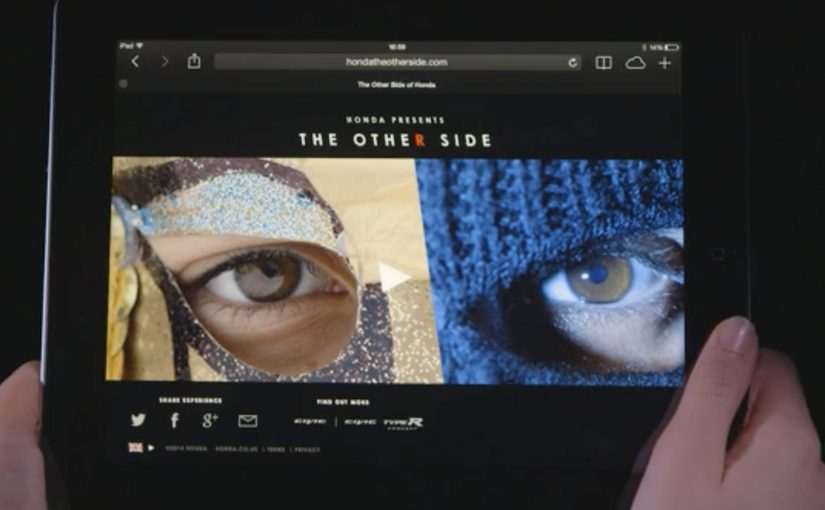
Car brands are always trying to show that their cars have different sides to their personalities, sporty vs reliable, safe vs cool, etc. What makes Honda’s latest effort unique is its YouTube video. By simply holding down the “R” key on the keyboard, the viewer can instantly switch between two different videos.

To execute this innovation, Wieden & Kennedy London had to create two storylines, one of an easygoing Dad doing the school run and the second as an undercover cop posing as a getaway driver. Both of which were then expertly mirrored with contrasting style and tone. The interactive experience was then put together by Stinkdigital at Honda’s YouTube Channel.

Why the mechanic matters more than the novelty

The “hold R to switch” idea is a simple interaction, but it changes how you watch. You are not just viewing a story. You are actively comparing two versions of the same moment, in real time.

  • One scene, two meanings. The mirrored structure makes contrast instantly legible.
  • Viewer control. You control the cut, which increases attention and repeat viewing.
  • Storytelling as product proof. Different “sides” of a car become a narrative device, not a claim.

Execution discipline: mirrored scenes, opposite tone

This only worked because the two storylines were designed to align. Timing, framing, and beats had to match so the switch felt seamless, not like two unrelated edits.

The payoff is that contrast becomes the hero. Calm family routine vs high-pressure escape. The same underlying vehicle context. Two different emotional reads.

What to take from this if you build interactive brand content

  1. Make the interaction explain itself. If the mechanic needs instructions, you lose momentum.
  2. Design for replay. The best interactive films reward going back and re-watching with intent.
  3. Let structure carry the message. When the format proves the point, you do not need heavy-handed copy.
  4. Keep the tech invisible. Viewers remember the feeling of control and contrast, not the implementation details.

A few fast answers before you act

What is Honda “The Other Side”?

It is an interactive film experience where viewers can switch between two parallel storylines by holding down the “R” key.

What are the two storylines?

One follows an easygoing Dad doing the school run. The other follows an undercover cop posing as a getaway driver, with both narratives mirrored scene-by-scene.

Why is the “hold R to switch” mechanic effective?

It gives the viewer control and makes the contrast immediate. That active comparison increases attention, engagement, and replays.

Who created the work?

Wieden & Kennedy London created the two mirrored storylines, and Stinkdigital put the interactive experience together on Honda’s YouTube Channel.

What is the transferable lesson for digital teams?

If you can express your message through an interaction that is instantly understandable, the format itself becomes the persuasion.

Volkswagen Smileage: Road Trips with Google

With the Volkswagen Smileage app, road trips are never going to be the same again. Powered by Google the app is set to socialise road trips world over.

To start earning Smileage you have to pair the app with your car and sign in with your Google account. Once synced, the app automatically connects each time you go for a ride.

Friends can then watch and comment on your journey in real time while you earn Smileage through shared photos, kilometers, checkins, comments, likes and punches from other nearby Volkswagen’s.

The car becomes a social object

The concept here is not just “tracking”. It is making the trip legible and interactive for people who are not in the car. Your drive becomes a live story, with reactions and contributions from friends.

  • Automatic connection. Pair once, then the app connects when you drive.
  • Live participation. Friends can watch and comment in real time.
  • Gamified reward loop. Points are earned through trip activity and social interactions.

Why the Google sign-in matters

Signing in with a Google account signals that this is more than a standalone app. It is built to plug into existing identity, location, and potentially mapping behavior. That is what enables a smoother experience and a more connected ecosystem around the trip.

Gamification that is tied to behavior

The points system is not abstract. It is linked directly to what happens on a trip. Photos, kilometers, check-ins, comments, likes, and even “punches” from nearby Volkswagens. The incentives are designed to encourage both movement and sharing.

  1. Drive. Kilometers and check-ins create baseline progress.
  2. Share. Photos create moments worth reacting to.
  3. Engage. Comments and likes add social energy.
  4. Connect. Nearby Volkswagens add community and surprise.

In connected consumer products, engagement grows fastest when real-world activity, identity, and social participation are designed as one loop.

What to take from this if you build connected experiences

  1. Reduce setup friction. Pair once. Auto-connect later.
  2. Design for spectators. The audience is part of the experience, not just the driver.
  3. Reward real activity. Gamification works best when points map to meaningful behavior.
  4. Use social to extend usage. Trips become more memorable when others can join in.

A few fast answers before you act

What is Volkswagen Smileage?

It is an app that pairs with your Volkswagen and Google account to make road trips social, letting friends follow and comment live while you earn points for trip activity and engagement.

How do you start earning Smileage?

You pair the app with your car and sign in with your Google account. Once synced, it connects automatically each time you go for a ride.

How do you earn points in the app?

Through shared photos, kilometers, check-ins, comments, likes, and “punches” from other nearby Volkswagens.

What is the main experience benefit for users?

Road trips become shareable in real time, turning the drive into a live story that friends can react to and participate in.

What is the transferable lesson for connected products?

If you combine automatic sensing with social participation and rewards tied to real behavior, you can turn routine usage into a repeatable engagement loop.

The Nissan Virtual Showroom

There was a time when people would go to the dealership to research cars. But now most research (70%) is done online, with 50% of buyers stating that online information was the most influential part of their research.

So Nissan decided to bring their dealership to the online audience through a custom YouTube Channel experience.

And for people on the go using smartphones for research, they also created a first of its kind custom mobile YouTube Channel, where they replicated the desktop experience for smaller screens.

As a result Nissan is said to have received an extremely positive response, along with a significant increase in people looking for their dealership after researching.

When a channel becomes product UI

What makes this interesting is not that Nissan published more videos. It is that the channel itself is treated like product UI. Instead of forcing viewers to hunt through a generic grid, the experience is designed to guide shopper intent from model discovery to feature deep-dives, then onward to the next step in the buying journey.

A “virtual showroom” in this sense is a structured video experience that lets a buyer explore models, features, and trims in a self-directed way, without sales pressure, and without leaving the environment where they are already doing research.

In automotive marketing, the research screen becomes the showroom. So the channel needs to behave like a product experience, not a playlist.

Why it lands with real car-shopping behavior

The psychology is simple. When someone is researching a car, they want control. They want to compare, replay, and go deep only on the features they care about. A channel-built showroom supports that viewer control, and it keeps momentum high because the buyer never has to “leave to learn” and then try to find their way back.

This is also why the mobile extension matters. In the moments where you spot a car on the street, see an ad, or get a recommendation from a friend, you can immediately jump into a structured product view rather than starting from scratch with a search query.

Business intent: turn video curiosity into dealer intent

Nissan is said to have received an extremely positive response, along with a significant increase in people looking for their dealership after researching. The strategic bet is clear. If you can keep the research experience coherent and confidence-building, you increase the odds that the next action is dealership search, a test drive, or a shortlist decision, rather than another brand’s video.

What to steal for your next “research-first” launch

  • Design the navigation, not just the content. The way viewers move matters as much as the videos themselves.
  • Map content to buyer questions. Make it easy to jump from overview to the exact feature proof someone is hunting for.
  • Keep parity across devices. If your audience researches on mobile, do not treat mobile as a scaled-down afterthought.
  • Build a clean handoff to the next step. The experience should naturally lead into dealer discovery, test drive intent, or model comparison.

A few fast answers before you act

What is a “virtual showroom” on a brand channel?

A virtual showroom is a structured video experience that helps shoppers explore products like they would in-store, with clear pathways from model overview to feature details, without relying on a salesperson or a separate site.

Why build the showroom inside a video platform experience?

Because that is where research attention already lives. Keeping the experience native reduces friction, preserves intent, and lets buyers move from curiosity to confidence without context-switching.

What makes a mobile virtual showroom different from “mobile video”?

It is not just playback on a phone. It is an interface designed for mobile decision-making, where browsing, comparing, and drilling into details still feels coherent on a smaller screen.

How does this drive dealership outcomes without being pushy?

By making the buyer feel informed and in control. When research is easy and confidence increases, dealer search and test drive intent tend to follow naturally as the next step.

What content do you need for this to work?

You need a library that covers the full set of buyer questions. Walk-throughs, feature explainers, comparisons, and proof points that can be consumed in any order depending on what the shopper cares about.

How do you measure whether it worked?

Track signals that reflect progression in the funnel, such as deeper feature engagement, repeat visits, branded search lift, and increases in dealer-locator usage or dealership queries following content exposure.