
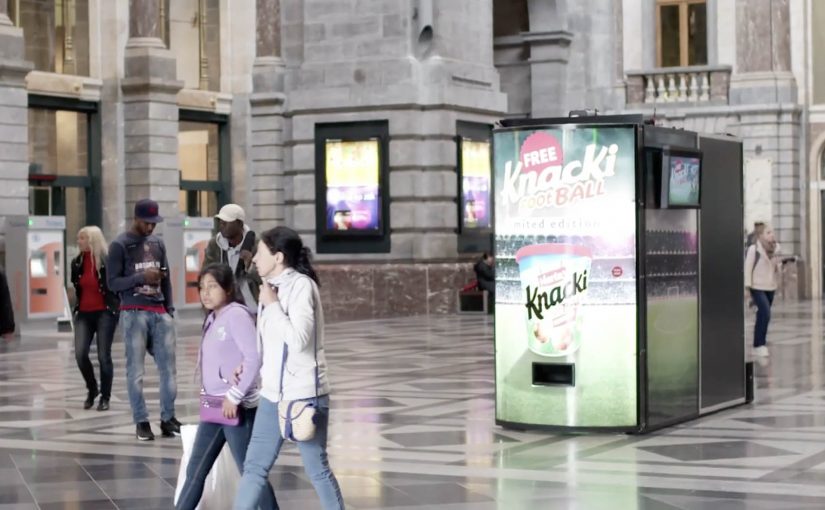
Herta Knacki FootBall: The Football Machine

Herta, described as a Nestlé brand in Belgium, launched Knacki FootBall. Small meatballs designed to look like footballs. Instead of relying on standard sampling, the brand and BBDO Brussels turned a train-station moment into a game people could not ignore.

At Antwerp Central Station, a vending machine offered the product for free. Then came the twist. Press the button and the machine opened into a miniature football pitch, with Belgian football legend Leo Van Der Elst waiting inside. To walk away with the snack, you had to score.

Free is easy. Earning it is memorable.

The mechanic is deliberately unfair in the right way. People approach expecting a quick handout. The reveal forces a choice. Walk away, or step in and play. That decision point creates tension, and tension creates attention. In high-traffic commuter environments, the best sampling ideas turn “free” into a short challenge with a story-worthy payoff. The real question is whether your sampling moment earns attention before it earns a bite.

Extractable takeaway: Sampling gets retold when it includes a moment of risk or effort. The product becomes a trophy, not a giveaway.

A vending machine that behaves like a stadium

The physical design does most of the communication. The moment the door opens, everyone nearby understands what is happening. It becomes a spectator event, which is crucial in a station setting where most people do not want to stop unless something is already happening.

Why the celebrity opponent matters

Leo Van Der Elst is not a generic “host.” He is the difficulty setting. His presence turns the activation into a genuine duel, and that makes the outcome feel earned whether you win or lose. It also gives the content a built-in headline when the story travels online.

What the brand is really reinforcing

Knacki FootBall is a novelty product, so the job is not deep education. It is instant association. Football. Fun. A quick bite. The machine makes those associations physical, then anchors them to a specific place and moment people remember.

How to copy The Football Machine

  • Build a single, obvious action. Press the button. The rest happens to you.
  • Make the reveal legible from 10 meters away. If bystanders cannot decode it fast, you lose the crowd effect.
  • Turn sampling into a challenge. Effort increases perceived value and shareability.
  • Use a real “difficulty signal.” A credible opponent or constraint makes the game feel legitimate.
  • Design the exit. Winning should end with a clear reward and a clean photo moment.

A few fast answers before you act

What is Herta Knacki FootBall “The Football Machine”?

It is a vending machine activation where commuters expecting a free sample discover a miniature football pitch inside, and must score a goal to win Knacki FootBall.

Where did the activation run?

It is described as being installed at Antwerp Central Station in Belgium.

Why use a vending machine for a food launch?

Because it creates a familiar expectation. Then you can subvert it. That contrast generates surprise, crowd attention, and strong word of mouth while still delivering the product sample.

What makes this work in a train station specifically?

Stations are full of people who are time-poor. A reveal that is instantly understandable, plus a short game loop, one attempt that takes seconds, can stop people without requiring explanation.

What is the biggest operational risk with this kind of live activation?

Throughput and safety. If the game takes too long, queues become friction. If the experience feels unsafe or embarrassing, people avoid participation and the crowd effect collapses.
Plan: The Erasable Billboard for Girls’ Education

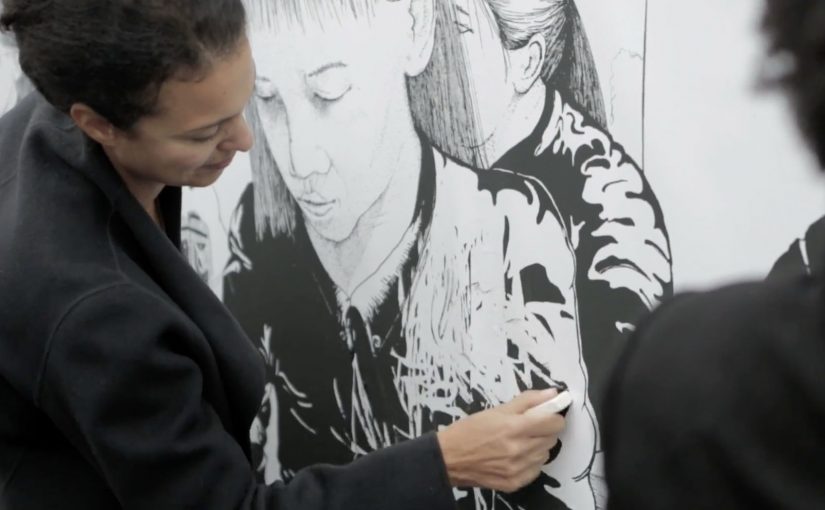
A large illustrated billboard appears in a busy city square. People donate, receive a simple eraser, and start rubbing away the artwork. As the top layer disappears, a second illustration is revealed underneath, shifting the story from girls working to girls going to school.

Plan has reported that tens of millions of girls worldwide are pushed into work instead of education, while in many less privileged countries boys are more likely to get access to schooling. To spark action, Plan and CLM BBDO created an erasable billboard with an illustration designed to be removed to reveal another illustration underneath. The billboard ran in central locations in Paris and Berlin. Passers-by were invited to donate in exchange for an eraser, then use it to change what the billboard showed.

Why the “erasable” mechanic is so strong

The mechanism does two jobs at once. It raises money, and it makes the issue understandable without explanation. The before-and-after is literal. Work disappears. School appears. The donor is not only informed. The donor performs the change. Cause-led campaigns should treat participation as the message, not a bonus layer.

Extractable takeaway: When the donor completes the transformation with their hands, the message becomes a memory and the donation feels consequential.

Definition-tightening: the eraser is not a gimmick. It is the interface, meaning the simple physical tool that gives the donor viewer control over the story. Because the act of erasing creates ownership, it makes someone more likely to donate, talk about it, and remember it.

In social-impact fundraising, participatory outdoor media can turn a small donation into a visible act of change that people feel in their hands.

The real question is whether your donation ask feels like participation or just passive sympathy.

What Plan is really buying

This is a public proof of participation. Instead of asking people to “care” in private, it makes caring visible, social, and shared. Every person who erases becomes a live endorsement that the issue matters enough to stop and act.

Steal this pattern: make giving tactile

  • Make the transformation physical. A tangible before-and-after beats a poster full of statistics.
  • Use the donation as the trigger. The action should only unlock after contribution, not before it.
  • Let participation create the content. The billboard changes because people change it.
  • Design for bystanders. Watching others erase is part of the persuasion.

A few fast answers before you act

What is the “Erasable Billboard” idea?

An illustrated billboard designed to be physically erased. Donors receive an eraser and reveal a second image underneath, shifting the story from girls working to girls going to school.

Why exchange a donation for an eraser?

Because it turns giving into an action. The eraser is a simple reward, but more importantly it is the tool that lets the donor create the transformation themselves.

What makes this more effective than a standard charity billboard?

It is participatory and observable. The public sees the billboard changing in real time, which builds social proof and makes the issue easier to grasp.

What is the main emotional lever?

Viewer control. The donor does not only learn about the problem. The donor performs a symbolic solution in front of others.

What is the biggest execution risk?

If the transformation is not instantly readable, people will not engage. The before-and-after needs to be obvious from a distance and satisfying up close.

ActionAid: Donate Your Profile

ActionAid is an organisation committed to many projects, like fighting hunger and poverty. But in Italy it is known primarily for sponsoring children.

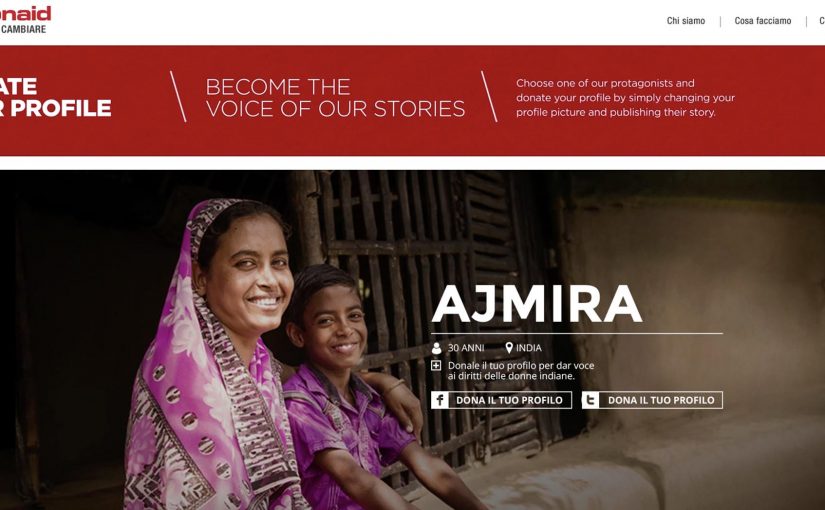
To communicate the broader work of ActionAid with a small media and production budget, DLV BBDO created “Donate Your Profile”. Participants donated their Facebook and Twitter profile pictures so that awareness could be generated for the stories of people ActionAid helped.

How “Donate Your Profile” worked

The mechanism is a simple identity swap. People hand over the most visible square in their social presence. Their profile photo. In return, they display a campaign image tied to a real person’s story, so every comment, like, and share carries that story into everyday social traffic.

Support from Radio 105, Radio Deejay, La Stampa, Marc Marquez and other Italian celebrities and brands helps normalise the behaviour. Once well-known accounts participate, the “donate your picture” action looks safe, easy, and socially endorsed.

In Italian cause marketing, borrowing social identity can outperform paid media when budgets are tight, because it turns personal networks into distribution.

The real question is how to turn a low-budget act of support into something people carry through their normal social behaviour.

Why the profile swap spreads

This works because it converts passive support into a visible, persistent signal. A profile picture is not a post that disappears in a feed. It is a durable badge that travels wherever you show up online, and it prompts questions that naturally lead to explanation and sharing.

Extractable takeaway: If you need earned reach without heavy spend, move the call to action from “share a post” to “change a default”. When people change a default surface, the campaign rides along with their normal behaviour.

The reported impact

The project was described as becoming the 5th most trending topic on Twitter and generating over 79 million media impressions, with more people joining in as the support network grew.

What to borrow from the profile-swap pattern

  • Pick a high-frequency surface. Defaults like profile photos travel more than one-off posts.
  • Make the action reversible. People participate faster when the commitment feels temporary.
  • Seed with credible partners. Media brands and recognisable faces reduce hesitation.
  • Turn participation into a conversation starter. The best mechanics invite questions, not just clicks.

A few fast answers before you act

What is “Donate Your Profile”?

It is a campaign where people replace their Facebook and Twitter profile pictures with a campaign image, so ActionAid stories gain awareness through everyday social interactions.

Why use profile pictures instead of posts?

A profile picture is persistent and high-visibility. It shows up repeatedly across comments and interactions, so the message travels without requiring constant re-posting.

How did the campaign scale beyond early participants?

Reportedly through support from media brands and celebrities, which makes the behaviour feel normal and increases follow-on participation.

What results were reported?

Reported results included reaching the 5th most trending topic on Twitter and generating over 79 million media impressions.

What is the main risk with this pattern?

Trust. If people are unclear about what is being changed, for how long, and what they are authorising, participation drops. The exchange must be transparent and easy to undo.