
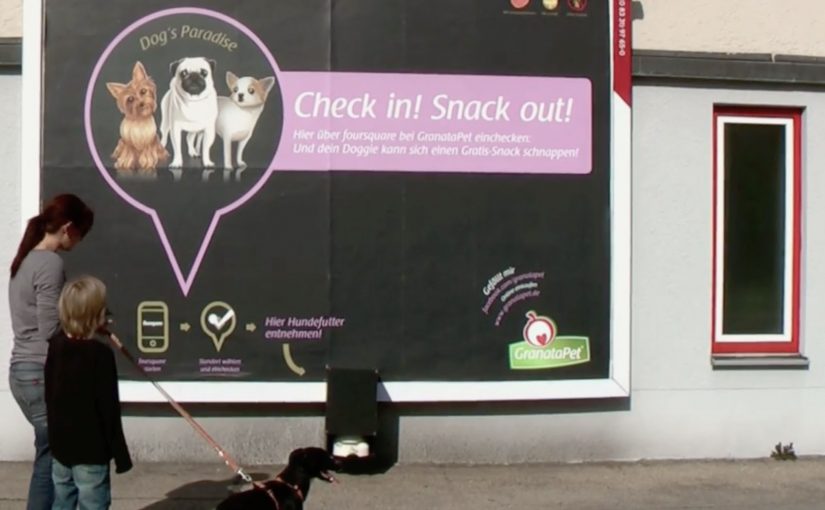
GranataPet: Check In, Snack Out

GranataPet is one of the innovative leaders of high premium pet food in Germany. Their agency, agenta, was given the challenge to create awareness for GranataPet dog food on a slim budget.

The idea targets dog owners at the exact moment they are most open to noticing pet-related messages. While walking their best friend. Socially activated installations are placed on key walking routes. Dogs catch the scent of treats, stop, and pull their owners toward a billboard that simply says “Check in. Snack out”.

A sampling demo that your dog starts for you

This is a classic trial mechanic with a smart trigger. Instead of asking humans to approach a promoter, the dog does the targeting. The owner follows the leash. Then the message becomes self-evident. Check in with Foursquare to activate a free bowl of dog food.

How the mechanism works

The billboard combines three parts. A location check-in prompt, a connected dispenser and bowl, and a social echo via the check-in behavior, meaning each check-in can create additional visibility beyond the street placement itself. When a user checks in at the billboard’s location, the system releases a portion of food into the bowl. The owner watches the dog’s reaction in real time, which functions as the product demo.

In pet food sampling, the highest-converting trial moments are the ones where the animal can deliver an immediate preference signal in front of the owner.

The real question is whether the brand can turn a routine walk into a low-friction proof moment that the owner trusts more than advertising copy. The stronger move here is to let the dog, not the promoter, make the case.

Why it lands

It is easy to trigger, well-timed, and emotionally loaded. The owner does not have to imagine whether the dog will like the food. They see it. That works because a visible reaction from the dog removes guesswork faster than any product claim can. The social layer then turns one local poster into distributed impressions, because check-ins can surface to friends depending on settings. The most important part is that the “proof” is not the copy on the billboard. It is the dog’s behavior.

Extractable takeaway: If your product decision depends on a third party’s preference, build a live demo where that third party delivers the verdict on the spot, and use a simple location trigger to scale it.

What the brand is really buying

This is awareness, trial, and measurable demand in one loop. The execution creates talk value, it generates trackable interactions per location, and it pushes owners toward retail purchase after a positive in-the-moment test. Trade coverage at the time also described increased local demand following the activation.

What pet food marketers can steal from this

  • Target the moment, not the demographic. Dog-walking routes beat broad reach when the category is specific.
  • Let behavior be the headline. A happy dog is more persuasive than any claim line.
  • Make the trigger simple. One action. One reward. No explanation tax.
  • Use the environment as your interface. The billboard is the call-to-action and the proof point.
  • Instrument the activation. Location check-ins can double as measurement, not just distribution.

A few fast answers before you act

What is “Check in, snack out” in one sentence?

An interactive billboard that dispenses free dog food when a nearby owner checks in using a location service.

Why does this outperform a normal sampling stand?

The dog initiates the interaction, and the product proves itself immediately through the dog’s reaction, which reduces hesitation for the owner.

What makes the social layer valuable here?

Check-ins can create secondary reach beyond the physical location, and they can be used to track which placements generate the most interactions.

What is the biggest operational risk?

Reliability. If the dispenser jams or the trigger fails, the experience collapses and the brand takes the blame.

How would you adapt this without Foursquare?

Keep the same structure. A location trigger plus instant physical reward. Use whatever mobile mechanism your audience already uses for quick opt-in and confirmation.
Augmented Reality Calendar by Audi

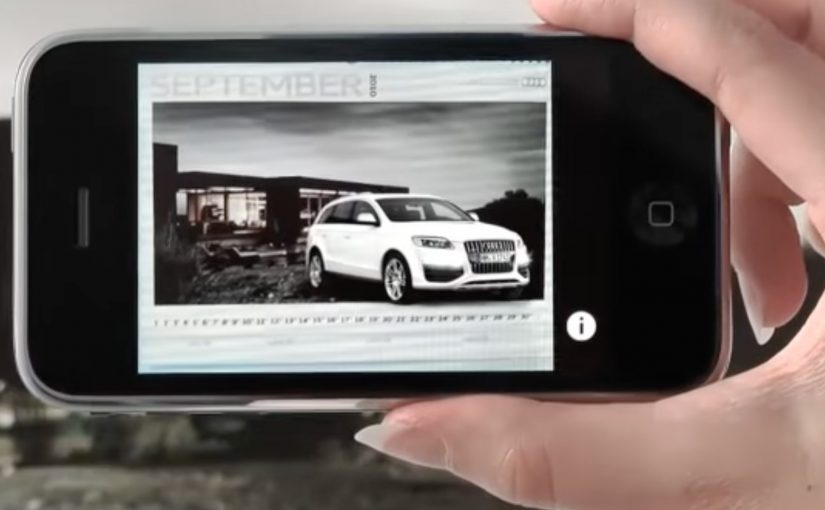
An Audi calendar arrives and it looks almost wrong. Each month is a beautiful landscape, with a deliberate empty space and no car in sight. You open Audi’s iPhone app, point the camera at the page, and the missing piece appears. An Audi A1 fills the blank area in augmented reality, sitting inside the printed scene as if it belongs there. Here, augmented reality means the app renders a 3D car model aligned to the printed page.

The idea. A car calendar without cars

Audi takes a familiar format. The premium calendar. Then it removes the expected hero asset. The car. The calendar becomes an invitation to discover, not a static brand object.

The real question is how to make a physical brand object earn interaction without adding friction.

How it works. Print as trigger, iPhone as lens

  • The printed calendar pages feature landscapes and intentional negative space.
  • People download and open the dedicated Audi iPhone app.
  • They point the phone’s camera at the calendar page.
  • The app overlays a car into the empty area, turning the page into a live scene.

The interaction is simple, but the effect is surprising because it uses a physical artifact as the interface. The calendar is not just content. It is the marker that activates the experience. Because the page is the trigger, the reveal feels like it belongs to the object, not like a separate digital stunt.

In brand marketing, the hardest part of physical brand objects is earning a second interaction without adding friction.

Why this works. A tangible product that earns a second look

This is not augmented reality for the sake of augmented reality. It is a clean integration of print and mobile that rewards curiosity. The calendar builds anticipation with absence, and the app completes the story in the moment you engage.

Extractable takeaway: Design intentional absence in the physical layer, then use mobile to deliver one earned reveal that completes the scene with minimal effort.

Augmented reality earns its keep when it completes a physical moment, not when it competes with it.

This idea is developed by Neue Digitale / Razorfish Berlin and executed for Audi.

What to take from it. Designing the reveal

  • Use restraint to create intrigue. Removing the obvious element can be more powerful than showcasing it.
  • Make the physical object the trigger. When the real-world asset is the interface, the digital layer feels earned.
  • Keep the action obvious. Point camera. See result. Low friction beats complex onboarding.
  • Build around a single wow moment. One crisp reveal is often enough to make the experience memorable.

A few fast answers before you act

What is Audi’s augmented reality calendar?

Audi’s augmented reality calendar is a printed calendar designed to work with a dedicated iPhone app, where pointing the phone camera at a page reveals an Audi car overlaid in augmented reality.

What is the core creative twist?

The creative twist is a car calendar without cars. The car appears only when you view the page through the app.

What role does the calendar page play?

The calendar page acts as the trigger, using the printed layout and empty space as the designed area the AR overlay “completes.”

What makes it effective as a brand experience?

It turns a passive object into an interactive reveal, linking print, mobile, and product desire in one simple action.

What is the transferable pattern for other brands?

Create curiosity in a physical artifact, then use mobile to deliver a single high-impact reveal with minimal friction.

CNN International: Go Beyond Borders

A brand message written into a city’s geography

The strongest initiatives do not ask people to remember. They make history physically reappear in the places where it happened.

The Go Beyond Borders Project was an initiative of Heimat Berlin and CNN International, in conjunction with Berlin tape artist El Bocho, created around the 20th anniversary of the fall of the Berlin Wall.

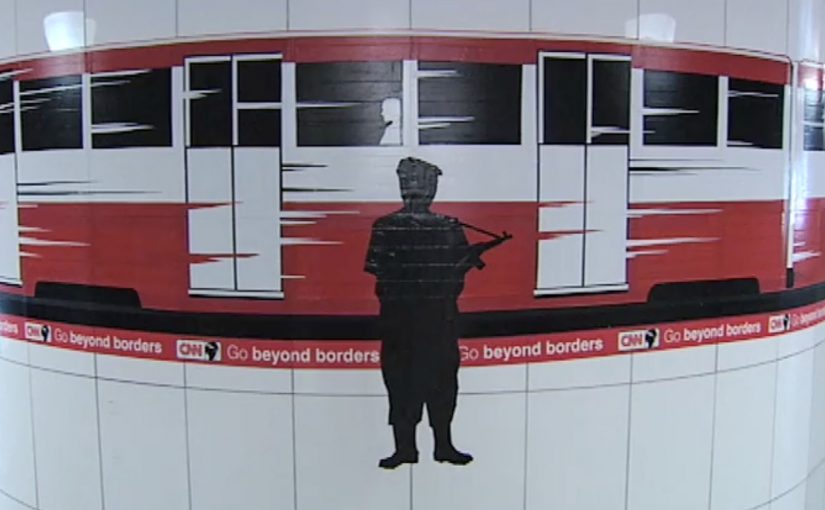
40 km of Go Beyond Borders tape was produced to mark the original position of the Berlin Wall, and eight street art installations told heroic stories of those who conquered the divide between East and West Berlin.

How the project worked as a city-scale marker

The mechanism combined two layers. A city-scale marker is a simple physical rule repeated along a route so the city itself becomes the medium.

First, the tape traced the former Wall line, turning an invisible historical boundary into a visible path you could follow. Second, the street art installations anchored that path with human stories, making the line about people, not only geography.

Because the tape turned an invisible boundary into a route you could walk, it made the former Wall line feel present in everyday movement.

It was simple enough to understand instantly, but large enough to feel unavoidable once you encountered it.

In European cities where collective memory is written into streets and transit, a walkable marker can carry meaning faster than a ceremony can.

The real question is whether your message can be experienced as a physical rule, not merely read as copy.

If the story is spatial, you should build the physical marker first and let media coverage follow.

Why it landed harder than a conventional commemoration

Most anniversaries stay inside ceremonies, speeches, and media coverage. This one put the memory back into the street. The tape created a direct, physical confrontation with “where the divide was.” The art installations made the meaning legible by focusing on courage and crossing, not abstraction.

Extractable takeaway: When meaning depends on place, turn the place into the medium with one walkable marker, then add human stories so the marker carries emotion, not just coordinates.

That shift matters because it turns history into presence, and presence into conversation.

The intent behind “Go Beyond Borders”

The action also marked the launch of CNN’s new international slogan: Go Beyond Borders.

The business intent was to associate the brand with perspective, movement, and crossing divides, using a real-world symbol that already carries emotional weight. Rather than declaring what the slogan means, the initiative demonstrated it through a place-based experience people could encounter and share.

What Go Beyond Borders teaches about place-based branding

A place-based brand initiative uses a physical location or route as the primary medium for the message, not only media.

  • Make the invisible visible. If the story is spatial, mark it in the real world so people can physically encounter it.
  • Pair scale with human narrative. A city-scale gesture earns attention. Stories earn meaning.
  • Use a simple rule. One clear device. Here, tape tracing the line. Makes participation and comprehension effortless.
  • Let the message be demonstrated. If your slogan is about crossing boundaries, show a boundary and what it took to cross it.

A few fast answers before you act

What was the Go Beyond Borders Project?

An initiative by Heimat Berlin and CNN International with artist El Bocho that used tape and street art to mark the former Berlin Wall line and tell stories of crossing East and West Berlin.

What was the core mechanism?

40 km of tape traced the Wall’s original position, while eight street art installations provided narrative anchors and human context.

Why did the tape approach work so well?

Because it turned an abstract memory into a physical, walkable marker that people could encounter in everyday life.

What business goal did this support?

Launching and giving meaning to CNN’s “Go Beyond Borders” slogan by demonstrating it through a culturally significant, real-world experience.

What is the main takeaway?

If you want a message to stick, embed it in a place people can experience, then reinforce it with stories that explain why it matters.