Over the last year or so I have seen numerous brands use the basic website functionalities of Twitter and Pinterest to reach out and engage with their audiences.
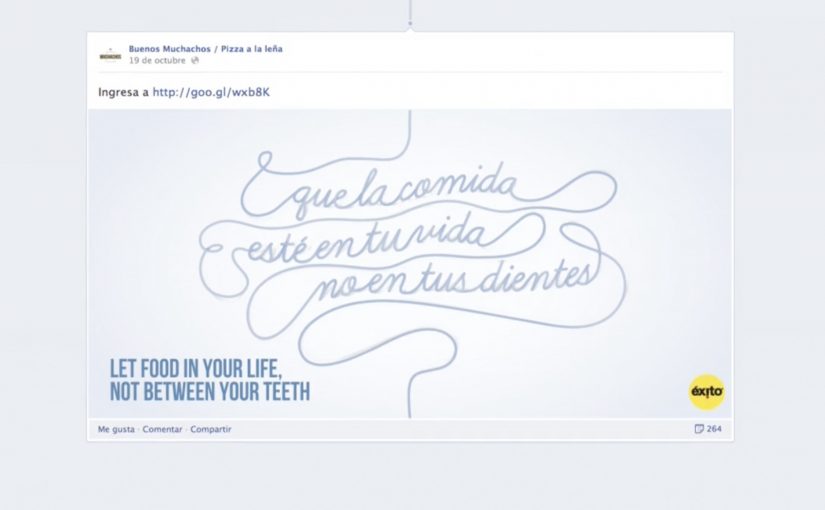
In this example, Sancho BBDO from Colombia creates a “banner” that promotes Exito dental floss by taking advantage of the Facebook Timeline. In the case video below you can see how the banner behaves like dental floss, sliding between pictures of food posted on restaurant fan pages.
The campaign reports that the Exito website received 30% more traffic and that the banner collected more than 200,000 likes across restaurant fan pages.
A banner that borrows the feed’s own grammar
The idea works because it treats the feed as the medium, not as a placement surface. Instead of shouting for attention, the unit inserts itself where the problem actually happens. Between the food and the teeth.
How the mechanism works
The execution uses a Timeline-format ad unit designed to appear between consecutive image posts, creating the visual metaphor of floss moving through a meal-heavy feed. It is still advertising, but it behaves like an interaction with the stream rather than a block sitting next to it. That matters because when the ad uses the stream’s own sequencing, the metaphor reads instantly and needs less explanatory copy.
In social platform marketing, the most durable executions are the ones that act like native feed behavior instead of interrupting it.
Why it lands
It lands because the metaphor is immediate and the placement is earned. If you are scrolling through indulgent food photography, you are already in the mental space where “maybe I should floss” makes sense. The banner does not have to convince you with copy. It just has to show up in the right gap, in the right moment, with a visual that explains itself.
Extractable takeaway: When a platform has a strong, repetitive content pattern, design your unit to exploit the “gap” between posts. The gap is where attention resets, and where metaphors can do more work than claims.
The business intent behind the trick
The real question is not whether a banner can get seen, but whether it can make its relevance obvious in the exact moment people are already primed for it.
This is efficient attention engineering. It makes a low-involvement product feel relevant by tying it to a high-frequency behavior. Scrolling food photos. That linkage is what turns a standard banner into a feed-native reminder you actually notice. Here, feed-native means the ad works inside the platform’s normal flow and spacing instead of fighting it.
What oral-care brands can lift from this
- Start with the platform pattern. Identify what people repeatedly do and what they repeatedly see.
- Build a metaphor that uses placement as part of the idea. Here, “between photos” is the point.
- Keep the unit visually self-explanatory. If it needs instructions, it loses the feed moment.
- Target the most relevant content contexts. Food imagery is the natural trigger for oral care.
- Measure beyond clicks. Engagement and downstream site lift can be the real win for a feed-native format.
A few fast answers before you act
What is “Flossbook” in one sentence?
A Facebook Timeline-format banner that visually acts like dental floss by appearing between food photos in the feed.
Why is the Timeline placement essential to the idea?
Because the meaning is created by the gap. The banner becomes “floss” only when it sits between two posts like something threading through them.
What makes this feel native instead of intrusive?
It uses the feed’s own rhythm and spacing. The unit behaves like a piece of the stream, not an unrelated rectangle alongside it.
What is the biggest risk with “platform mechanic” ideas?
If the platform changes the format, the idea can break overnight. These executions need contingency planning for UI shifts.
How can other brands apply this without copying the metaphor?
Find the repeatable content pattern in your audience’s feed, then design an insertion that only makes sense in that exact pattern and moment.