
Google: Project Re:Brief

Google: Project Re:Brief

In 2011, Google partnered with four global brands in an advertising experiment. Their goal was simple. How can the ideas that defined the advertising industry in its infancy inspire a whole new generation of creatives and marketers?

So Google set out to re-imagine and remake some of the most iconic ad campaigns from the 1960s and 1970s with today’s technology, led by the same creative legends who made these campaigns.

Re-briefing classics with modern tools

The premise is a clean creative constraint. Here, a re-brief means keeping the original strategic promise while rewriting the assignment for today’s interfaces, devices, and distribution. Take an idea that became culturally famous in its original medium, then re-brief it as if you were building it for a digitally connected world. Not by “updating the look”, but by asking what the original strategy would do if it had today’s interfaces, devices, and distribution.

In global brand advertising, revisiting iconic work is a practical way to test which storytelling principles survive a major technology shift.

The four remakes

With that said, here are the results of the best of the old with the best of the new.

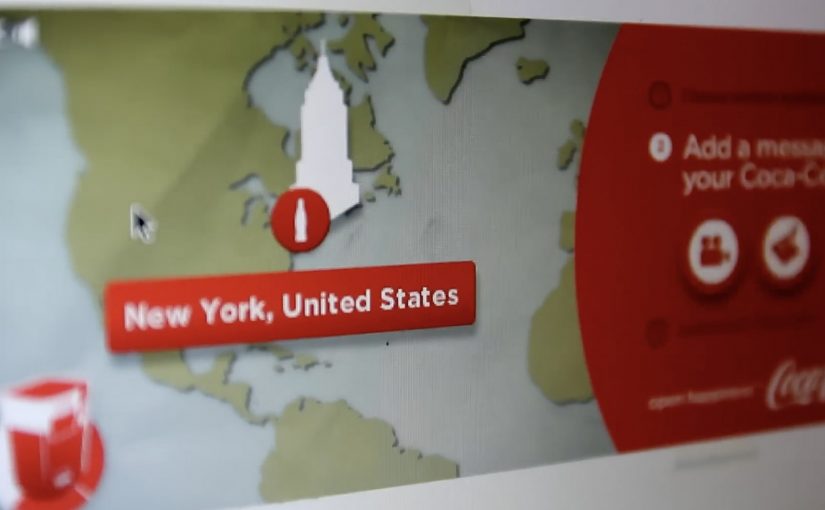
Re-imagining Coca-Cola’s “Hilltop”

Re-imagining Volvo’s “Drive it Like You Hate it”

Re-imagining Alka-Seltzer “I Can’t Believe I Ate That Whole Thing”

Re-imagining Avis “We Try Harder”

Why this format works for marketers

The real question is not whether old campaigns deserve a digital remake, but whether the original strategic idea still produces useful behavior in a connected medium. It forces discipline. You cannot hide behind novelty because the original idea is already known and already strong. That pushes the work to earn its keep through mechanics, not decoration. That works because a proven idea gives the technology a clear job to do, so the audience experiences the promise through behavior rather than explanation. When the core idea is clear, technology becomes an amplifier, not a replacement for strategy.

Extractable takeaway: If you want to explore new tech without producing gimmicks, start with an idea that already proved its emotional truth, then design one modern interaction that makes that truth more immediate.

How to borrow the approach without copying it

  • Pick one timeless promise. Strip it down until it fits in a single sentence.
  • Define one modern behavior. Sharing, scanning, tapping, responding, connecting. Build around one.
  • Make the mechanic do the explaining. The best remakes do not need a voiceover to justify the tech.
  • Keep a clear before and after. What stays from the original idea, and what changes because of the medium.

A few fast answers before you act

What is Project Re:Brief?

A Google-led experiment that re-imagines classic campaigns from the 1960s and 1970s using modern technology, guided by the original creative legends behind those ads.

Why remake old ads instead of creating new ones?

Because the originals provide a proven strategic baseline. You can see whether technology strengthens the core idea, or distracts from it.

What does “re-brief” actually mean in practice?

It means taking the original strategy and re-writing the assignment for a new media reality, then building a modern mechanic that expresses the same core promise.

What should a team learn from this kind of exercise?

That strong ideas travel across formats, and that the role of technology is to make the benefit more immediate, more personal, or more connected, not merely more complex.

How do you judge whether a modern remake is successful?

Look for clarity of the core idea, the usefulness of the interaction, and whether the mechanic creates behavior people would repeat or share, not just view.
Share a Coke

Share a Coke

Despite healthy brand tracking data, 50% of the teens and young adults in Australia hadn’t enjoyed ‘Coke’ in the previous month alone. Here, “brand tracking” refers to awareness and preference metrics that can look healthy even when recent consumption is slipping.

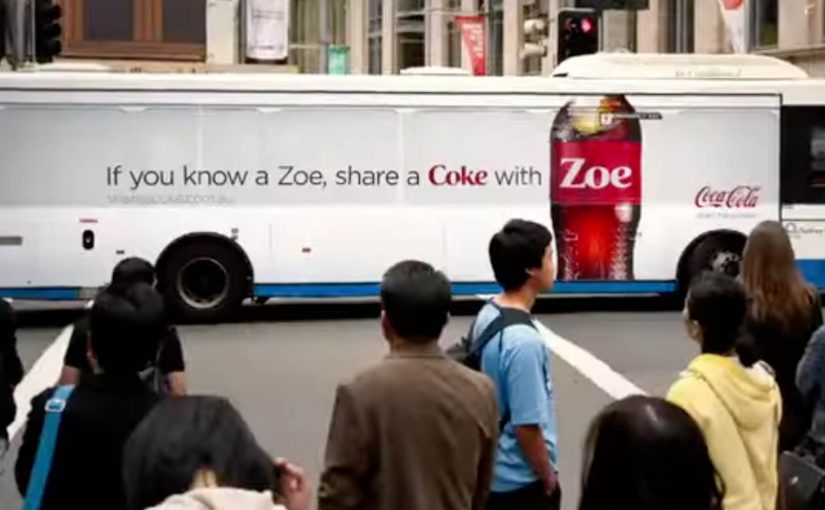
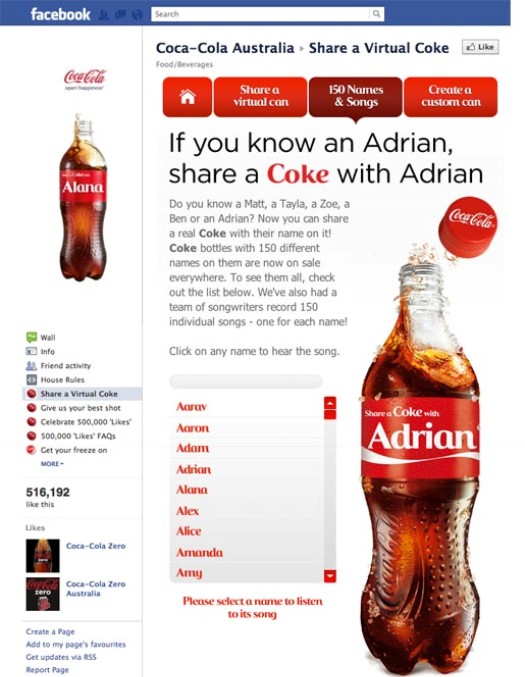
After 125 years of putting the same name on every bottle of ‘Coke’, they decided to do the unthinkable. They printed 150 of the most popular Australian first names on their bottles and then invited all Australians to ‘Share a Coke’ with one another.

Facebook image showing Coca-Cola promoting the Share a Coke campaign.

The result…

Packaging becomes the conversation

What stands out here is the simplicity. A bottle stops being just a product and becomes a prompt. A name makes it personal. Personal makes it talkable. Talkable makes it shareable.

Because the name turns the pack into a prompt, it triggers talk and sharing without requiring people to learn a new action.

In consumer brands with mass distribution and fragmented media, the pack is one of the most consistent touchpoints, so a pack-level prompt can carry an integrated campaign.

In a world where brands are fighting for attention across channels, this is a reminder that the pack itself can be the media, if it gives people a reason to participate.

Why it works (and why it is more than a label change)

It works because it makes personal relevance visible at the exact moment of choice, and that relevance is what people naturally want to point out and pass along.

Extractable takeaway: If you can make the product itself the trigger for a social action, you reduce friction and get sharing that feels like a natural behaviour, not a forced message.

  • It lowers the barrier to engagement. You don’t need a new behaviour. You just need to spot your name, or someone else’s.
  • It turns purchase into a social act. The “share” is built into the product, not bolted on as a message.
  • It scales personal relevance. The idea is big, but the execution is local. It lives in the names people recognise.
  • It links offline and online naturally. When something feels personal in-store, people are more likely to talk about it beyond the store.

The real question is whether your product can create a social reason to talk at the moment of choice, instead of asking media to do all the persuasion.

When you can bake the “share” into the product experience, packaging-led participation is a more reliable lever than a channel-first campaign plan.

What to take from this for integrated campaigns

  1. Start with a human trigger. A real reason for someone to say: “This is for me”, or “This is for you”.
  2. Make the product do the work. If the core idea is physically present, the campaign holds together across channels.
  3. Design for sharing as a behaviour. Not as a slogan. The easiest shares are the ones that feel natural and immediate.
  4. Keep it legible in one glance. The best integrated ideas can be understood instantly, without explanation.

A few fast answers before you act

What is the “Share a Coke” idea?

It is a packaging-led campaign where Coca-Cola printed popular first names on bottles, then invited people to “Share a Coke” with someone else.

What problem was Coca-Cola trying to solve in Australia?

Despite healthy brand tracking data, 50% of teens and young adults in Australia hadn’t enjoyed ‘Coke’ in the previous month, so the brand aimed to reignite consumption and relevance through conversation.

Why is printing names on bottles strategically interesting?

It makes the product feel personally relevant at the moment of choice. That personal relevance can trigger attention, talk, and sharing without needing complex mechanics.

Is this a “digital campaign” or a “packaging campaign”?

It is both, but it starts with the pack. The packaging is the trigger that can naturally extend into social sharing and broader integrated storytelling.

What is the transferable lesson for other brands?

If you can embed participation into the product experience itself, you reduce friction and increase the odds that people will carry your message across channels for you.

Coca-Cola: The Future Room Exhibition

Coca-Cola: The Future Room Exhibition

A museum-scale brand moment for a milestone anniversary

In brand experience work, the strongest anniversary executions do not look like commemorations. They look like a reason to step inside the brand world. Coca-Cola’s “Future Room” is a clean example of that approach.

For Coca-Cola’s 125th Anniversary, Istanbul’s creative agency Antilop created a “Future Room” concept, made specifically for the Turkish modern-art museum Santralistanbul. They transformed a section of the gallery into an impressive 90 square meter, 270-degree projection mapping installation.

How the Future Room worked as an immersive installation

The mechanism was spatial immersion. Here, that means using the room itself as the storytelling surface, so viewers are surrounded rather than watching a single screen.

That choice changed the viewing behavior. People did not just watch a piece of content. They entered it, and the room itself became the interface.

In global consumer brands, milestone experiences land best when the venue and the format give people a reason to physically show up.

Why it landed in a modern-art setting

In a museum context, attention is earned through presence, scale, and craft. Projection mapping fits because it turns a physical space into a living canvas.

Extractable takeaway: In cultural venues, design the environment first, then let the brand meaning ride on the craft people can feel in the room.

By committing 90 square meters of gallery to one experience, the work signaled seriousness. It also made the activation feel like an exhibit, not an ad, which is exactly the psychological shift a heritage brand wants during an anniversary moment.

The business intent behind the exhibition format

The intent was to elevate the partnership between brand and venue, and to position Coca-Cola as culturally fluent rather than purely commercial.

The real question is how you make a milestone feel current without turning it into a retrospective.

An anniversary is a credibility play, meaning a chance to reaffirm relevance in the present. The exhibition format helped translate “125 years” into something contemporary, sensory, and shareable, without relying on nostalgia alone.

Design cues for your next immersive brand experience

  • Choose a format that matches the venue. In cultural spaces, experience and craft beat messaging density.
  • Use scale as a signal. Large physical commitment communicates importance before anyone reads a word.
  • Turn the room into the medium. Immersion works when the environment does the storytelling, not just the screen.
  • Make milestones feel current. Anniversary work lands when it shows relevance, not only history.

A few fast answers before you act

What was Coca-Cola’s “Future Room”?

An immersive, exhibition-style installation that used large-scale projection mapping to wrap visitors in a future-facing brand environment.

Where did it appear?

It was created for Santralistanbul, a Turkish modern-art museum in Istanbul, as part of Coca-Cola’s 125th anniversary moment.

What was the mechanism?

The room became the medium. A wraparound projection space made the environment itself the interface.

Why does this work in a museum context?

Museums reward presence, scale, and craft. An immersive installation can read as an exhibit, not an ad, which changes how people grant attention.

Why is this effective for anniversaries?

It makes the milestone feel current. It gives people a reason to attend now, not just a reason to remember then.

What should experience teams copy from it?

Match the format to the venue, commit physically to signal seriousness, and design for movement and dwell time instead of messaging density.