

AI in Hollywood: Threat or Storytelling Upgrade?

AI is now part of everyday filmmaking. Some people see opportunity. Others see threat.

So, will AI destroy Hollywood and the film industry. Or will it change how we tell stories, who gets to tell them, and what “craft” even means.

AI is already in how films get made. Whether we admit it or not

The debate often sounds theoretical. Meanwhile, AI is already doing real work in how films get made. From early ideas to post-production: scripting support, concept design, scoring, editing assistance, voice work, and performance modification.

That matters for one simple reason. The question is no longer “Will AI arrive?”. The question is “What kind of AI use becomes normal, and under what rules?”.

If you look closely, the industry is already making that choice in small, easy-to-miss steps. The tools are frequently packaged as “features” inside software people already trust. Auto-transcription. Auto reframing for different screen formats. Tools that automatically cut out subjects from backgrounds. Tools that track motion in a shot. Noise reduction. Dialogue cleanup. Autotagging clips by faces or scenes. Call it machine learning, call it AI. The practical outcome is the same. Decisions that used to require time, specialists, or budget are getting compressed into buttons.

Because these features ship as defaults inside tools people already use, adoption becomes invisible, and “normal” shifts one button at a time.

The real question is how AI gets used, and what standards come with it.

In Hollywood production and modern brand storytelling teams, AI shifts the cost curve of production while raising the premium on taste, direction, and rights management.

AI is a tool. What matters is how you use it

There’s a repeating pattern in creative industries.

Extractable takeaway: When a tool compresses cost and time, the differentiator moves upstream to taste, direction, and the rules around what you are allowed to use.

A new tool arrives. People fear it will dilute artistry, eliminate jobs, and flood the market with mediocrity. Some jobs do change. Some workflows do get automated. Then the craft adapts, and the best creators use the tool to raise the ceiling, not lower the bar.

Sound did not kill cinema. Digital did not kill cinematography. Non-linear editing did not kill storytelling. CGI did not kill practical effects. What changed was access, speed, and the competitive baseline.

The sober takeaway is this. AI at its core is a tool. Like any tool, it amplifies intent. Without taste, it accelerates slop, meaning output that is fast but unconsidered. With taste, it accelerates iteration.

AI is leveling the playing field for filmmakers and creators

Here’s where the conversation gets practical.

AI lowers the cost of getting from idea to “something you can show.” It helps smaller teams and individual creators move faster. It also lets bigger studios compress timelines.

That’s the real shift. Capability is becoming less tied to budget, and more tied to taste, direction, and how well you use the tool.

Does AI help you be creative, or does it replace you?

Used well, AI helps you unlock options and enhance what you already made. It is not about creating a film from scratch. You still have to create. You still have to shoot. You still have to film. The difference is access. AI puts capabilities that used to require six-figure VFX budgets within reach, so more of your ideas can make it to the screen.

The line that matters is this: enhancement, not replacement.

The dark side. When “faster and cheaper” wins

The risk is not that AI exists. The risk is that business pressure pushes studios to use it as a shortcut.

When “cheap and fast” replaces craft, the damage shows up quickly: fewer human jobs, weaker trust, and more content that feels engineered instead of made. This is where AI stops being a creative tool and becomes a replacement strategy.

The pragmatic answer. It’s not AI or artists. It’s AI and artists

The realistic future is hybrid.

The best work will blend the organic and the digital. It will use AI to strengthen a filmmaker’s vision, not replace it. CGI can strengthen practical effects, and editing software can assemble footage but not invent the story. Similarly, AI can support creation without owning authorship.

So the goal is not “pick a side.” The goal is to learn how to use the machine without losing the magic. Also to make sure the tech does not drown out the heart.

AI is here to stay. Your voice still matters

AI is not going away. Ignoring it will not make it disappear. Using it without understanding it is just as dangerous.

The creators who win are the ones who learn what it can do, what it cannot do, and where it belongs in the craft.

Because the thing that still differentiates film is not gear and not budget. It is being human.

AI can generate a scene. It cannot know why a moment hurts. It can imitate a joke. It cannot understand why you laughed. It can approximate a performance. It cannot live a life.

That’s why your voice still matters. Your perspective matters. Your humanity is the point.

What to change in your next AI-assisted cut

  • Set the “allowed use” rules first. Decide what inputs are permitted, what must be licensed, and what needs explicit consent.
  • Use AI to expand options, not to dodge choices. Faster iteration is only useful if a human still owns direction and taste.
  • Protect trust as a production requirement. If viewers or talent feel tricked, the work loses leverage no matter how efficient it was to make.
  • Design for credit and accountability. Make it clear who is responsible for decisions, even when parts of the pipeline are automated.

A few fast answers before you act

Will AI destroy Hollywood?

It is more likely to change how work is produced and distributed than to “destroy” storytelling. The biggest shifts tend to be in speed, cost, and versioning, meaning producing multiple tailored cuts quickly. The hardest parts still sit in direction, taste, performance, and trust.

Where is AI already being used in film and TV workflows?

Common uses include ideation support, previs, VFX assistance, localization, trailer and promo variations, and increasingly automated tooling around editing and asset management. The impact is less “one big replacement” and more many smaller accelerations across the pipeline.

What is the real risk for creators?

The risk is not only job displacement. It is also the erosion of creative leverage if rights, compensation models, and crediting norms lag behind capability. Governance, contracts, and provenance, meaning where assets came from and what rights attach to them, become part of the creative stack.

What still differentiates great work if everyone has the same tools?

Clear point of view, human insight, strong craft choices, and the ability to direct a team. Tools compress execution time. They do not automatically create meaning.

What should studios, brands, and agencies do now?

Set explicit rules for data, rights, and provenance. Build repeatable workflows that protect brand and talent. Invest in directing capability and taste. Treat AI as production infrastructure, not as a substitute for creative leadership.
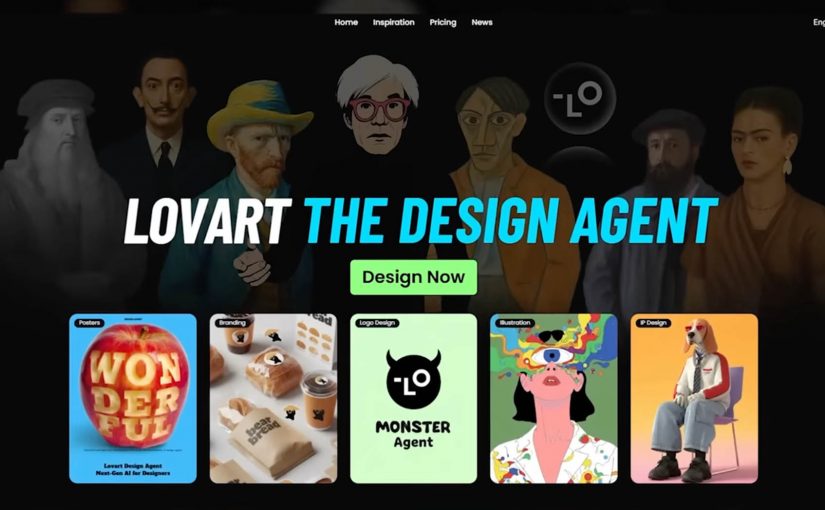
Lovart AI: Photoshop, Now as Simple as Paint

The Lovart AI ‘designer for everyone’ moment just got real

For decades, creative software demanded expertise. Layers. Masks. Rendering. Color theory. Not because it was fun, but because the tools were built for specialists.

Lovart frames a different future. Instead of learning the tool, you describe the outcome, and an AI design agent orchestrates the work across assets and formats.

What Lovart is really selling. Creative output as an agent workflow

The shift is not “design got easier”. The shift is that the workflow collapses into intent. You type what you are trying to achieve, and the system produces a coordinated set of outputs.

In the positioning and demos around Lovart, the promise is that you can move from a prompt to a usable bundle of creative. Brand identity elements. Campaign assets. Even video outputs. Without tutorials, plugins, or the classic “maybe I will learn Photoshop someday” hurdle.

By “agentic design tools,” I mean systems that plan and execute multi-step creative work across assets and formats, not just generate a single output.

In enterprise brand teams, the main unlock from agentic design tools is faster option generation while governance and taste still decide what ships.

Why Photoshop starts to feel like Microsoft Paint

This is not a diss on Photoshop. It is a reframing of value.

When an agent can produce a coherent set of assets quickly, the advantage shifts away from operating complex software and toward higher-order thinking:

  • What is the offer.
  • What is the story.
  • What is the differentiation.
  • What should the system optimize for. Consistency, conversion, memorability, or speed.

If everyone can generate assets, the edge belongs to people who can direct the system with clarity and taste, not just execute.

The real constraint moves upstream. Taste, strategy, and governance

The future hinted at here is not “more content”. It is content creation that behaves like a pipeline, which raises two practical questions that matter more than the wow factor:

Extractable takeaway: When production gets cheap, the advantage shifts to upstream constraints. A shared definition of “good”, plus guardrails and review rhythms, beats faster output alone.

  1. How do you keep quality high when output becomes abundant.
  2. How do you keep brand coherence when anyone can spin up campaigns in minutes.

The real question is whether you can define “good” once and enforce it consistently when output becomes abundant.

Brand teams should treat agentic design as a governance problem first, not a production shortcut.

This is where the craft does not disappear. It relocates. From hands-on production to creative direction, guardrails, and decision-making.

Directing agentic design without losing the brand

Lovart is a signal that creative tooling is becoming agentic. The barrier is no longer the interface. The barrier is how well you can articulate what “good” looks like, and how consistently you can repeat it across channels.

  • Write the brief like a spec. Describe the offer, the audience, the constraints, and what “good” looks like before you generate.
  • Decide the guardrails up front. Clarify what must stay consistent across assets, and what can vary for speed and experimentation.
  • Keep humans as the decision layer. Use the agent for options and iteration, then apply taste and governance to choose what ships.

The future is not coming. It is already here. Are you ready?


A few fast answers before you act

What is Lovart in one sentence?

Lovart is a design-oriented agent experience that turns a brief into a guided workflow. It plans, generates, and iterates across assets, rather than handing you a blank canvas.

How is this different from using Photoshop plus AI tools?

The difference is orchestration. Instead of switching between tools and prompts, the workflow becomes “brief to deliverables” with the system managing steps, versions, and outputs.

Does this replace designers?

It can replace some production tasks and speed up concepting. It does not replace taste, direction, brand judgment, and the ability to decide what is worth making.

What should brand teams watch closely?

Brand safety, rights and provenance, and consistency. Faster creation increases the need for clear guardrails, review, and a shared definition of “good.”

What is the simplest way to test value?

Pick one repeatable asset type, run the same brief through the workflow, and compare speed, quality, and revision cycles against your current process.

LEGO France: Creativity Forgives Everything

A child gets caught mid-creation. The scene looks like trouble at first glance, then the line flips the judgement: “We forgive everything to their creativity”. LEGO has recently launched this campaign in France around that exact tension between mess and imagination.

Click here to watch the video on AdsSpot website.

Turning “naughty” into proof of imagination

The core mechanism is a simple reframe. Instead of defending play as “educational”, the work leans into the moments parents normally correct. The child’s act is still a transgression, but it is also a creative act. The signature gives parents permission to smile first, and judge later.

In brand advertising for physical toys competing with screens, the fastest way to win attention is to make imagination look like something happening right now in the room.

Why the line sticks

“Creativity forgives everything” works because it treats creativity as a social contract, not a product feature. Here, “social contract” means an unspoken trade-off: parents tolerate the mess because it signals imagination at work. Parents recognise the micro-drama instantly. You want boundaries, but you also want your child to be bold, curious, and inventive. The campaign positions LEGO as the tool that triggers that boldness, even when it comes with collateral damage.

Extractable takeaway: If your category is crowded with functional claims, choose a human tension your audience already lives with. Then write a line that resolves the tension emotionally, and let the product become the enabler of that resolution.

What LEGO is protecting

This is brand defence disguised as humour. The real question is how LEGO stays culturally distinctive when screens can deliver endless entertainment without leaving any real-world evidence. It keeps LEGO out of a specs battle and away from “learning toy” cliches. By celebrating the messy edge of creativity, the brand claims a territory that is hard for digital entertainment to steal. Real-world play that leaves evidence.

What brands can borrow from LEGO here

  • Use a permission-giving signature. A great brand line does not just describe. It authorises a feeling or behaviour.
  • Stage recognisable “caught in the act” moments. When the scenario is instantly familiar, the audience supplies the backstory for you.
  • Make the brand the ally. The work does not lecture parents. It makes them complicit, which is more persuasive.
  • Let the theme travel across formats. This idea naturally fits film, print, and outdoor because the tension can be captured in a single moment.

A few fast answers before you act

What is LEGO’s “Creativity forgives everything” campaign?

It is a LEGO France brand campaign built around the idea that adults can forgive children’s small “misbehaviours” when they are clearly driven by creativity and imaginative play.

What is the core idea in one sentence?

Reframe mischief as imagination, then position the product as the trigger for that imagination.

Why does this positioning work for LEGO specifically?

Because LEGO is a physical system for building anything. The campaign connects that open-endedness to real, observable behaviour rather than abstract “learning” benefits.

How do you adapt this approach to another category?

Identify a daily tension your audience recognises, write a line that gives emotional permission, then demonstrate the product as the enabling tool inside that tension.

What should you avoid when copying the pattern?

Avoid moralising. The power comes from empathy and recognition, not from telling the audience how they should behave.