
Apotek Hjärtat: Blowing in the Wind

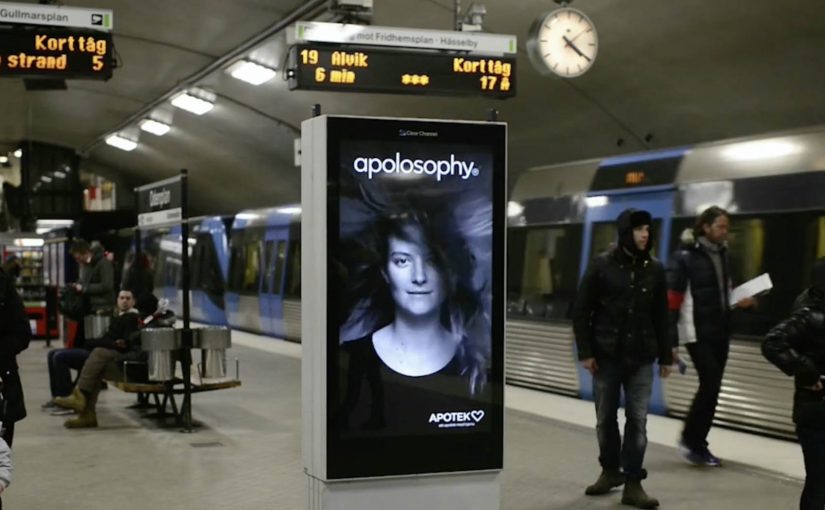
A subway platform in Stockholm. A digital screen. A model with a lush mane. Then the train arrives and her hair starts to whip around, perfectly timed to the rush of air you can feel on the platform.

To introduce a new line of hair products, Swedish pharmacy Apotek Hjärtat worked with Åkestam Holst to fit the platform screens with ultrasonic sensors. When those sensors detect an incoming train, the film switches into a “blowing in the wind” sequence, creating the illusion that the turbulence from the train is affecting the model on the screen.

The trick behind the timing

This is reactive outdoor done with restraint. Here, reactive outdoor means the screen responds to a real environmental trigger instead of running the same sequence on a fixed loop. There is no complex interface and no extra instruction for commuters. The environment provides the trigger, the sensor provides the cue, and the creative provides the payoff. The moment is over in seconds, which is exactly how long you get on a platform before attention snaps back to schedules and crowds.

In high-traffic transit environments where attention is scarce, reactive outdoor works best when it synchronizes with a real-world moment everyone already notices.

Why commuters stop

The effect feels “impossible” because it is contextual and precise. People experience the wind and see the wind at the same time. That sensory alignment is what makes it memorable, and it makes the product claim feel physical instead of cosmetic.

Extractable takeaway: If you want outdoor to earn attention, link the creative to a shared environmental trigger, and make the response immediate enough that viewers can connect cause and effect without being told.

What the brand is signaling

The story is not really about sensors. It is about vitality. The real question is whether the public moment makes the product promise feel physically true before the commuter moves on. The ad implies the product brings hair to life, then proves that idea through a living, timed reaction in a public space. You remember the feeling first, then the brand name attached to it.

What to steal for reactive outdoor

  • Pick a trigger that already exists. Trains arriving, doors opening, crowds gathering.
  • Make the payoff instantly legible. One glance should be enough to get it.
  • Use craft to hide the tech. The illusion matters more than the explanation.
  • Design for repeat viewing. Platforms are perfect for loops, because people wait.

A few fast answers before you act

What is “Blowing in the Wind”?

A reactive DOOH installation for Apotek Hjärtat where ultrasonic sensors detect an approaching subway train and trigger a film effect that makes the model’s hair appear to blow in the train’s turbulence.

What is the core mechanism?

Sensor detects train arrival. Creative switches at the same moment the real airflow hits the platform. The viewer experiences both together, which sells the illusion.

Why does it feel more persuasive than a normal screen ad?

Because it is synchronized with the physical environment. That alignment makes the message feel like something happening, not something being played at you.

What is the most common mistake when copying this pattern?

Overbuilding the interaction. If viewers need instructions, or if the trigger is unreliable, the magic disappears and the screen becomes just another screen.

Why does the product claim feel more real than in a standard beauty ad?

Because the demonstration is tied to a real physical cue on the platform. That makes the benefit feel observed in the moment, not merely claimed in the creative.
MINI: Salutes You in London

In August I wrote about how Coca-Cola Israel used technology to personalise billboards for people who drove by.

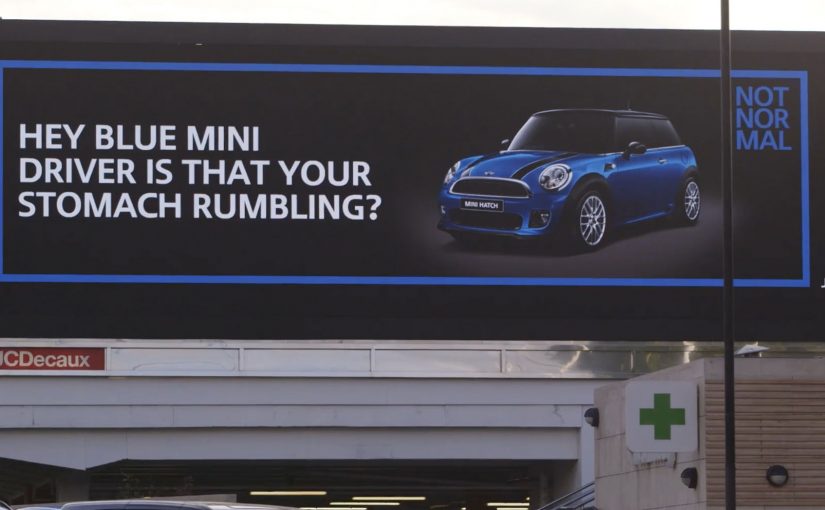
Now, as part of its ongoing Not Normal campaign, MINI decides to give MINI drivers in London a custom message by taking over a run of giant billboards along a fast-paced road for a two-week period. “Not Normal” is the positioning line for celebrating owners over product claims.

Reportedly, the campaign reached out to 1,941 MINI drivers in London during the run.

How the billboards “recognise” drivers

The mechanism is deliberately human. Spotters use iPads to identify approaching MINIs and trigger the right creative. Each message is sent with pictures of the make and model of the MINI it relates to, so the driver sees something that feels directed, not generic.

In urban out-of-home advertising, combining live triggers with personalised creative can make a brand message feel like a service moment, not just media.

A human-triggered approach is the right call on a fast road, because it keeps the moment specific without pretending you have perfect recognition tech.

Why this lands on a road, not in a feed

Most personalised media is private and one-to-one. This flips it into a public setting. The driver gets a direct salute, and everyone else sees a brand that appears to be paying attention to its community in real time. That publicness is the multiplier, because it turns a personal moment into shared talk value, meaning people retell it.

Extractable takeaway: Public personalisation works when the proof cue is instantly legible to bystanders, not just meaningful to the target.

What the campaign is really doing for MINI

The work reinforces the Not Normal positioning by celebrating owners rather than pushing product claims. It also turns “existing drivers” into the hero audience, which is a neat way to build loyalty and social proof at the same time.

The real question is whether the salute feels like a genuine community nod, not a clever stunt.

Transferable moves from MINI Salutes You

  • Use a simple trigger and a clear payoff. Recognition plus a tailored line is enough if the timing is perfect.
  • Keep it brand-native. A salute fits a community brand. A hard sell would break the spell.
  • Make personalisation visibly specific. Showing the make and model is the proof cue that prevents it feeling random.
  • Design for safety and readability. Short messages, high contrast, instant comprehension.

A few fast answers before you act

What is “MINI Salutes You” in one line?

A digital out-of-home activation that displays personalised messages to MINI drivers as they pass selected London billboards.

How are the personalised messages triggered?

Human spotters using iPads identify approaching MINIs and trigger the relevant creative, including make and model visuals.

Why use billboards for personalisation?

Because it makes recognition public. The driver feels noticed, and bystanders see a brand visibly celebrating its community.

What do you need to make this work without advanced tech?

A small set of tightly written messages, clear proof cues (like make and model), and a reliable human trigger that can fire the right creative at the right moment.

What is the main transferable lesson?

If you can time a simple personalised moment perfectly, you do not need complex tech to create a campaign people retell.

McDonald’s Free WiFi: Turning SSIDs into Ads

In Spain, McDonald’s offers free WiFi to all its customers. Since the WiFi signal reaches quite far, customers in surrounding restaurants also tend to use the McDonald’s network.

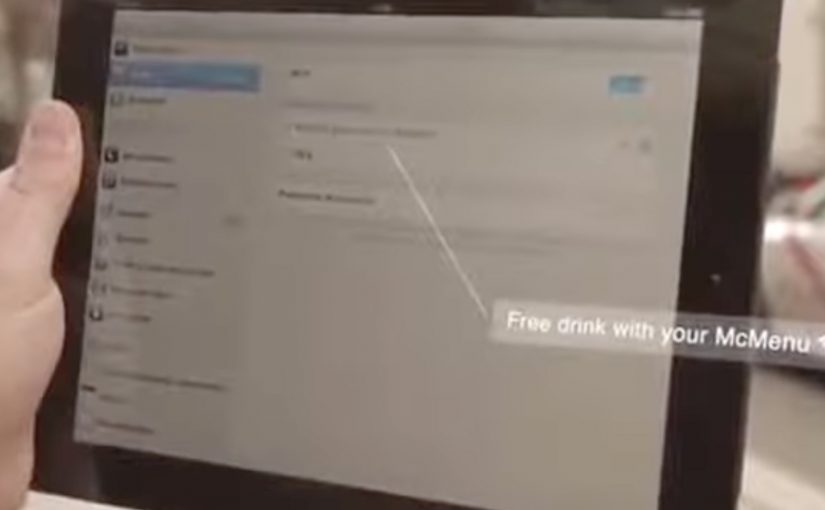
So McDonald’s decided to attract new customers via their own WiFi network. They simply changed the signal’s name into a message and embedded a promotion into it.

The simplest media channel you already own

This is a tiny idea with a very clear mechanism. A WiFi network name is a broadcast surface. That name is the SSID, the label devices show in the network list. It shows up exactly when people are deciding where to sit, what to order, or whether to move.

Instead of treating WiFi as utility, McDonald’s treated it as a micro-channel for demand capture.

Why the WiFi name works as advertising

In high-footfall retail settings where people scan for quick utility, the WiFi list becomes a decision interface and the SSID becomes a tiny billboard in that interface.

Extractable takeaway: When people already scan a utility list, naming inside that list can outperform bigger media because it meets intent at the moment of choice.

  • High intent moment. People looking for WiFi are already in “connect me now” mode.
  • Local reach. The signal spills into nearby venues, where potential switchers sit.
  • Zero-click visibility. You see the message before you even connect.
  • Low cost, repeatable. Updating an SSID is simple, fast, and scalable.

Where this crosses from clever to strategic

The real question is whether you treat owned infrastructure as a distribution channel, or just as a cost line.

The strategic move is not the pun. It is the use of owned infrastructure as a distribution channel. When your message sits inside a system people actively scan for, you reduce friction and increase the odds of action.

This is worth doing wherever you run guest WiFi and can keep the message instantly understandable.

It is also a reminder that not all “digital” has to be an app. Sometimes it is just naming.

What to take from this if you run retail or CX

  1. Audit your hidden touchpoints. SSIDs, receipts, kiosks, queue screens, packaging, all are media surfaces.
  2. Message at the decision point. Proximity channels work best when they align with immediate behavior.
  3. Keep the offer instantly understandable. People scan lists quickly. Clarity beats cleverness.
  4. Test and rotate. Like any channel, vary the message to learn what actually moves footfall.

A few fast answers before you act

What did McDonald’s do with its free WiFi in Spain?

It changed the WiFi network name into a message and embedded a promotional offer into the SSID to attract people nearby who could see the network on their devices.

Why does the WiFi signal matter here?

Because it reaches beyond the restaurant itself, meaning people in surrounding venues can still see and use the network, making it a local acquisition channel.

What is an SSID in this context?

It is the WiFi network name that appears in a device’s list of available networks. Changing it changes what people see before connecting.

Is this a “growth hack” or a real marketing tactic?

It is both. It is a lightweight tactic, but it is grounded in a real channel. Owned infrastructure that reaches potential customers at a high-intent moment.

What is the transferable lesson for brands?

Look for owned, ambient digital surfaces where people already scan for utility, then place a clear message there that can drive immediate action.